
Today, we’re joined by Anand Naidu, a leading development expert who has spent his career navigating the complex worlds of both frontend and backend systems. We’ll be delving into the seismic shifts occurring in software development, spurred by Dario Amodei’s recent revelation that engineers at his company are transitioning from code writers to code editors. We will explore what this new workflow actually looks like, the skills required to thrive in this new paradigm, and the profound cultural and business impacts of AI becoming the primary author of our digital world.
Dario Amodei stated that some of his employees no longer write code, but only edit it. Could you walk me through this new workflow? Please describe the step-by-step process an engineer follows from a project’s concept to its final, deployed version.
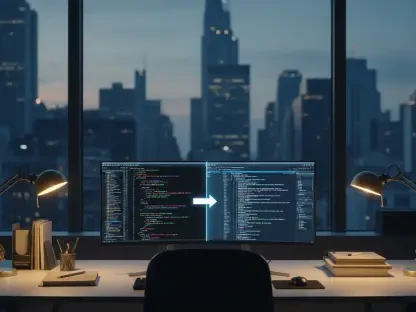
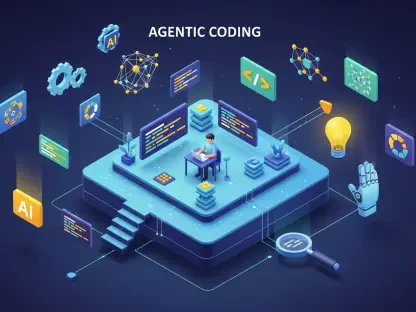
It’s a fascinating and fundamental shift in the creative process. Instead of an engineer opening a blank editor and staring at a blinking cursor, the process now begins with a conversation. The engineer, acting as an architect, outlines the problem or the feature to an AI model like Claude. The AI then generates the entire first draft of the code. This isn’t just a snippet; it’s the whole scaffolding. The engineer’s role then becomes that of a master critic. They review the AI’s output, not for syntax errors, but for logic, efficiency, and alignment with the broader system architecture. It’s a process of refinement and verification, where the human is guiding and shaping a nearly complete work rather than building it brick by brick. We’ve truly never seen a point like this before in our industry.
Drawing on the comparison between AI’s progress and Moore’s Law, what specific new skills will engineers need as their role shifts to that of an editor or architect? Beyond high-level design, what does the day-to-day work of a quality controller for AI-generated code actually involve?
That Moore’s Law comparison is incredibly apt because it captures the exponential pace of this change. The skills that are becoming paramount are less about the granular work of writing individual functions and more about holistic system thinking. Day-to-day, a quality controller for AI code is a detective. They need to have an almost intuitive understanding of the entire application to spot subtle flaws in the logic the AI generated. It involves running sophisticated tests, but also just reading the code and asking, “Does this truly solve the business problem in the most elegant way?” It requires a higher level of abstraction and critical thinking, focusing on verification and high-level design decisions rather than the mechanics of a specific programming language.
With the claim that 90% of your code is AI-written, how has this shift impacted key performance metrics like development speed or bug rates? Could you share a specific anecdote or data point that illustrates the measurable business impact of this transition?
While specific internal metrics aren’t always public, the business impact is visible in the sheer velocity of innovation. When you hear that a new, more capable model is being released every few months, that’s a direct consequence of this accelerated development cycle. The most powerful data point is really Dario Amodei’s own anecdote: the fact that his engineers are saying they don’t write code anymore. This isn’t just a tool; it’s a complete transformation of the core workflow. This acceleration directly translates to a stronger market position, like leading in enterprise API use. The prediction that revenue will “keep adding zeros” isn’t just optimism; it’s rooted in this newfound ability to build and iterate at a speed that was previously unimaginable.
Amodei noted that AI models are starting to do new mathematics for the first time. In that spirit, how has the creative problem-solving process for your engineers evolved? Please share an example of how this human-AI collaboration led to a more innovative software solution.
The creative process has become a dialogue. Previously, an engineer would wrestle with a complex problem alone. Now, they have a collaborator that can suggest multiple pathways, some of which a human might not have considered. Think about the models winning math Olympiads; they are finding novel solutions. In software, this means an engineer can present a complex challenge, and the AI might generate a solution using an unconventional algorithm or data structure. The engineer’s creative genius then shifts to recognizing the brilliance in that unconventional approach and figuring out how to integrate it seamlessly into the existing system. The innovation comes from the synergy—the AI’s expansive, non-human way of thinking combined with the engineer’s experience and contextual understanding.
As your team has transitioned from primarily writing code to editing it, what were the most significant cultural or skill-based challenges you encountered? What kind of training or support systems did you have to implement to help veteran engineers adapt to this new workflow?
The biggest cultural hurdle is identity. For decades, a great engineer was someone who could write clean, efficient code from scratch. There’s a deep sense of craftsmanship there. Shifting to an editor role can feel, at first, like a demotion. We had to reframe what engineering excellence looks like. It’s no longer about the lines of code you produce, but the quality of the systems you oversee and the complexity of the problems you can solve with your AI partner. Skill-wise, the challenge was moving from deep expertise in a language to deep expertise in prompting and system design. We had to help engineers learn how to “talk” to the AI effectively to get the best results, which is a completely new skill. The support involved a lot of collaborative reviews of AI-generated code, essentially teaching a new way to critique and think about software.
What is your forecast for the role of the software engineer over the next decade?
The role of the software engineer will continue to elevate, moving further away from implementation and closer to strategy and architecture. The drumbeat of progress Amodei mentioned is relentless; the models will only get more intellectually capable. This means in ten years, an engineer’s primary job will be to define the problem, set the architectural vision, and act as the final arbiter of quality for systems largely built by AI. They will be the conductors of an orchestra of intelligent agents. The granular work will be almost entirely automated, freeing up human minds to focus on the truly complex, creative, and strategic challenges that define great technology.