
The ability of a single prompt to generate a functional snippet of code has rapidly shifted from a technical marvel to a baseline expectation, yet the journey from a simple script to a production-grade application remains a chasm that raw model power alone has failed to bridge. While Large Language Models have become increasingly eloquent in their architectural suggestions, they frequently stumble when faced with the grinding reality of long-term project maintenance and complex state management. This review examines the Autonomous Agent Harness Design, a sophisticated engineering framework that moves beyond the “chatbot” paradigm to create a structured, multi-agent ecosystem capable of building, testing, and refining full-stack software with minimal human intervention.
The Evolution of Multi-Agent Orchestration
Early attempts at automated software development relied heavily on a linear interaction model where a human provided a prompt and the AI provided a file. This “naive” approach worked for isolated functions but collapsed under the weight of larger projects where dependencies and architectural consistency are paramount. As tasks grew in duration, models began to exhibit a phenomenon known as context anxiety, where the increasing volume of conversation history caused the AI to lose its technical edge or prematurely truncate its output to avoid hitting memory limits. The emergence of the autonomous harness represents a transition from these fragile, single-threaded scripts toward a robust environment inspired by the iterative loops found in Generative Adversarial Networks.
Modern orchestration thrives by breaking the monolithic “developer” persona into specialized sub-agents that can focus on narrow objectives without the cognitive burden of managing the entire lifecycle. This evolution was not merely about adding more agents but about defining how those agents communicate and hand off state. By moving away from simple prompt engineering and toward a system of managed environments, engineers have found a way to bypass the performance ceiling that previously limited AI to generating “hello world” demos. The harness acts as the scaffolding that allows the underlying model to perform at its peak for hours rather than minutes, ensuring that the final output is a coherent product rather than a collection of disconnected code fragments.
Core Architectural Components and Mechanisms
At the center of the modern harness design is the separation of concerns, achieved through a structured triad of personas: the Planner, the Generator, and the Evaluator. This division of labor is critical because it addresses the inherent bias models have toward their own work. The Planner acts as the architect, translating vague user requirements into a rigorous technical specification before a single line of code is written. By establishing this roadmap early, the system prevents the “cascading error” effect where a minor misunderstanding in the initial prompt leads to an unusable final product. This preparatory phase ensures that the subsequent agents are working toward a validated, technically sound goal.
The Generator and Evaluator then engage in a high-stakes dialogue that mirrors the relationship between a developer and a quality assurance lead. The Generator works in focused “sprints,” implementing features within a modern tech stack like React and FastAPI. However, unlike a solo agent that might “hallucinate” functional code, the Generator must submit its work to the Evaluator. The Evaluator uses tools like the Model Context Protocol to interact with the code in a live environment, checking for broken routes or UI inconsistencies. This adversarial relationship forces the Generator to move past generic library defaults and actually solve the unique technical challenges of the project, resulting in software that is not just syntactically correct but functionally robust.
Innovations in Automated Quality Assurance
One of the most transformative aspects of current harness design is the implementation of what engineers call “quantifiable subjectivity.” Historically, AI has struggled with design and aesthetics because there are no binary unit tests for “beauty” or “professionalism.” The modern harness solves this by providing the Evaluator with a specific rubric for grading Design Quality, Originality, Craft, and Functionality. By forcing the AI to act as a skeptical critic, the system can identify “AI slop”—those predictable, bland design patterns that models tend to fall back on when they lack clear direction. This allows the agentic loop to iterate until the software reaches a level of polish that rivals human-made applications.
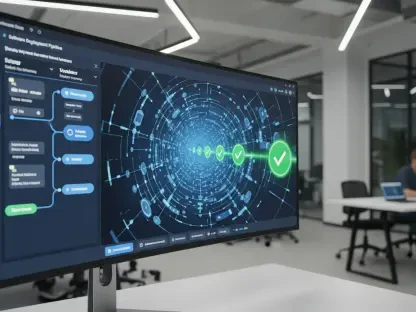
Furthermore, the integration of real-time verification loops has changed the definition of “done” in autonomous engineering. Instead of the model simply asserting that a feature works, the harness utilizes browser automation tools to verify that buttons are clickable, APIs return the correct data, and state is preserved across transitions. This move toward active verification means that the AI is no longer operating in a vacuum; it is responding to the actual behavior of the software it has created. This feedback loop is essential for building complex tools like Digital Audio Workstations or game engines, where the interaction between different systems is too intricate for a model to simulate purely through internal reasoning.
Real-World Implementations and Use Cases
The practical application of these harnesses has yielded results that were previously considered impossible for autonomous systems. In one notable instance, a harness was tasked with building a 2D retro game maker. While a solo agent produced a broken UI with non-functional physics, the full-harness version successfully engineered a 16-feature application complete with a sprite editor and animation systems. The difference was not in the model used, but in the environment that supported it. The harness allowed the model to spend hours refining the logic, catching its own bugs through the Evaluator, and eventually producing a tool that was ready for end-user deployment.
Beyond gaming, these systems have proven their worth in creating high-concept frontend experiences. By moving away from standard templates, autonomous agents have demonstrated the ability to create 3D spatial interfaces using advanced CSS techniques that even many human developers find daunting. In the realm of professional tooling, harnesses have been used to build browser-based audio editors that manage the complexities of the Web Audio API while integrating internal AI agents for music composition. These successes suggest that the harness is the key to unlocking the latent potential of LLMs, turning them from sophisticated text predictors into genuine software engineers.
Technical Hurdles and Adoption Obstacles
Despite these advancements, the transition to autonomous engineering is not without significant friction. The most prominent barrier is the economic trade-off between speed and quality. A full-harness run is often twenty times more expensive than a simple prompt-and-response interaction, as it consumes a massive number of tokens through repeated iterations and multi-agent dialogues. This makes the technology overkill for minor bug fixes or basic landing pages. There is also the matter of latency; a harness might take several hours to “think” its way through a complex application, which can be frustrating for users accustomed to the near-instantaneous feedback of traditional AI tools.
Moreover, the complexity of the harness itself introduces new points of failure. Managing the state handoffs between a Planner, a Generator, and an Evaluator requires a sophisticated orchestration layer that can sometimes break if the underlying model updates its behavior. There is a constant need for “harness tuning” to ensure that the grading criteria remain relevant and that the agents do not get stuck in a loop of unproductive criticism. While these systems are becoming more resilient, they still require a high level of AI engineering expertise to set up and maintain, which limits their accessibility for general consumers or small development teams without deep technical roots.
Future Trajectory of Autonomous AI Engineering
The path forward for harness design involves a shift toward “dynamic scaffolding.” As models become more capable, the rigid structures that define today’s harnesses—such as forced context resets and tiny sprint chunks—will likely become obsolete. We are moving toward a future where the primary agent is intelligent enough to know when it needs to spawn its own sub-agents to handle specialized tasks. This “AI-within-AI” approach will allow for even greater levels of complexity, as the central coordinator manages a hierarchy of specialized workers that can be created and dissolved on the fly based on the needs of the project.
In the coming years, the role of the human engineer will undergo a fundamental transformation. Rather than writing code or even writing prompts, the engineer will focus on designing the “legal and evaluative” frameworks that govern how these agents operate. This involves setting the high-level goals, defining the success metrics, and fine-tuning the skeptical filters that ensure the AI remains creative and original. As the boundary between creation and critique continues to blur, the harness will evolve from a restrictive set of rules into a flexible, intelligent environment that adapts to the specific challenges of every new software project.
Summary of Findings and Final Assessment
The shift from standalone Large Language Models to structured autonomous agent harnesses represented a necessary maturation of AI engineering. By isolating the distinct phases of planning, generation, and evaluation, the industry successfully navigated around the coherence issues and self-evaluation biases that previously crippled long-running projects. The transition from simple text generation to verifiable, functional software development was not achieved by making models larger, but by making the environments they inhabit smarter. The results speak for themselves: where solo agents often produced unusable “slop,” the multi-agent triads delivered professional-grade applications capable of handling complex state and sophisticated user interactions.
Looking back on the development of these frameworks, it was clear that the “harness” was the missing link in the autonomous coding puzzle. It provided the skepticism and rigor that LLMs naturally lacked, forcing them to move beyond the most probable (and often most mediocre) outputs. While the costs and time requirements of these systems remained high, the ability to generate viable, full-stack software from a few sentences of intent proved to be an undeniable value proposition. The success of this design pattern established a new standard for AI-driven development, moving the goalpost from mere assistance to genuine autonomy. This evolution demonstrated that the most effective way to manage AI was not to control its every move, but to build a system where it was constantly challenged to prove its own competence.