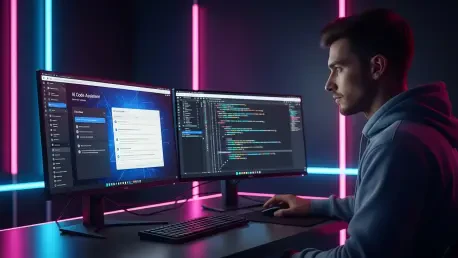

A profound transformation is quietly reshaping our digital landscape, making the ability to create custom software no longer the exclusive domain of highly trained engineers but an accessible skill for anyone with a specific problem to solve. What was once a complex, syntax-driven craft is now becoming a conversational act, driven by the power of artificial intelligence. This shift marks the dawn of a new era where individuals are moving from being passive consumers of technology to active creators, building hyper-personalized tools that cater to their unique needs and workflows. This report analyzes this burgeoning movement, exploring its technological underpinnings, economic implications, and the challenges that lie ahead.
The New Frontier of Personal Software Creation
The software industry is witnessing the rise of the “micro-app revolution,” a fundamental shift away from monolithic, one-size-fits-all applications toward a creator-centric model. In this new paradigm, the emphasis is on developing small, highly specialized applications designed to solve a single, often personal, problem. These micro-apps are not intended for mass-market distribution but rather serve as bespoke digital tools for an individual or a small team, filling the countless niches that commercial software overlooks.
At the heart of this revolution is a practice known as “vibe coding.” This term aptly describes the process of using natural language to instruct an AI assistant, such as those powered by models from OpenAI or Anthropic, to generate functional code. Instead of writing precise lines of syntax, a user describes the desired functionality, look, and feel—the “vibe”—of an application. The AI then acts as an interpreter, translating these conversational instructions into a working prototype and dramatically lowering the barrier to entry for software creation.
This entire movement is made possible by the rapid maturation and widespread accessibility of Large Language Models (LLMs). These sophisticated AI systems have evolved beyond simple text generation to become powerful reasoning engines capable of understanding complex requirements, writing code in multiple languages, and even debugging their own work. Their integration into user-friendly platforms has turned the abstract concept of AI-assisted development into a practical reality for a global audience.
Consequently, a vibrant ecosystem of platforms has emerged to support this new wave of creators. Integrated development environments like Replit offer a seamless space where users can describe, generate, and deploy an application within a single browser tab. Alongside these established players, specialized startups such as VibeCode are focusing on streamlining the text-to-app process even further, creating tools specifically designed for non-technical users to bring their ideas to life with minimal friction.
Charting the Rise of the Citizen Coder
From “Vibe Coding” to Functional Reality
The most significant impact of AI-assisted development is the democratization of problem-solving. It empowers individuals from all backgrounds to build custom solutions for niche challenges that are too specific to be addressed by commercial software. A student combatting “decision fatigue,” for example, can now build a simple app to randomly select a nearby restaurant, a task that once would have required formal programming knowledge. This capability allows a much broader segment of the population to engage directly with technology creation.
This trend has also given rise to “ephemeral software”—disposable, single-purpose applications built for temporary needs. Much like a social media post, these micro-apps are often created to solve an immediate, situational problem and may be discarded once that need has passed. This represents a fundamental shift in how software is perceived, moving from a permanent, carefully maintained product to a transient, on-demand utility that can be created and retired with ease.
The profile of this new builder is remarkably diverse, spanning from students and artists with no technical background to seasoned software engineers leveraging AI for rapid prototyping and personal side projects. An artist might build a tool to track submission deadlines, a media strategist could create a custom dashboard for social media metrics, and an engineer might whip up a utility to automate a tedious work-related task. This breadth of users underscores the universal appeal of being able to craft one’s own digital tools.
However, success in this new landscape requires a novel skill: the art of “prompt engineering.” Effectively communicating requirements to an AI is not a passive act but an iterative process of clarification, refinement, and logical guidance. The ability to articulate a clear vision and troubleshoot the AI’s output has become the critical competency that separates a vague idea from a functional, well-executed application.
Projecting the Economic and Social Shockwaves
Industry analysts are drawing parallels between the current micro-app movement and the transformative economic shifts sparked by previous democratization waves. Just as Shopify empowered anyone to become an e-commerce entrepreneur and social media platforms turned individuals into global content creators, AI-driven development tools are now enabling a new generation of software builders. This is expected to unlock a massive long tail of innovation.
A significant growth area is emerging for hyper-personalized software that occupies the space between basic spreadsheets and expensive, feature-heavy commercial SaaS products. Millions of users have unique workflow needs that are too complex for a simple table but not substantial enough to justify a costly subscription. AI-built micro-apps are perfectly positioned to fill this gap, leading to a surge in bespoke digital solutions for both personal and professional use.
This trend poses a potential disruption to the traditional SaaS market. As users become more proficient at building their own tools, they may opt to create custom versions of software they currently pay for, tailored precisely to their needs. This could lead consumers and small businesses to cancel subscriptions to generic platforms, pressuring the established software industry to adopt more flexible, modular, and customizable business models to retain their user base.
Navigating the Hurdles of AI-Assisted Development
Despite the immense potential, the rise of AI-assisted development is not without significant challenges, particularly concerning quality and security. Applications built by amateurs often contain bugs, inefficient code, or, more alarmingly, critical security vulnerabilities. While these issues may be manageable for a simple personal tool, they become a major risk if the app handles sensitive data like financial or health information, making it unsuitable for wider use.
Furthermore, the idea of “push-button” app creation is largely a myth. While AI handles the heavy lifting of writing code, the process still demands considerable effort, logical thinking, and persistence. A successful outcome depends on the user’s ability to debug unexpected behavior, refine their prompts iteratively, and systematically test the application to ensure it functions as intended. The human remains a crucial and active participant in the development loop.
A more systemic risk is the inherent dependency on third-party platforms. The entire micro-app ecosystem is built upon the APIs of AI providers and the infrastructure of low-cost cloud services. Any change to the pricing, terms of service, or functionality of these foundational platforms could instantly break an application or render it financially unsustainable. This reliance places individual creators in a vulnerable position, subject to the business decisions of large tech companies.
Finally, the isolated nature of these projects creates a “collaboration gap.” Unlike the open-source community, where code is shared, reviewed, and improved collectively, micro-apps are typically developed in a silo. This prevents community-driven bug fixes, shared improvements, and the organic evolution of better tools, limiting the potential for these applications to mature beyond their initial version.
The Unwritten Rules and Platform Gatekeepers
For many aspiring creators, the primary barrier to building and distributing a mobile app lies with the stringent policies of platform gatekeepers like Apple. Its App Store requires a paid developer account and subjects every application to a rigorous review process, creating significant hurdles for individuals looking to deploy a simple, personal tool. These corporate policies were designed for a world of commercial software, not for the emerging ecosystem of micro-apps.
In response, builders have devised creative workarounds to share their creations without navigating the official channels. A popular method is to use beta-testing platforms like Apple’s TestFlight, which allows a developer to invite a limited number of users to install an app directly. Another increasingly common approach is the development of Progressive Web Apps (PWAs), which are web-based applications that can be saved to a phone’s home screen and function almost identically to a native app, bypassing the app store entirely.
This friction has also created an opportunity for a new class of startups focused on streamlining mobile-first development. Companies are emerging with tools designed specifically to help users create and deploy mobile applications through these alternative channels. Their goal is to abstract away the complexities of app store compliance and provide a more direct text-to-app pathway that empowers creators to get their software onto devices with minimal overhead.
Envisioning the Future of Bespoke Software
The next wave of innovation in this space is expected to push beyond simple web applications toward more complex and deeply integrated mobile apps. As AI models become more capable of understanding device-specific features like cameras, GPS, and notifications, the potential for creating sophisticated personal utilities will expand dramatically. This will further blur the line between professionally developed software and AI-generated tools.
Driving this evolution will be a new generation of future disruptors: companies entirely focused on creating a seamless, end-to-end text-to-app generation experience. These platforms will likely integrate AI-powered coding, automated testing, and simplified deployment into a single, cohesive workflow, making the journey from a simple idea to a functional app on a phone almost instantaneous.
Ultimately, this trend points toward the evolution of digital literacy itself. Just as typing became a fundamental skill in the personal computer era, the ability to conceptualize and generate software through natural language is poised to become a core competency. Interacting with AI to create bespoke tools may soon be as common as using a word processor or a spreadsheet is today.
From Consumer to Creator: The Final Verdict
The rise of AI-driven development signaled a paradigm shift in how society viewed software, reframing it as a personally crafted tool rather than a mass-market product to be consumed. This movement empowered a new class of creators to build solutions tailored to their unique digital lives. The role of the professional developer was not rendered obsolete but was instead augmented, as AI expanded the software universe and opened up new frontiers for innovation. This era was ultimately defined not by one application used by millions, but by millions of unique applications, each built by and for a single individual.