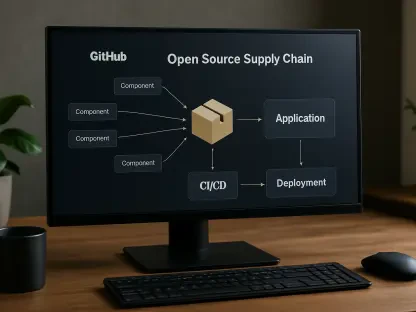

The very code that fuels rapid digital transformation and powers nearly every application in use today also represents one of the most significant and often overlooked security vulnerabilities for modern enterprises. While organizations celebrate the speed and efficiency gained from leveraging open source software, a quiet and persistent threat grows within their development pipelines. This reliance on a vast, interconnected web of third-party components has turned the software supply chain into a critical infrastructure that is as fragile as it is essential, demanding a fundamental shift in how security is perceived and managed.
Is Your Innovation Pipeline Secretly a Security Liability
In the relentless pursuit of competitive advantage, development teams are encouraged to build and deploy faster than ever before. This push for rapid innovation heavily relies on integrating pre-existing open source packages to avoid reinventing the wheel, turning the development process into an assembly line of third-party components. However, this acceleration creates a dangerous blind spot, where the origin, maintenance, and security of these components are often secondary to their immediate functionality.
This dependency transforms the innovation pipeline from a strategic asset into a potential liability. Each unvetted component introduced into a project carries the risk of hidden vulnerabilities or even malicious code from unknown maintainers. The growing adoption of AI-powered code generators further complicates this landscape, as these tools can automatically pull in vast quantities of code from unverified sources, amplifying the scale and opacity of the potential threat.
The Open Source Paradox: Powering Your Business While Exposing It to Risk
The central challenge lies in a fundamental paradox: open source software is an indispensable engine of modern business, yet it is also a primary source of risk. Its collaborative and decentralized nature has democratized software development, enabling access to powerful tools and libraries across more than a dozen language ecosystems, including Java, JavaScript, Go, and Python. This accessibility allows organizations to build sophisticated applications without incurring massive development costs from scratch.
In contrast, this same decentralized model creates significant security exposures. Without a central authority to vet and govern components, organizations are left to navigate a landscape of inconsistent updates, abandoned projects, and known vulnerabilities that malicious actors actively exploit. The responsibility for security shifts entirely to the consumer, who often lacks the resources or visibility to effectively manage the risks embedded within the code they use every day.
The Hidden Drain: Quantifying the True Cost of Unvetted Code
The consequences of an insecure software supply chain extend far beyond the immediate threat of a data breach. There is a substantial, yet often unmeasured, operational cost associated with managing third-party code. Industry analysis reveals that DevSecOps teams spend an estimated 30% to 50% of their time simply managing, troubleshooting, and remediating vulnerabilities found in the open source components they rely on.
This constant, reactive cycle of patching and fixing represents a significant drain on resources that could otherwise be directed toward innovation and revenue-generating activities. The time spent chasing down dependencies and addressing security alerts detracts from core development work and complicates compliance efforts, creating a hidden tax on productivity that quietly undermines an organization’s bottom line.
Shifting from Defense to Offense: Why Vulnerability Scanners Arent Enough
Traditional security measures, such as vulnerability scanners, have proven insufficient for addressing the scale of this problem. These tools typically operate reactively, identifying known Common Vulnerabilities and Exposures (CVEs) only after they have already been integrated into an application. While useful, this approach places teams in a perpetual state of defense, forcing them to respond to an endless stream of alerts rather than preventing the issues from occurring in the first place.
A more effective strategy requires shifting from a defensive posture to an offensive one. This means moving security considerations to the very beginning of the development lifecycle—the moment a component is selected. Proactive governance involves preventing vulnerable or untrusted code from ever entering the pipeline, which fundamentally reduces the attack surface and frees teams from the burdensome cycle of reactive remediation.
Forging a Golden Path: A Practical Framework for Supply Chain Security
To navigate this complex environment, organizations are now forging a “golden path” for consuming open source software. This framework involves establishing a single, trusted source for all third-party components, ensuring that every package has been vetted and approved before it is made available to developers. By creating a curated and governed catalog, enterprises can standardize their software supply chain and regain control over their development ecosystem.
Implementing such a system has a transformative impact. A unified repository, like ActiveState’s catalog of 79 million components, offers a practical solution to this challenge. This approach helps standardize the enterprise software supply chain by moving beyond simple scanning to a proactive, governed system for managing secure open source components. By providing developers with a reliable source of pre-vetted code, this model was shown to reduce CVE exposure by up to 99% and reclaim as much as 30% of engineering time, allowing teams to focus on building value instead of fighting fires.