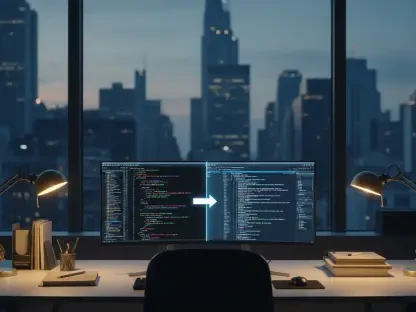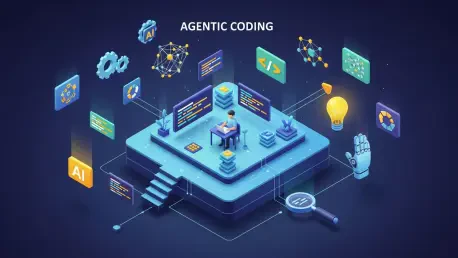

The landscape of software engineering is currently undergoing a structural realignment as autonomous agents begin to supersede the traditional utility of basic autocomplete tools. These advanced systems, exemplified by platforms like Claude Code, have moved beyond mere syntax suggestions to undertake the holistic responsibilities of a human developer, including architectural planning, complex debugging, and the implementation of nuanced business logic. This transition marks a fundamental shift in the professional identity of the programmer, who is no longer defined by the manual labor of typing strings of code but rather by the ability to direct high-level outcomes through strategic oversight. As the technical barrier to entry continues to lower, the industry is witnessing a decoupling of “coding” from “creation,” where the former is becoming a specialized commodity handled by machines while the latter remains the primary domain of human ingenuity and vision.
Scaling Productivity: The Rise of the Hundredfold Developer
The emergence of agentic development tools has effectively birthed a new class of high-output engineers capable of achieving what was previously considered impossible for a single individual. By offloading the repetitive and syntactically rigorous aspects of programming to autonomous agents, developers are now able to function at a scale that resembles an entire department. For instance, the creation of a sophisticated, production-ready web application that once required weeks of coordinated effort between frontend and backend specialists can now be executed in a single afternoon. In this new workflow, the vast majority of a developer’s time is reclaimed from the “grunt work” of wiring databases or managing API endpoints, allowing for an intense focus on the aesthetic refinements and user experience nuances that define a premium product. This shift indicates that the primary bottleneck in software production is no longer the speed of manual typing or the memorization of library functions, but rather the clarity of the initial architectural vision and the capacity to fine-tune the output.
This massive leap in efficiency is fundamentally altering the economics of software development by collapsing the time-to-market for innovative ideas. Projects that were previously relegated to a “backburner” due to resource constraints are now being brought to life with minimal friction, as the cost of experimentation has dropped to nearly zero. When a developer can prompt an agent to build a functional prototype in minutes, the risk of failure becomes negligible, encouraging a culture of rapid iteration that was previously reserved for the most well-funded startups. However, this velocity introduces a new set of challenges regarding the management of high volumes of code. As the quantity of software grows exponentially, the role of the human engineer shifts toward that of a curator or a systems judge, tasked with ensuring that the mountain of AI-generated logic remains coherent, secure, and aligned with long-term business objectives. The value of a developer in this era is measured not by how much code they produce, but by their ability to navigate and govern the immense output of their digital agents.
The Evolution of Craft: Navigating the Loss of Manual Mastery
While the gains in productivity are undeniable, the industry is simultaneously grappling with the potential erosion of the traditional “craft” that has defined programming for decades. There is a palpable concern that future generations of engineers may never experience the deep psychological immersion of a flow state triggered by solving a complex algorithmic puzzle by hand. The “manual era” was characterized by a specific type of intellectual grit—the multi-day debugging session, the meticulous design of class hierarchies, and the hard-won satisfaction of making a recalcitrant system function through sheer persistence. As AI agents turn these once-profound struggles into instantaneous fixes, the professional journey risks becoming sanitized. For those who entered the field in 2026 or later, the “magic” of an agent solving a memory leak in seconds will be the baseline expectation rather than a miracle, potentially leading to a lack of appreciation for the underlying mechanics that make modern computing possible.
Skeptics frequently dismiss the current output of agentic tools as “slop” or compare the behavior of these systems to that of an overeager junior developer who lacks a sense of context. However, this critique often fails to account for the sheer velocity of improvement and the unique nature of AI-driven labor. Even if an agent currently operates with the foresight of a junior coder, it is a junior coder that never sleeps, possesses an exhaustive knowledge of every existing library, and can iterate through a hundred versions of a function in the time it takes a human to read a single error message. This change in speed effectively redefines the concept of software quality; a “bug” that is identified and rectified by an agent before it ever touches a version control repository is no longer a bug in any practical sense. As these models evolve from junior-level proficiency to expert-level mastery within months rather than years, the window for dismissing their capabilities based on occasional hallucinations is rapidly closing, leaving critics in a position of increasing irrelevance.
An Irreversible Industry Shift: Strategic Integration and Future Outlook
The democratization of software creation has reached a definitive point of no return, where the technical barriers that once guarded the gates of the tech industry are effectively crumbling. We are witnessing a historic leap where the ability to bring a dormant digital idea to life is becoming accessible to anyone with the vision to describe it accurately. This transition is not merely a passing trend but an irreversible evolution of the medium itself, rendering manual coding unnecessary for the vast majority of production-level tasks. As the industry matures, the focus is shifting away from the “how” of implementation and toward the “why” of product design. Organizations are increasingly prioritizing individuals who can synthesize market needs with technical possibilities, as the actual assembly of the software is handled by autonomous systems. This realignment suggests that the most successful professionals will be those who treat agentic tools as a force multiplier for their creative intent rather than a threat to their established routines.
To navigate this new reality, developers and technology leaders should focus on developing a set of “agent-orchestration” skills that emphasize systems thinking over syntax. Rather than resisting the inevitable decline of manual coding, professionals ought to invest in learning how to prompt, audit, and integrate autonomous outputs into larger, more complex ecosystems. This involves a shift toward rigorous testing frameworks and automated oversight, as the human role becomes one of defining the “definition of done” and ensuring ethical guardrails are maintained. The future of the industry belongs to those who can master the art of the high-level directive, using their historical understanding of software principles to guide agents toward elegant and sustainable solutions. By embracing the intoxication of speed and the capability to realize complex visions almost instantly, the modern developer can transcend the limitations of the past and lead the charge into an era where human creativity is the only true constraint on what can be built.