
The long-held tradition of developers meticulously typing out line after line of code is rapidly being upended by a new paradigm where artificial intelligence generates the syntax, leaving humans to direct the symphony. This shift is not a distant forecast but a present-day reality, exemplified by a recent, striking claim from an engineer at OpenAI who asserted they no longer write any code manually. This statement acts as a lightning rod, illuminating a profound transformation across the software development landscape where the very definition of a programmer’s job is being rewritten. This report analyzes this pivotal moment, exploring the acceleration of AI integration, the practical challenges that arise from this dependency, and the evolving skill set required for the engineer of tomorrow.
The New Coding Frontier: AI’s Role in Modern Software Development
The software engineering landscape of 2026 is fundamentally different from that of just a few years ago. AI-powered coding assistants, once a novelty, are now standard issue in the developer’s toolkit, with platforms like GitHub Copilot becoming as indispensable as the compiler itself. Major industry players have poured resources into creating sophisticated models that can translate natural language prompts into functional code, automate repetitive tasks, and even suggest solutions to complex problems. This integration has triggered a seismic shift in how software is conceptualized and constructed.
Consequently, the traditional development workflow is undergoing a radical reinvention. The cycle is moving away from a labor-intensive process of manual creation and toward a more supervisory model of AI-augmented development. Developers now spend less time on syntactical minutiae and more on high-level architectural design and prompt engineering. This change accelerates production timelines and allows for more rapid iteration, redefining productivity metrics and team dynamics across the industry.
From Keystrokes to Prompts: Charting the AI Coding Revolution
The “100% AI-Coded” Claim: A Glimpse into the Future or Hyperbole?
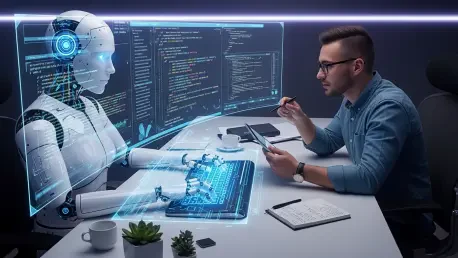
The assertion from an OpenAI engineer, who stated they “don’t write code anymore” and view the manual process as a chore now automated, serves as a powerful case study for this transition. Whether viewed as an exaggeration or a literal description of their workflow, the claim crystallizes an emerging reality where a developer’s primary function is no longer to be the author of code. Instead, their role evolves into that of a meticulous editor, a critical reviewer, and a strategic director of AI output.
This evolution redefines the core competencies of a programmer. The emphasis shifts from memorizing syntax and library functions to the ability to articulate complex requirements clearly to an AI. Skills in verification, debugging AI-generated logic, and integrating disparate automated outputs into a cohesive system become paramount. The engineer’s value is now measured not by lines of code written, but by the quality and reliability of the final product they oversee.
Measuring the AI Boost: Productivity Gains and Adoption Rates
Market data confirms that this shift is not isolated to a few pioneers but reflects a widespread industry trend. Adoption rates for AI coding assistants have surged, with a majority of development teams now incorporating these tools into their daily operations. The measurable productivity gains, from accelerating boilerplate code generation to solving routine programming challenges, provide a compelling business case for their integration.
Looking ahead, forecasts from 2026 to 2028 predict that AI will become even more deeply embedded in the entire software development lifecycle, extending beyond code generation to automated testing, deployment, and monitoring. This will continue to reshape how teams measure performance, moving from individual output to the overall velocity and quality of the system. The focus will be on leveraging AI to shorten the gap between idea and implementation, making innovation faster and more accessible.
The Hidden Bugs in the Machine: Challenges of AI-Generated Code
Despite the remarkable advancements, a complete reliance on AI for code generation introduces significant challenges. The models, trained on vast datasets of public code, can inadvertently reproduce buggy, inefficient, or insecure patterns. This creates an “illusion of productivity,” where code is generated in seconds but requires hours or even days of human effort to debug, optimize, and secure. The speed of creation can be easily negated by the complexity of verification.
To counteract these risks, organizations must implement robust mitigation strategies. This includes establishing stringent code review processes specifically for AI-generated output, utilizing advanced static and dynamic analysis tools to catch vulnerabilities, and fostering a culture where human oversight is non-negotiable. The ultimate responsibility for the software’s integrity cannot be offloaded to the machine; it remains firmly with the human engineers who must test and validate every line of automated code before it reaches production.
Who’s Accountable? Navigating the Legal and Ethical Maze of AI Code
The rise of AI-generated software introduces a complex web of legal and ethical questions, particularly concerning liability and intellectual property. When an AI-powered application fails, causing financial or physical harm, determining accountability is far from straightforward. The responsibility could fall on the developer who prompted the AI, the organization that deployed the software, or the company that created the AI tool itself, creating a murky regulatory landscape that the legal system is still struggling to navigate.
Furthermore, the very nature of how these AI models are trained—on billions of lines of code from public repositories—raises critical copyright and licensing issues. It is often unclear whether the generated code constitutes a derivative work, potentially infringing on the licenses of the source material. This ambiguity poses a significant risk for companies building commercial products with AI-generated components, necessitating careful legal review and clear policies to avoid future intellectual property disputes.
The Evolving Engineer: Redefining the Developer’s Role in an AI-Powered World
The profession of software engineering is not disappearing; it is evolving into a more strategic and analytical role. The future developer will operate as a partner to AI, focusing less on writing syntax and more on system-level architecture, complex problem-solving, and ensuring the quality of automated work. Their expertise will be directed toward guiding the AI, validating its output, and making the critical design decisions that machines are not yet capable of.
This new reality demands a new set of essential skills. Proficiency in advanced prompt engineering—the art of crafting precise instructions to elicit optimal AI responses—will become a core competency. Equally important will be skills in AI model verification, ethical oversight, and the ability to critically assess whether the AI’s solution is not just functional, but also efficient, secure, and aligned with business objectives. The engineer’s role becomes that of a sophisticated quality-control expert and system integrator.
The Final Verdict: Human Ingenuity in the Age of Automation
The analysis demonstrated that artificial intelligence has cemented its place as a powerful force multiplier in software development, fundamentally altering workflows and boosting productivity. The industry’s trajectory clearly pointed toward a deeper partnership between human developers and their AI counterparts, where automation handled the rote tasks of syntax generation, allowing engineers to focus on higher-level architectural and strategic challenges. The claim of a developer no longer writing code was less a sign of obsolescence and more an indicator of this profound role evolution.
Ultimately, the findings confirmed that the ultimate accountability for creating robust, secure, and reliable software remained a human responsibility. While AI served as an increasingly capable tool, the critical thinking, ethical judgment, and deep system understanding required to build quality products were qualities that belonged to the engineer. The recommended path forward was a balanced approach, where organizations embraced AI for its efficiency while simultaneously investing in upskilling their teams for the vital roles of review, verification, and oversight.