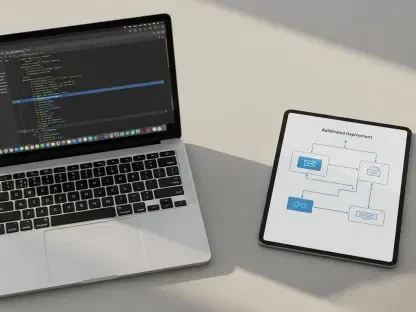

The long-standing bottleneck of manual enterprise coding is finally collapsing under the weight of an automated revolution that transforms months of grueling labor into mere hours of algorithmic precision. As the global technology sector grapples with an unprecedented shortage of skilled engineers and the looming “Digital Cliff,” the emergence of sophisticated AI-driven development platforms represents more than just a marginal improvement in efficiency. It marks a fundamental shift in the very philosophy of software engineering, moving the industry away from the archaic “person-month” billing model toward a future defined by rapid, value-based outcomes. This review examines how Fujitsu and its contemporaries are leveraging specialized large language models and multi-agent orchestration to modernize the crumbling foundations of legacy digital infrastructure.
The core of this technological leap lies in the transition from simple code-assistance tools to fully autonomous ecosystems capable of managing the entire software development lifecycle. Unlike the fragmented automation of previous years, current platforms integrate requirement definitions, architectural mapping, and rigorous integration testing into a single, cohesive workflow. This evolution is particularly critical for large-scale public and corporate systems that have historically been resistant to change due to their sheer complexity. By automating the drudgery of routine maintenance and regulatory updates, the industry is effectively freeing human intelligence to focus on high-level strategy and creative problem-solving.
The Dawn of Automated Software Engineering
The current technological landscape is defined by the urgent need to modernize aging digital infrastructures that have become too complex for traditional manual intervention. This shift is driven by the realization that labor-intensive coding is no longer sustainable in a world where regulatory requirements and market demands change weekly rather than annually. The emergence of automated software engineering represents a move toward high-efficiency, value-based paradigms where the primary goal is the rapid delivery of functional, secure, and compliant software. This context is essential for understanding why simple generative AI is insufficient; the industry requires a system that understands the “why” behind the code, not just the “how.”
Central to this new era is the principle of full-cycle autonomy, which seeks to eliminate the friction points between different stages of development. In the past, a change in government regulations might require a cascade of manual updates across dozens of interconnected modules, each prone to human error. Modern AI platforms mitigate this by treating the entire system as a living organism, where a single prompt can trigger a synchronized update across the entire stack. This holistic approach ensures that the context of the business logic remains intact, even as the underlying code is rewritten or modernized for current cloud environments.
Core Technical Components of the AI Platform
The Takane Large Language Model
At the heart of Fujitsu’s specialized approach is the Takane Large Language Model, a system designed specifically to navigate the dense thickets of enterprise-grade software. Unlike general-purpose models that are trained on broad internet data, Takane is optimized for the structural nuances and “spaghetti code” often found in legacy systems that have been patched for decades. It excels at deciphering undocumented dependencies and understanding the specific regulatory environments of the Japanese and global markets. This specialization is what allows the model to act as a bridge between the rigid logic of the past and the fluid requirements of the present, ensuring that modernizations do not break mission-critical functions.
The significance of Takane lies in its ability to process “tacit knowledge”—the unwritten rules and historical quirks of a system that usually exist only in the minds of veteran engineers. By analyzing thousands of lines of legacy code alongside technical manuals, the model can reconstruct the original intent of a software architecture. This capability is vital for organizations facing a “brain drain” as senior developers retire, leaving behind systems that no one else fully understands. Takane essentially digitizes this institutional memory, turning a potential liability into a structured asset that the AI can then manipulate and improve.
Agentic AI and Multi-Agent Orchestration
The platform achieves its high degree of autonomy through the use of agentic AI, a system where multiple specialized AI entities collaborate like a well-oiled engineering team. Each “agent” within the orchestration layer is assigned a specific role, such as architect, coder, or security auditor. These agents do not merely follow a script; they communicate with one another to resolve ambiguities and verify that the output of one stage meets the requirements of the next. This collaborative intelligence allows the system to handle complex tasks that would overwhelm a single monolithic model, providing a level of reliability that mimics a human peer-review process.
Technically, this multi-agent orchestration functions by breaking down a massive development project into manageable micro-tasks. When a requirement is entered, the “architect agent” maps out the necessary changes, which are then passed to “coding agents” for implementation. Simultaneously, a “testing agent” generates specialized scripts to validate the new code in real-time. This parallel processing not only accelerates the development timeline but also creates a self-correcting loop. If the testing agent identifies a flaw, it sends the code back to the coding agent with specific feedback, ensuring that the final product is production-ready without human troubleshooting.
AI-Ready Engineering Framework
Preparing an organization for this level of automation requires a rigorous process known as AI-Ready Engineering. This framework is designed to bridge the gap between messy, real-world data and the structured input required by high-performance AI models. It involves the systematic ingestion and “cleaning” of legacy codebases, design documents, and operational logs to create a comprehensive digital twin of the existing infrastructure. Without this foundational step, even the most advanced AI would struggle to provide accurate results, as it would be operating on incomplete or contradictory information.
This preparation phase is unique because it forces a level of organizational transparency that many companies have lacked for years. By converting historical assets into AI-processable data, companies can finally see the “hidden debt” in their systems—redundant functions, security vulnerabilities, and inefficient logic paths. The AI-Ready Engineering process effectively “standardizes” the heritage of a company, making it possible for the AI to not only maintain the status quo but to actively propose optimizations that a human team might never have the time to discover.
Emerging Trends in AI-Augmented Development
The most disruptive trend in the current market is the decisive shift away from the “person-month” billing model that has dominated the IT service industry for half a century. In the traditional model, service providers were incentivized to use more labor, as their revenue was tied to the number of hours billed. However, the 100-fold productivity increases offered by AI are making this model obsolete. Clients are now demanding outcome-based service delivery, where they pay for the successful deployment of a feature or the modernization of a system, regardless of whether it took a human three months or an AI four hours to complete.
Furthermore, we are witnessing the rise of the Forward Deployed Engineer (FDE), a role that prioritizes customer value creation over routine maintenance. In this new paradigm, the engineer acts more like a high-level consultant and orchestrator, using the AI platform to rapidly prototype and deploy solutions that directly impact the client’s bottom line. This shift is refocusing the entire industry on innovation. Instead of being bogged down by the “drudgery” of impact analysis and manual testing, engineers are now empowered to explore how technology can solve broader societal challenges, such as improving patient outcomes in healthcare or optimizing supply chains in manufacturing.
Real-World Applications and Industry Impact
Healthcare and Public Sector Modernization
The deployment of AI-driven platforms in the healthcare sector has already demonstrated staggering results, particularly in managing the biennial medical fee revisions in Japan. These revisions represent a massive administrative hurdle, requiring thousands of software updates to comply with new government regulations. In a recent application, the AI-driven platform reduced the labor required for a complex set of 300 updates from three person-months to a mere four hours. This speed allows healthcare providers to implement legislative changes almost instantly, ensuring that medical billing remains accurate and compliant without the typical months of manual verification.
In the public sector, this technology is being used to revitalize government business software that has long been hampered by bureaucratic inertia and technical debt. By automating the integration of new laws and administrative requirements, government agencies can become more responsive to the needs of citizens. The ability to rapidly adapt systems means that public services can evolve at the speed of policy, rather than being held back by the limitations of their digital infrastructure. This level of agility was previously unthinkable in the public sector, where large-scale IT projects are notoriously slow and expensive.
Financial and Manufacturing System Integration
The financial sector is perhaps the most demanding environment for autonomous development, given the zero-tolerance policy for errors in transaction systems. AI platforms are now being utilized to manage these complex environments, where they handle everything from regulatory compliance updates to the integration of new fintech services. The autonomous nature of the system allows banks to “rough out” and test new service ideas in a fraction of the time it would take using traditional methods. This ensures that even the most conservative financial institutions can remain competitive in an era of rapid digital disruption.
In manufacturing, the impact is equally profound, particularly in the management of supply chain logic and design changes. When a manufacturer needs to switch a component or adjust a production line, the AI can perform a comprehensive impact analysis across the entire enterprise resource planning system. It identifies every dependency that will be affected by the change and automatically generates the necessary code updates to keep the factory running smoothly. This level of automated oversight reduces the risk of costly production halts and allows manufacturers to be much more flexible in responding to global market fluctuations.
Overcoming Technical and Operational Hurdles
Bridging the Legacy Debt Gap
One of the most significant challenges in implementing AI-driven development is the “legacy debt gap,” which refers to the difficulty of documenting the intricate, often messy logic of systems built decades ago. Much of this logic is considered “tacit knowledge,” residing only in the experience of engineers who are now reaching retirement age. The technical hurdle lies in converting these historical assets—some of which are written in outdated languages or lack any formal documentation—into a format that an AI can reliably process. This is not just a data entry problem; it is a complex translation task that requires the AI to infer meaning from context.
Moreover, organizations must overcome the cultural resistance to trusting an automated system with their most critical assets. Many stakeholders are understandably wary of letting an AI rewrite the “black box” code that has kept their business running for years. Bridging this gap requires a transparent approach to AI-Ready Engineering, where the AI’s interpretations are clearly mapped out and verified by human experts. The goal is to create a symbiotic relationship where the AI does the heavy lifting of data conversion, while the humans provide the final validation, ensuring that no vital business logic is lost in the translation.
Ensuring Multi-Layer Quality Control
General generative AI has often been criticized for its “hallucinations” and lack of precision in high-stakes environments. To counter this, advanced platforms have implemented multi-layer quality control mechanisms that go far beyond simple syntax checking. These systems use autonomous auditing agents to verify the logic, security, and performance of every line of code generated. By repeating processes and checking for ambiguities, the AI can ensure that its output is not just “functional” but truly production-grade. This multi-layered approach is what differentiates a professional development platform from a mere coding assistant.
The development of these autonomous auditing mechanisms is a response to the need for absolute reliability in sectors like finance and healthcare. The system must be able to prove its work, providing a clear trail of logic for every decision it makes. This creates a “safety-first” environment where the AI is constantly checking its own work against a set of predefined constraints and best practices. While this adds a layer of complexity to the platform’s architecture, it is a necessary trade-off to ensure that the speed of AI development does not come at the cost of system integrity or public safety.
The Future Outlook of Software Engineering
As we look toward the immediate future, it is clear that AI will become the primary foundation for human creativity and judgment in the digital realm. The total automation of the software development lifecycle is no longer a distant goal but a rapidly approaching reality. In this environment, the traditional barriers between “business” and “IT” will continue to blur. Business leaders will be able to describe a new service or a change in strategy, and the AI will handle the technical implementation in real-time. This will allow organizations to be truly agile, responding to opportunities and threats with a speed that was previously reserved for the smallest startups.
Furthermore, the long-term impact on the global IT talent shortage will be transformative. By drastically reducing the number of hours required for routine tasks, the industry can meet the expanding demand for digital services even as the workforce shrinks. This does not mean that human engineers will become obsolete; rather, their roles will be elevated. The focus will shift to “system orchestration,” where humans act as the ultimate arbiters of design philosophy and social impact. The future of software engineering will be defined by a partnership where AI manages the complexity of the code, and humans define the vision for how that code should serve society.
Summary and Final Assessment
The review of current AI-driven software development platforms revealed a paradigm shift that successfully addresses the most critical limitations of traditional engineering. By integrating specialized models like Takane with robust multi-agent orchestration, these platforms have moved beyond simple automation to achieve true autonomous development. The documented 100-fold increases in productivity are not merely statistical anomalies; they represent a fundamental change in how digital infrastructure is maintained and evolved. The transition from labor-based to value-based engineering is a direct response to the global talent crisis, providing a sustainable pathway for corporate and public growth.
The implementation of these technologies across healthcare, finance, and manufacturing demonstrated that the “Digital Cliff” can be navigated through strategic AI adoption. The success of the AI-Ready Engineering framework proved that even the most convoluted legacy systems can be modernized without compromising their integrity. While technical hurdles regarding tacit knowledge and quality control remain, the development of multi-layer auditing mechanisms provided a reliable safeguard for high-stakes environments. This evolution effectively signaled the end of the “person-month” era, establishing a new industry standard centered on speed, precision, and human-centric innovation.
Ultimately, the impact of this technology on the global digital landscape was profound and lasting. It enabled a level of systemic agility that allowed organizations to adapt to legislative and market changes in hours rather than months. By formalizing expert know-how into digital assets, the industry managed to preserve decades of institutional knowledge while simultaneously making it more accessible. The verdict on AI-driven software development was clear: it functioned as a vital catalyst for the next generation of digital transformation, ensuring that the software of the future is as dynamic as the world it serves. These advancements moved the industry toward a state where technology is no longer a bottleneck but a seamless extension of human intent.