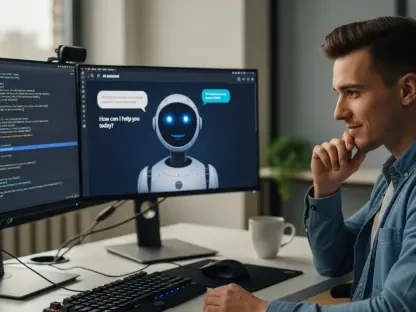

Imagine a world where your operating system doesn’t just respond to clicks and commands but anticipates your needs, autonomously orchestrating tasks across applications with precision and security. This isn’t science fiction; it’s the reality Microsoft is crafting with its latest innovation in the Windows ecosystem. The integration of artificial intelligence directly into the core of Windows marks a transformative shift, positioning it as an agentic OS—a platform where AI agents manage workflows on your behalf. This review dives deep into this groundbreaking technology, exploring how it redefines personal computing through local processing, robust security frameworks, and seamless task management, while also addressing the challenges that lie ahead in this ambitious journey.
Unveiling the Core of an Agentic Operating System
At its heart, the agentic Windows OS represents Microsoft’s vision of an operating system that transcends traditional boundaries. Unlike conventional systems that rely on user input for every action, this new iteration leverages AI agents to interpret requests, connect applications, and execute complex workflows with minimal intervention. The foundation of this transformation lies in on-device AI processing and a sophisticated framework known as the Model Context Protocol (MCP), which ensures secure interactions between agents and system resources.
This shift responds to a growing demand for privacy and performance in computing. With users increasingly wary of data leaving their devices for cloud-based processing, Microsoft has engineered a solution that keeps sensitive tasks local while maintaining the power of AI. Moreover, the emphasis on edge computing aligns with broader industry trends toward faster, more reliable systems that don’t depend on constant internet connectivity. The result is a Windows experience that promises both autonomy and trustworthiness.
The relevance of this technology extends far beyond individual users. In enterprise settings, where efficiency and data protection are paramount, an agentic OS could revolutionize how businesses operate, streamlining operations through intelligent automation. As this review unfolds, the focus will be on how these principles translate into tangible features and real-world impact, painting a picture of a system poised to reshape the digital landscape.
Diving into Key Features and Performance
On-Device AI Power with Copilot+ PCs
One of the standout features of the agentic Windows OS is its ability to process AI tasks locally through Copilot+ PCs. Equipped with neural processing units (NPUs), these devices handle small language models (SLMs) directly on the hardware, eliminating the need to send data to the cloud. This approach not only addresses privacy concerns by keeping personal information on the device but also delivers a noticeable performance boost, as tasks execute without the latency associated with remote servers.
Beyond privacy, local processing means reliability in environments with limited or no internet access. Imagine working on a critical project during a flight or in a remote location—Copilot+ PCs ensure that AI assistance remains available, seamlessly supporting tasks like document analysis or data organization. This capability positions Windows as a frontrunner in a market increasingly focused on data sovereignty, where control over information is as crucial as functionality.
However, the transition to local AI isn’t without its hurdles. The computational demands of SLMs require specialized hardware, which may limit accessibility for users with older systems. Despite this, Microsoft’s commitment to expanding hardware compatibility suggests a future where more devices can harness this power, democratizing access to agentic capabilities over time.
Model Context Protocol: The Security Backbone
Central to the agentic Windows OS is the Model Context Protocol (MCP), a framework designed to standardize and secure interactions between AI agents and system resources. Integrated into Windows ML frameworks, MCP acts as a gatekeeper, ensuring that agents access only the data and functions they’re authorized to use, whether local or remote. This structured approach minimizes risks like unauthorized data exposure or system vulnerabilities.
In practical terms, MCP enables a balance between functionality and safety. For instance, an AI agent tasked with file management can interact with Windows File Explorer through a dedicated connector, but only within predefined boundaries set by user permissions. Such granular control not only enhances security but also improves usability, as users can trust agents to perform tasks without overstepping.
The implications of MCP extend to developers as well. By providing a consistent API for agent interactions, Microsoft simplifies the creation of agentic applications, fostering an ecosystem where innovation thrives without compromising on protection. As this framework matures, it could become a cornerstone of secure AI integration across the tech industry.
Recent Advancements Shaping the Agentic Landscape
Microsoft’s progress in developing the agentic Windows OS has accelerated significantly in recent months. Updates to development platforms like Win App SDK and Windows ML have streamlined the process of building AI-driven applications, empowering creators to craft agents that integrate seamlessly with the OS. These advancements signal a maturing ecosystem ready to support both developers and end-users with robust tools.
A notable highlight is the preview of Agent Workspace at a recent industry conference, offering a glimpse into a dedicated environment for managing AI agents. This tool, alongside emerging trends in localized AI processing, reflects a shift in user expectations toward systems that prioritize speed and autonomy. Consumers and businesses alike are beginning to demand operating systems that don’t just react but proactively assist, a demand Microsoft is clearly aiming to meet.
Additionally, the evolving landscape of developer support cannot be overlooked. With resources like sample code and command-line utilities for MCP server management, Microsoft is lowering barriers to entry, ensuring that even those new to agentic development can contribute. This democratization of tools hints at a vibrant future where community-driven innovation plays a key role in shaping Windows’ capabilities.
Real-World Impact Across Diverse Sectors
The practical applications of the agentic Windows OS are already making waves in various domains. In consumer settings, AI agents enhance daily productivity by automating repetitive tasks—think organizing files, scheduling meetings, or summarizing documents with a single voice command. The connector for Windows File Explorer, for instance, allows agents to navigate and manage files effortlessly, saving users valuable time.
In enterprise environments, the impact is even more profound. Businesses leveraging this OS can orchestrate complex workflows across departments, with agents linking disparate applications to handle everything from data entry to customer service inquiries. A notable case study involves a logistics firm that used agentic Windows to automate shipment tracking, reducing manual oversight by a significant margin while ensuring data remained secure on local systems.
What stands out is the versatility of these applications. Whether aiding a small business owner in managing inventory or assisting a creative professional with project timelines, the agentic OS adapts to diverse needs. This flexibility underscores its potential to become a universal tool, bridging gaps between personal and professional computing in ways previously unimagined.
Navigating Challenges and Limitations
Despite its promise, the agentic Windows OS faces substantial challenges that could temper its adoption. Integrating AI agents with traditional Windows applications is a complex endeavor, often requiring intricate sandboxing to prevent security breaches. While Microsoft employs constrained environments to isolate agents, the risk of exploits like prompt injection attacks remains a concern that demands ongoing vigilance.
Regulatory hurdles also loom large. With data privacy laws tightening globally, ensuring compliance while maintaining the functionality of AI agents is no small task. Microsoft’s efforts to balance user control with agent autonomy—through features like adjustable access permissions—offer a partial solution, yet navigating this legal landscape will likely require continuous adaptation.
Market acceptance presents another obstacle. Users accustomed to conventional operating systems may hesitate to embrace a paradigm where AI plays such a central role, especially if early implementations encounter bugs or performance issues. Microsoft’s strategy to address this through iterative updates and user education is commendable, but building trust will be a gradual process that hinges on delivering consistent, reliable experiences.
Looking Ahead to the Horizon
Peering into the future, the trajectory of the agentic Windows OS holds immense potential for reshaping computing. Anticipated breakthroughs in AI integration could see agents handling even more sophisticated tasks, from predictive analytics to real-time decision-making, further blurring the line between human and machine interaction. The expansion of secure agentic applications might also unlock new possibilities in fields like healthcare and education, where tailored automation could drive efficiency.
Moreover, the long-term impact on personal and enterprise solutions appears transformative. As hardware evolves to support more powerful local AI processing, the dependency on cloud infrastructure could diminish, heralding a new era of self-sufficient devices. This shift might redefine industry standards, pushing competitors to adopt similar agentic frameworks or risk falling behind.
Yet, the path forward isn’t without uncertainty. Balancing innovation with security will remain a critical focus, as will addressing accessibility to ensure that this technology benefits a broad audience. If Microsoft can navigate these challenges, the agentic Windows OS could become the benchmark for intelligent computing in the years to come.
Reflecting on a Groundbreaking Step
Looking back, the journey of the agentic Windows OS stood as a bold stride toward redefining what an operating system could achieve. Its blend of local AI processing and secure frameworks like MCP carved out a unique space in a crowded tech landscape, offering users a glimpse of autonomous computing that prioritized both power and privacy. The real-world applications, from consumer convenience to enterprise efficiency, demonstrated a versatility that was hard to overlook.
For those eager to embrace this technology, the next steps involved staying informed about Microsoft’s updates and exploring how agentic features could integrate into existing workflows. Developers, in particular, had an opportunity to dive into available frameworks, experimenting with tools to build the next generation of intelligent applications. Meanwhile, businesses could begin pilot programs to test the OS in controlled settings, gathering insights to inform broader adoption.
Ultimately, the conversation around this innovation shifted toward collaboration—between Microsoft, users, and regulators—to refine and expand its potential. By addressing security and accessibility concerns head-on, stakeholders could collectively ensure that the agentic Windows OS evolved into a tool that not only met current needs but also anticipated tomorrow’s challenges, setting a new standard for technology’s role in daily life.