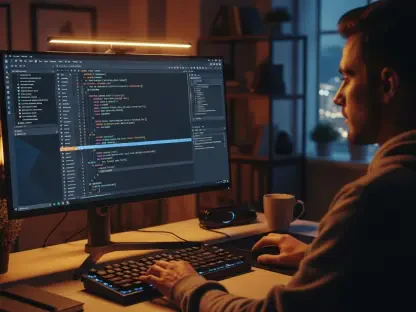

The long-standing chasm separating the meticulous, text-based world of software development from the fluid, visual realm of web design is rapidly closing, thanks to a new wave of AI-powered tools that are fundamentally rewriting the rules of digital creation. Cursor’s new Visual Editor feature represents a pivotal moment in this evolution, blurring the lines between a high-powered Integrated Development Environment (IDE) and a dedicated web design studio. This launch is not merely an incremental update; it’s a foundational shift that directly impacts web development workflows by embedding design-centric functionality into the heart of the coding process. The tool’s introduction signals a broader and more profound evolution in productivity software, where the seamless integration of intuitive visual interfaces and powerful artificial intelligence is creating an entirely new paradigm for how professionals build, refine, and interact with technology in their daily work.
A Closer Look at the Visual Editor
Bridging the Gap Between Code and Design
At its core, the Visual Editor functions as a sophisticated bridge, translating direct visual manipulation into clean, corresponding code without the developer ever needing to leave their primary workspace. This feature allows users to interact with their web application in a hands-on, tangible manner, offering functionalities that were once the exclusive domain of specialized design software. Developers can click and drag elements to new positions, drop in pre-built components, and directly style properties through a graphical user interface. A critical component of this system is an integrated inspection tool, which operates much like the familiar DevTools found in major web browsers such as Google Chrome and Safari. By clicking on any web component, from a button to a header, users are presented with its associated properties. These attributes, including font sizes, opacity levels, and spacing values, can be modified in real-time, with all visual changes instantly and accurately reflected in the underlying codebase, streamlining the development process by eliminating the need to constantly switch contexts.
The immediate benefit of this integrated approach is a dramatic acceleration of the front-end development cycle, which has traditionally been characterized by a high degree of trial and error. By providing real-time visual feedback, the editor significantly lowers the cognitive load on developers, who no longer need to mentally map abstract CSS properties in a text file to their tangible outcomes in a separate browser window. This environment of direct manipulation makes the design process more accessible and intuitive, empowering developers who may be less confident in their design sensibilities to create more polished and professional user interfaces. It removes the friction often associated with minor aesthetic tweaks and adjustments, allowing for a more fluid and iterative workflow. The onboarding process is also designed for immediate engagement; a prominent “Try” button opens the editor with a pre-loaded website, inviting new users to experiment with the tools in a familiar, hands-on environment and immediately grasp the power of this new workflow.
The AI-First Advantage
The true innovation behind the Visual Editor lies in Cursor’s foundational identity as an “AI-first IDE,” a philosophy that infuses every feature with intelligent assistance. The integrated AI is not a passive tool but an active, context-aware collaborator that understands the user’s current focus. For instance, selecting an # heading on a webpage provides the AI with the necessary context to assist with a variety of relevant tasks, from suggesting alternative phrasing to adjusting its typographic scale. This capability transforms the editor from a simple visual manipulation tool into a powerful creative partner. Users can employ natural language prompts, similar to interacting with an advanced chatbot, to direct the AI to perform a wide range of functions that extend far beyond simple formatting adjustments. During testing, this AI assistant proved capable of handling more creative and strategic work, such as brainstorming marketing copy for a hero section, demonstrating how the tool effectively supports both the technical and conceptual aspects of modern web design.
This deep integration of an AI assistant fundamentally changes the nature of problem-solving within the development process. Instead of navigating through extensive documentation or searching community forums to resolve a complex styling issue, a developer can now simply articulate their goal to the AI and have it implement the required changes. This creates a conversational and highly iterative design and development cycle, where ideas can be tested and refined with unprecedented speed. Furthermore, this feature serves as a powerful educational tool for junior developers, who can observe how the AI translates their natural language requests into precise, well-structured code. This process reinforces their understanding of syntax, best practices, and the relationship between code and visual output. The AI evolves from being a simple co-pilot for writing code into a comprehensive assistant for designing, refining, and perfecting the entire user experience, making sophisticated web development more accessible than ever before.
The Bigger Picture Reshaping the Productivity Landscape
The New Battlefield IDEs vs The World
Cursor’s innovative approach is not an isolated event but a key development in a much larger market trend: the convergence of disparate software tools and the emergence of a “neo Browser Wars” being fought within the IDE space. Leading competitors, including Microsoft with its ubiquitous Visual Studio Code and Google’s ambitious “Antigravity” project, are also aggressively expanding their feature sets far beyond their original purpose of serving professional software engineers. This expansion is a deliberate strategy to democratize powerful development tools, making them more accessible and useful to a broader, “semi-technical” audience that does not necessarily consist of full-time coders. These evolving IDEs are no longer niche products for a specialized few; they are transforming into versatile platforms designed to empower a new generation of creators, marketers, and entrepreneurs who need to build and manage digital projects without writing code from scratch.
This strategic shift signals a new competitive landscape where the primary battle is no longer fought over which IDE possesses the most efficient debugger or the most intelligent code completion. Instead, the contest is to determine which platform can successfully establish itself as the central, indispensable hub for a wide and growing range of creative and technical tasks. This evolution is driven by the market’s recognition that the once-distinct lines between coding, designing, content creation, and project management are becoming increasingly blurred in modern workflows. The IDEs poised to dominate this new era will be those that offer the most seamless, powerful, and integrated experience, attracting users who may not identify as developers but who require sophisticated tools to bring their digital ideas to life. The ultimate goal for these companies is to capture user attention and become the default environment for all forms of digital creation and productivity.
From IDE to IPE The Future of Integrated Work
This ongoing trend points directly toward the evolution of the Integrated Development Environment into a far more comprehensive platform: the “Integrated Personal Environment” or “Integrated Productivity Environment” (IPE). In this forward-looking concept, the IDE transcends its code-centric origins to become a centralized, collaborative workspace for an extensive and diverse array of professional and personal tasks. This ambitious vision encompasses functionalities that are currently handled by a fragmented ecosystem of separate applications. It imagines a future where users can manage complex documents, plan team events, draft and handle legal paperwork, and even conduct sophisticated real estate analysis, all from within a single, unified platform. This IPE would leverage the inherent power of code and the intelligence of AI to enhance productivity across nearly every aspect of a user’s digital life.
The implications of this fundamental shift toward a unified IPE are profound, potentially disrupting the entire market for specialized, single-purpose software applications. If a single, intelligent environment can expertly manage tasks, documents, communication, and code, the need for separate project management tools, document editors, and communication platforms could be significantly diminished. This consolidation promises unprecedented levels of efficiency and collaboration, as information would no longer be siloed in different applications. However, this future also raises important questions about the risks of vendor lock-in and the immense challenge of creating a single tool that can truly excel at such a diverse range of functions. The key enabling technology for this vision is the advanced AI layer, which would act as a universal translator and an intelligent assistant, seamlessly bridging the gaps between different domains and making such a powerful consolidation not only possible but practical.
Disrupting the No-Code Market
The primary catalyst for this paradigm shift was the pervasive integration of artificial intelligence, which dramatically lowered the barrier to entry for complex technical and creative tasks. This democratization of capability gave rise to entirely new workflows, such as “vibe coding,” where users could generate entire applications simply by describing their desired outcome to an AI assistant through natural language prompts. This rapid evolution, underscored by constant advancements in underlying AI models like OpenAI’s GPT-5.2, created a significant and immediate threat to the established no-code and low-code web design platforms. The workflows of many users were transformed overnight; a daily routine that once involved multiple applications could now begin by collaborating with an AI assistant inside a single environment, creating a sense of being technologically augmented, or “bionic.”
The introduction of Cursor’s Visual Editor was ultimately a landmark event in the ongoing transformation of web design and digital productivity. It served as a major salvo in a broader conflict that challenged the market dominance of platforms like Webflow, Framer, Wix, and Squarespace, forcing them to reckon with a new category of competitor that seamlessly blended the power of professional coding with the accessibility of visual design. This development did more than just supercharge workflows for existing developers; it attracted a new and growing wave of creators who sought to leverage the immense power of AI without being constrained by the limitations of traditional no-code builders. The tool’s launch created a new reality where the distinction between coder and creator was no longer relevant, reshaping the competitive landscape for years to come.