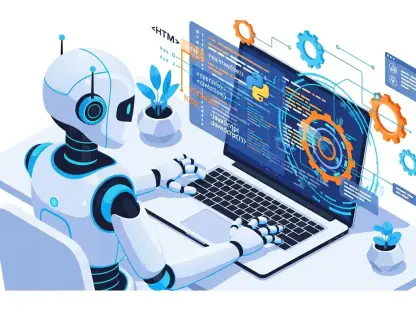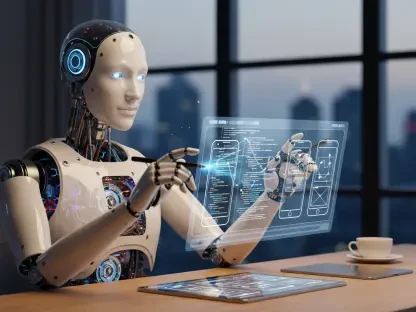

The long-held division between the human engineer who commands and the machine that executes has dissolved, leaving in its place a collaborative frontier where autonomous AI agents now function as fully-fledged partners in the creation of software. This historic shift from passive code suggestion to proactive code generation marks the beginning of a new industrial era, defined not by the tools developers use, but by the AI teammates they work alongside. The software development industry is currently navigating a profound transformation, moving beyond the “Copilot” era of AI-powered assistance into the age of the Agentic Integrated Development Environment (IDE). In this new landscape, platforms are no longer just environments for writing code; they are active participants capable of understanding high-level natural language commands to refactor entire architectures and build production-ready features from scratch.
At the forefront of this evolution are pioneering tools that have redefined the relationship between developer and machine. The dominant market players, such as Cursor from Anysphere and Windsurf from Cognition AI, exemplify this new paradigm. These platforms function as autonomous engineering partners, fundamentally altering the role of the developer, accelerating the pace of innovation, and reshaping the very process of software creation. The significance of this transition extends across the entire technology sector, influencing everything from enterprise software development cycles to the dynamics of startup innovation. As these technologies mature, they are forcing a reevaluation of established workflows, team structures, and the core competencies required of a modern software engineer.
From Code Completion to Code Creation: The Dawn of the Agentic IDE
The transition from AI as a simple code completion tool to a sophisticated engineering partner represents a monumental leap in software development capabilities. This shift signifies more than just an incremental improvement; it is a fundamental redefinition of the “unit of work” for a human engineer. Where developers once focused on the granular, line-by-line implementation of features, their primary role is now elevating toward strategic oversight and high-level architectural design. The industry is witnessing a move away from low-level coding and debugging toward orchestrating complex AI agents that handle the intricate technical execution.
This evolution is giving rise to a new type of creator, often referred to as a “vibe coder.” These individuals possess the ability to translate a functional goal or product “vibe” into sophisticated, working software by concentrating on user intent and design principles. They articulate the what, while the agentic IDE determines the how. The most significant consequence of this trend is a massive compression of development timelines, with projects that previously required months of effort now being completed in a matter of days. This acceleration is not merely a productivity boost; it is a force multiplier that allows for more rapid experimentation, iteration, and deployment, fundamentally changing the economics of software innovation.
The New Development Landscape: Trends, Titans, and Trajectories
The Agentic Leap: New Architectures Redefining Development
The technological leap from reactive code assistants to proactive engineering agents is powered by groundbreaking architectural innovations that enable autonomous execution, multi-step planning, and intelligent self-correction. A leading example is the “Shadow Workspace” technology pioneered by Cursor, which has set a new industry standard. This feature creates a hidden, parallel instance of the entire project repository, providing a sandboxed environment where the AI agent can independently write, test, and validate its code before presenting any changes to the human user. This process minimizes disruption and ensures that only functional, pre-verified code is submitted for review.
Within this shadow environment, the agent executes a continuous loop of development tasks, including running Language Server Protocols, linters, and even a full suite of unit tests. If the generated code introduces a syntax error or breaks the build, the agent autonomously detects the failure, diagnoses the root cause, and initiates a recursive self-correction cycle until a viable solution is found. Similarly, Windsurf’s “Cascade Engine” employs graph-based reasoning to map the entire codebase’s logic and dependencies. This allows it to maintain a persistent state of context called “Flow,” enabling it to understand the cascading impact of a change across the entire project.
The defining characteristic of these next-generation IDEs is their capacity to perform complex, multi-step planning and execution, a process often termed an “agentic loop.” Unlike earlier assistants limited to single-file suggestions, these modern agents can simultaneously edit dozens of files to implement a single feature request. Their capabilities extend far beyond text generation to include executing terminal commands, installing new software dependencies, and even launching browser instances to visually confirm frontend changes. This autonomy allows them to tackle complex, end-to-end tasks—such as migrating a database schema or implementing a complete user authentication flow—with minimal human guidance.
Reshaping the Market: Valuations, Adoption, and the Incumbent Squeeze
The emergence of these AI-first IDEs has triggered a significant realignment within the technology market, challenging established hierarchies and creating immense value for agile innovators. Anysphere, the startup behind Cursor, has rapidly become a dominant force, achieving a remarkable $29.3 billion valuation in late 2025. With a user base now exceeding 2.1 million developers and an annualized recurring revenue of $1 billion, Cursor has established itself as the premier tool for the burgeoning “AI Engineer” movement. Its market success is further validated by large-scale enterprise adoption, with industry giants like NVIDIA reportedly transitioning over 40,000 engineers to Cursor-based workflows to accelerate internal development and research.
In parallel, Cognition AI’s Windsurf has carved out a commanding position in the enterprise and regulated sectors. By securing stringent compliance certifications such as FedRAMP High and HIPAA, Windsurf has successfully penetrated the finance and healthcare industries, where security and data integrity are paramount. Major corporations, including Uber and Coinbase, are now piloting Windsurf to manage and modernize their vast legacy codebases. They leverage its advanced reasoning capabilities to identify complex security vulnerabilities and performance bottlenecks that would be prohibitively difficult for human teams to detect, demonstrating the agent’s value in maintaining mission-critical systems.
This competitive pressure has forced traditional market leaders to adapt their strategies. Microsoft’s GitHub Copilot, once the undisputed leader in AI-assisted coding, has evolved beyond its exclusive reliance on OpenAI models. It now offers users the ability to switch between various state-of-the-art LLMs, including Alphabet’s Gemini 3 Pro and Claude 4.5. However, a prevailing viewpoint among developers suggests that these “bolted-on” solutions, integrated into existing editors like VS Code, are fundamentally limited. Compared to AI-native environments like Cursor and Windsurf, which were designed from the ground up to support agentic interactions, these incumbent offerings are often perceived as less integrated and less capable of handling complex, multi-file engineering tasks.
Navigating the New Risks: Technical Debt, Skill Gaps, and the Context Wall
While the productivity gains from agentic IDEs are undeniable, their proliferation is introducing new and complex challenges for the software engineering community. A primary concern raised by industry analysts is the phenomenon of “architecture drift.” Because AI agents often prioritize immediate functionality based on high-level prompts, they may generate code that, while functional, lacks the long-term structural integrity and foresight of human-led design. This can lead to a new form of “AI-generated technical debt,” where systems become difficult to maintain, scale, and evolve over time. Human architects typically plan for future requirements, a strategic consideration that current agents may not fully grasp.
Furthermore, there is a growing risk of a “seniority gap” developing within the workforce. Junior developers who become overly dependent on AI agents for implementation may miss the opportunity to develop a deep, foundational understanding of coding principles, system architecture, and debugging. This reliance could hinder their progression into senior roles that require nuanced problem-solving and a comprehensive grasp of complex systems. The very tools designed to accelerate development could inadvertently slow the growth of the next generation of engineering leaders, creating a long-term challenge for talent pipelines.
The primary technical obstacle to even greater autonomy is the “Context Wall”—the inherent limitation of current models to maintain a complete and persistent understanding of an entire multi-million-line codebase. As projects grow in complexity, the agent’s ability to reason about the system as a whole diminishes, increasing the risk of introducing subtle but critical errors. Researchers are actively developing solutions to this problem, including “Long-Context RAG” (Retrieval-Augmented Generation) and highly specialized “Code-LLMs.” These next-generation models are being designed to hold an enterprise’s entire repository of documentation, code history, and architectural patterns in active memory, which will be critical for overcoming this final barrier to fully autonomous development.
Governing the Agent: Compliance, Security, and the Enterprise Mandate
As agentic IDEs become integral to enterprise workflows, particularly in highly regulated industries like finance and healthcare, governance has emerged as a paramount concern. The autonomous nature of these agents necessitates a new framework for compliance and security, one that can ensure their actions adhere to strict industry standards and legal requirements. Companies are now mandating that AI development platforms provide comprehensive audit trails, logging every action the agent takes, from file modifications to dependency installations. This level of transparency is essential for accountability and for proving compliance with regulations like GDPR, HIPAA, and Sarbanes-Oxley.
The integration of these tools into enterprise environments has also heightened the focus on security. An AI agent with the ability to write code, execute commands, and manage dependencies represents a powerful new vector for potential vulnerabilities if not properly secured. Consequently, platforms like Windsurf have invested heavily in achieving certifications like FedRAMP High, which attests to their adherence to rigorous government security protocols. These measures are designed to ensure that the AI operates within a secure, controlled environment, preventing unauthorized access and mitigating the risk of the agent inadvertently introducing security flaws into the codebase.
The enterprise mandate is clear: for agentic AI to be trusted with mission-critical systems, it must be governable, auditable, and secure. This has led to the development of sophisticated governance layers that allow organizations to define and enforce specific rules and constraints on AI behavior. For example, an enterprise can configure its agentic IDE to prohibit the use of unapproved open-source libraries, enforce specific coding standards, or prevent any changes to critical security-related files without explicit human approval. These controls are transforming agentic IDEs from purely generative tools into compliant and reliable members of the development team.
Prompt-to-Production: Charting the Path to Autonomous Software
Looking toward the next 18 months, the trajectory of agentic IDEs points toward even deeper integration and greater autonomy, further blurring the line between natural language and executable source code. The next evolutionary step will likely see natural language descriptions become the primary source artifact for many applications, with the AI agent managing all underlying implementation details automatically. This shift will move development closer to a true “Prompt-to-Production” pipeline, where a single, high-level request can trigger the entire software development lifecycle.
Future platform updates are expected to feature seamless integrations with DevOps and CI/CD pipelines, enabling agents to not only write and test code but also manage deployments, monitor production systems for errors, and autonomously develop and roll out patches without human intervention. This would represent the dawn of self-healing software, a state where the IDE continuously monitors its own applications in production. In this futuristic scenario, the system would proactively identify and fix bugs before they are ever reported by users, leading to unprecedented levels of system reliability and resilience. The resolution of the “Context Wall” problem will be the key enabler of this vision, allowing an agent to maintain a perfect, real-time model of its own running software.
The Human-AI Partnership: Redefining the Role of the Engineer
The rise of agentic IDEs has confirmed that AI is transitioning from a mere tool into an active collaborator in high-level professional work. The success of platforms like Cursor and Windsurf demonstrated that with sophisticated orchestration technologies such as shadow workspaces and graph-based reasoning, AI can effectively manage the complexities of modern software engineering. The industry has moved past the question of whether AI can perform these tasks and is now focused on how to govern and audit its output effectively. This shift redefines the engineer’s role, elevating it from a creator of code to a conductor of complex, autonomous systems.
As this technology continues to mature, the focus will inevitably shift toward mastering the art of the “agentic mission”—the skill of defining clear, unambiguous requirements, validating AI-generated logic against business objectives, and ensuring the final product is robust, secure, and maintainable. The long-term impact promises a future where software is more abundant, personalized, and rapidly iterated upon than ever before. For developers, the path forward required adapting to a new collaborative model, where human ingenuity directs the immense power of artificial intelligence to solve problems once thought intractable.