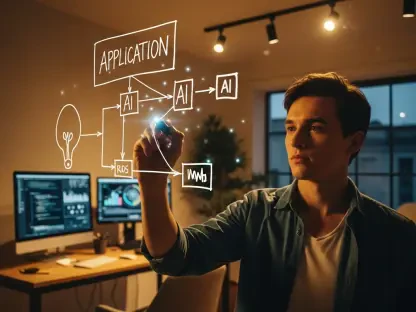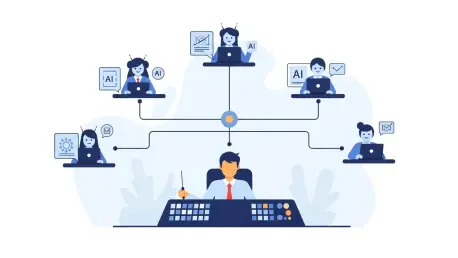

The very definition of software development is undergoing a profound transformation, moving away from the meticulous, line-by-line craft of coding toward a new model of strategic oversight and high-level direction. OpenAI has accelerated this evolution with the launch of a standalone Codex application, a strategic pivot that signals a future where developers orchestrate teams of autonomous AI agents rather than simply writing code themselves. This new platform, initially released on macOS for paid subscribers, provides a centralized workspace designed not for generating isolated code snippets, but for managing a portfolio of AI-driven projects. By organizing AI agents into distinct, project-specific threads, the app allows developers to seamlessly switch between complex tasks, effectively supervising multiple coding initiatives simultaneously without losing context or momentum. This move represents a significant step beyond chat-based interactions, heralding an era where the primary role of a human developer is to manage, review, and guide the work of their digital counterparts.
The Rise of an AI-Powered Development Environment
A New Paradigm in Coding Collaboration
The introduction of OpenAI’s dedicated Codex application marks a clear departure from the model of AI as a simple autocomplete or a conversational assistant. Instead, it establishes a comprehensive development environment where AI agents are treated as persistent, long-term collaborators. Within this framework, a developer’s interaction with AI transcends fleeting queries for code snippets. The app’s architecture, centered around project-organized threads, enables each AI agent to maintain its own context and history, allowing it to work on complex, multi-stage tasks over extended periods. This structure is fundamentally different from a chat interface, providing a persistent workspace where a developer can assign a task, monitor progress, and intervene when necessary, much like a project manager overseeing a team member. The ability to multitask across different AI-managed projects within the same interface streamlines the entire development lifecycle, reducing cognitive load and allowing human engineers to focus on architectural decisions and strategic problem-solving rather than the minutiae of implementation.
The true innovation of the Codex app lies in its empowerment of AI agents with a set of “skills” that extend far beyond mere code generation. These capabilities transform the AI from a passive generator of text into an active participant in the development process. With these integrated skills, an agent can autonomously gather information from various sources, analyze complex problems to devise potential solutions, and even execute actions directly on the developer’s local machine, such as running tests or compiling code. This represents a significant leap towards agent-driven software development, where the AI can take on a much larger portion of the workflow. For instance, a developer could assign a high-level goal, like “build a user authentication module,” and the AI agent would not only write the necessary code but also research best practices, identify required libraries, and perform initial validation. This enhanced autonomy fundamentally refines the human-AI partnership, positioning the AI as a proactive junior engineer that handles the end-to-end execution of defined tasks under human supervision.
Navigating the Competitive Landscape
OpenAI’s strategic launch of the Codex app does not occur in a vacuum; it intensifies an already fierce competition among tech giants to define the future of software development. This move positions the company directly against rivals like Anthropic, which has been making its own inroads with features such as Claude Code and the collaborative Cowork functionality. The battleground is shifting from who has the most accurate code completion model to who can provide the most seamlessly integrated and powerful development ecosystem. The focus is now on creating tools that embed AI deeply within enterprise workflows, turning them into indispensable partners rather than optional add-ons. As these platforms evolve, they are not just competing on technical prowess but also on their ability to create an intuitive and efficient management layer for AI agents. This race to build the definitive AI-powered integrated development environment (IDE) will likely spur rapid innovation, pushing the boundaries of what autonomous coding agents can achieve within a corporate setting.
Industry analysts widely perceive this development as a crucial, evolutionary step that reshapes the daily responsibilities of a software engineer. Abhivyakti Sengar of Everest Group aptly notes that this shift elevates the developer’s role from that of a “typist to a manager.” In this new paradigm, the bulk of a developer’s time is no longer spent on writing boilerplate or debugging rudimentary syntax errors. Instead, their expertise is redirected toward more strategic activities, such as designing system architecture, defining complex logic, and performing rigorous reviews of the code generated by their AI counterparts. This dynamic mirrors the relationship between a senior engineer and a junior developer, where the senior provides guidance, sets standards, and validates the final output. The AI handles the laborious task of implementation, freeing up human talent to focus on creativity, innovation, and ensuring that the final product aligns with overarching business goals, thereby increasing both productivity and the strategic value of the development team.
Enterprise Adoption and Its Inherent Risks
The Challenge of Governance and Oversight
The increasing autonomy of AI coding agents introduces a new and complex set of governance challenges that enterprises must address proactively. As these tools become more capable of operating independently, they can no longer be treated as simple utilities; they must be subjected to the same rigorous oversight and accountability standards as human developers. This necessitates the creation of robust governance frameworks that include mandatory, systematic code reviews for all AI-generated output. Organizations must establish clear lines of ownership and accountability, defining who is ultimately responsible for the code an AI produces, including its quality, security, and adherence to company standards. Without such structures, companies risk deploying insecure or faulty code, creating significant operational and reputational damage. The integration of autonomous AI coders requires a cultural and procedural shift, compelling businesses to build new processes for managing, auditing, and validating the work of their non-human development team members.
Alongside operational governance, the unresolved legal questions surrounding intellectual property (IP) and licensing for AI-generated code present a formidable obstacle for enterprise adoption. When an AI agent trained on vast datasets of public and proprietary code produces a new software component, the ownership of that component becomes ambiguous. This ambiguity creates a potential minefield of legal and financial liabilities. Could using AI-generated code lead to unintentional infringement of existing licenses or expose a company’s own proprietary information? These are critical questions that currently lack clear legal precedent. Until there is greater clarity on IP rights for machine-created works, companies must proceed with extreme caution. Integrating these powerful tools without a comprehensive legal strategy could result in costly litigation, loss of competitive advantage, and significant compliance failures, making it essential for legal and technical teams to collaborate closely on risk mitigation strategies.
The Specter of Vendor Lock-In
A significant long-term risk associated with the adoption of advanced AI development platforms is the threat of vendor lock-in. As enterprises begin to deeply integrate a specific provider’s AI models and agents into their proprietary codebases and internal development workflows, the cost and complexity of switching to a competitor’s solution can become prohibitively high. These AI systems learn the nuances of a company’s specific architecture, coding standards, and business logic, creating a powerful, customized tool that is not easily replicated. This deep integration can create a dependency that limits a company’s flexibility and negotiating power, effectively trapping them within a single vendor’s ecosystem. The process of migrating to a new platform would not just involve changing a tool but would require retraining AI models, re-integrating APIs, and potentially rewriting significant portions of the infrastructure that has become reliant on the initial vendor’s technology.
To counteract the pervasive threat of vendor lock-in, industry experts strongly advise enterprises to prioritize solutions that are built on open standards and designed for interoperability. Neil Shah of Counterpoint Research emphasizes the need for companies to demand transparency from AI vendors regarding how their data and intellectual property are handled. A proactive strategy involves selecting tools that allow for seamless integration with existing, widely adopted systems like GitHub, ensuring that the company retains control over its core assets. Furthermore, it is imperative for organizations to implement strong internal governance frameworks that include continuous usage monitoring, strict policy enforcement, and the ability to conduct thorough audits. These controls serve as a critical defense, protecting a company’s security and sovereignty by ensuring they can track, manage, and, if necessary, decouple from a vendor’s platform without causing catastrophic disruption to their development operations.
A New Chapter in Software Creation
The emergence of sophisticated AI-driven development environments effectively closed one chapter of software engineering and began another. The conversation shifted from whether AI could write code to how organizations could best manage and govern AI as a new class of developer. This transition brought to the forefront critical questions about accountability, intellectual property, and the long-term strategic risks of vendor dependency. Enterprises that successfully navigated this landscape were those that established robust oversight protocols and prioritized interoperability, treating their AI agents with the same scrutiny as their human talent. The role of the developer was irrevocably elevated from a focus on implementation to one of strategic direction and quality assurance. This evolution ultimately underscored a new reality: the future of software development was not about replacing humans, but about augmenting their capabilities, allowing them to build more complex and innovative systems than ever before.