
AI-assisted code completion was just the beginning. Now, software development is marked by autonomous systems that interpret business requirements, navigate codebases, and execute development workflows with minimal human intervention. For enterprise technology leaders, that shift has direct implications for how engineering teams operate, how productivity is measured, and where competitive advantage comes from. This article explores the role of agentic AI in shaping software development and what it takes to keep pace.
From Autocomplete to Autonomous: What Actually Changes
Legacy AI assistants functioned as sophisticated lookup and autocomplete tools. They suggested syntax, completed functions, and occasionally debugged simple errors, but they required constant human intervention to connect individual code snippets into coherent systems. That limitation meant developers remained the architects, builders, and quality inspectors, with little help from AI, putting a ceiling on productivity.
Enter agentic AI with systems that interpret high-level business requirements and translate them into actionable technical milestones without waiting for step-by-step instructions. These AI agents navigate file structures, identify dependencies, initiate pull requests, and conduct self-directed testing before flagging work for human review, helping developers understand context, not just syntax. The result is a 20% improvement in productivity and up to 50% faster coding on certain subtasks for many engineers.
This capability transforms how software development is done. Developers move from writing code to directing it, defining objectives and guardrails, while agents handle the implementation work that once consumed most of the development cycle.
Redefining the DevOps Pipeline
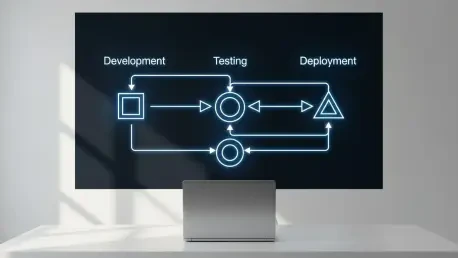
The shift in a developer’s role becomes most visible inside the delivery pipeline. Modern DevOps implementations embed autonomous agents directly into monitoring and remediation workflows to support continuous delivery. These agents analyze performance metrics and security vulnerabilities in real time, and initiate corrective action before issues reach production.
Agents use historical data and predictive analytics to recommend structural optimizations that reduce latency and infrastructure costs. They interpret regulatory frameworks and embed compliance checks into the design phase itself. The result? Security audits that once required weeks of manual code review now happen continuously, with agents flagging violations as code is written.
The impact on release velocity is measurable. Traditional development cycles allocated substantial time for testing, security review, and compliance verification. When these activities happen autonomously and continuously, software release timelines accelerate.
Addressing the Talent Crisis
Faster development pipelines help, but they do not solve the underlying supply problem. The global shortage of experienced software engineers has reached critical levels. Industry insights indicate that 87% of tech leaders struggle to find developers with the specialized skills needed to manage increasingly complex digital portfolios. This scarcity drives compensation inflation, project delays, and strategic compromises that constrain growth.
Agentic AI functions as a force multiplier for existing teams. A developer working with autonomous agents can manage larger codebases and more sophisticated architectures without proportional increases in headcount. Repetitive tasks are automated, freeing cognitive bandwidth for problem-solving that requires genuine human judgment.
The effect on junior developers is important to consider. These systems provide real-time guidance that accelerates skill development, allowing less experienced engineers to operate at higher levels while learning from agent recommendations. But that convenience comes with its own risks. Developers who never write foundational code may struggle to understand the systems they are overseeing. Few organizations plan for this when rolling out automation.
Smart implementation strategies build in deliberate practice alongside automation, ensuring human expertise continues to develop even as mechanical work diminishes.
The Business Case for Customization
Off-the-shelf software rarely fits the way a large organization actually operates. As enterprise processes grow more specialized, standardized products struggle to keep pace with the workflows and competitive differentiators that matter most, and the demand for custom solutions reflects that pressure.
Agentic AI changes the cost equation. McKinsey research found that generative AI tools can accelerate developer speed by 20% to 45% across code documentation, generation, and refactoring, with the largest gains in code generation and testing, directly reducing the cost of custom builds.
Custom application development has traditionally required significant investment in specialized talent and extended timelines that compete with other strategic priorities. Autonomous agents compress those timelines and reduce the labor hours required for complex system builds, making it possible to pursue customization at a scale and speed that was previously difficult to justify.
Reliability and Security: Two Sides of the Same Risk
Speed and customization only hold value if the software being built can be trusted. That trust has two dimensions: quality and security, and agentic AI is reshaping how organizations approach both.
On the quality side, traditional test automation carried a well-documented maintenance burden. Minor interface changes broke scripts, creating cycles of manual intervention that consumed development capacity. Agentic AI addresses this through adaptive testing techniques that adjust to interface changes without requiring human reconfiguration, providing the stability that continuous delivery demands. Developers must still be able to audit the reasoning behind agent decisions, understanding not just what the system did but why. The most effective implementations provide detailed logging that maintains human oversight even as autonomous execution expands.
On the security side, traditional approaches treated security as a final checkpoint before deployment. This created bottlenecks and often resulted in compromises when release deadlines conflicted with remediation timelines. Autonomous agents change that by continuously scanning code for vulnerabilities, misconfigurations, and compliance violations throughout the development cycle. They anticipate attack vectors during the design phase, neutralizing weaknesses before they are coded rather than patching them afterward. As malicious actors deploy increasingly automated attacks, organizations that rely on periodic manual security reviews are structurally exposed. Proactive, agent-driven defense is no longer a differentiator. It is a baseline requirement.
Moving Toward The Orchestration Mindset
None of these capabilities delivers full value without a corresponding shift in software development culture. As agents take on implementation work, the skills that matter most are shifting toward logic definition, system oversight, and the ability to translate business strategy into technical governance. Developers become orchestrators, and that transition is harder than it sounds.
Engineers who built expertise through years of hands-on coding may find their skills less differentiated in an environment where AI handles implementation. Organizations that want to retain valuable talent need to invest in retraining and role redefinition rather than assuming the transition will manage itself. The human element becomes more critical as automation expands, not less, because technology serves broader business objectives only when human judgment guides its application.
Defining intent clearly enough for autonomous systems to execute correctly requires precision that casual instruction cannot achieve. Developers who can articulate goals, constraints, and quality standards in ways that leave no room for misinterpretation will deliver value that autonomous agents cannot replicate.
Conclusion: The Shift Has Already Started
Agentic AI is not an emerging consideration for software developers. It is an active restructuring of how software is built, tested, secured, and delivered. Organizations that are moving deliberately now, embedding agents into DevOps pipelines, investing in orchestration skills, and building governance frameworks, are compressing timelines that their competitors are still planning around.
The question is no longer whether agentic AI belongs in enterprise software development. Instead, it is whether the engineering culture, governance structures, and leadership mindset are ready to use it at the level the technology now makes possible. For organizations still evaluating where they stand, that window is narrowing quickly.