
The promotional products industry is currently navigating a period of rapid expansion and digital transformation. As North American sales figures climb toward record heights, the pressure on backend infrastructure has never been more intense. Anand Naidu, a seasoned development expert with a deep mastery of both frontend and backend systems, joins us to discuss how modern ERP solutions are evolving to meet these demands. With his extensive background in coding languages and system architecture, Anand provides a technical yet practical perspective on synchronizing complex decoration workflows, managing multi-channel inventory, and selecting the right software to anchor a growing enterprise.
North American promotional product sales are projected to reach $27.7 billion by 2025. How can distributors prepare their infrastructure to handle this rising volume without increasing manual errors, and what specific metrics indicate that a current system is reaching its breaking point?
To handle a market that grew by 4.2% recently, distributors must move toward a centralized “single source of truth” where e-commerce, sales agents, and data feeds converge into one dashboard. Manual errors typically spike when data is trapped in silos, forcing staff to re-key information across different platforms for the same order. You know your system is reaching a breaking point when you see a consistent lag in real-time inventory updates across warehouses or an increase in “missed” artwork approvals that stall production. High customer churn and a rise in shipping errors are the ultimate sensory red flags that your current manual workarounds can no longer support the 2025 volume.
Managing apparel requires handling complex style, color, and size matrices. What challenges arise when tracking the transition from blank stock to finished decorated goods, and how should a workflow be structured to ensure artwork approvals don’t delay the production schedule?
The primary challenge lies in the “transformation” phase where a generic blank SKU suddenly becomes a unique, branded asset. Without an integrated decoration module, businesses often lose visibility of their stock the moment it hits the embroidery or screen-printing floor. A structured workflow must natively link the apparel matrix—tracking every size and color—directly to an integrated approval portal where clients sign off on designs digitally. By automating this trigger, the production schedule only activates once the “approved” status is logged, preventing the chaos of decorated goods sitting in limbo or, worse, being printed with the wrong logo.
Many businesses juggle B2B distributor portals alongside B2C e-commerce stores. What are the operational risks of keeping these sales channels in separate data silos, and what steps are necessary to synchronize inventory levels across multiple warehouses in real-time?
Keeping B2B and B2C channels separate creates a high risk of overselling, leading to awkward “out of stock” calls to major clients and damaged reputations. If your B2C site doesn’t know that a B2B distributor just wiped out your inventory of navy blue hoodies in a different warehouse, you’re headed for a fulfillment disaster. To synchronize this, you need a unified cloud-based ERP, like NetSuite or FDM4, that uses electronic data feeds to update stock levels globally the moment a transaction occurs. This ensures that whether a buyer is on a custom corporate portal or a public web store, they see the exact same, accurate stock counts.
Some firms prefer industry-specific solutions with built-in decoration modules, while others choose scalable generalist platforms. How do you weigh the cost of custom development against the benefits of a native workflow, and what role does an open API play in that decision?
Choosing a generalist platform like Oracle or Acumatica often means you are buying a powerful engine that doesn’t yet have the “seats” for apparel decoration, requiring expensive custom coding to handle matrices. In contrast, an industry-specific solution like FDM4, which has been refining these workflows since 1978, provides that functionality out of the box, saving you months of development time. However, an open API is the ultimate insurance policy; it allows you to enjoy the stability of a core ERP while still plugging in niche third-party apps for things like advanced shipping or specific marketing tools. You have to weigh the immediate “fit” of a specialized tool against the “limitless” but costly scalability of a global giant.
Connecting purchasing and inventory data directly to the general ledger is vital for financial health. How can automated purchase orders based on stock levels improve capital allocation, and what information is most critical when tracking inbound shipments from diverse vendors?
Automated purchase orders take the guesswork out of procurement by triggering buys only when stock hits a specific threshold, which prevents your capital from being tied up in slow-moving “dead” inventory. This connection to the general ledger ensures that every dollar spent is immediately reflected in your financial forecasting, providing a clear picture of your company’s health. When tracking inbound shipments, the most critical data points are supplier lead times and real-time transit status. Knowing exactly when a shipment of blank t-shirts will arrive allows you to schedule the decoration team precisely, reducing idle time on the warehouse floor.
Efficient warehouse management often relies on barcode scanning and optimized route planning. What is the step-by-step process for implementing these tools in a facility handling both hard goods and apparel, and how does this integration specifically impact order accuracy and shipping deadlines?
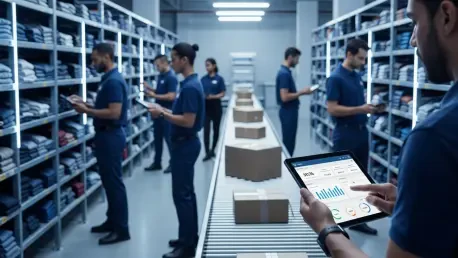
Implementation begins with a full digital mapping of your warehouse locations, followed by assigning unique barcodes to every item in your matrix, from pens to extra-large jackets. Next, you deploy mobile scanning units that guide pickers through the most efficient route, ensuring they don’t walk back and forth across a 50,000-square-foot facility. This integration eliminates the “human “element of grabbing the wrong size or color, which drastically improves order accuracy. By shaving minutes off every pick and pack cycle through optimized routing, you can meet much tighter shipping deadlines, even during the frantic Q4 holiday rush.
Promotional agencies often prioritize project management and resource planning over traditional inventory. For businesses that focus on creative services, how can they maintain profitability across high-volume campaigns, and what is the best way to integrate these service-side metrics with back-office financials?
For creative-heavy agencies, profitability isn’t just about the cost of the goods; it’s about the “time” spent on design and client management. Using a tool like Productive allows these firms to track employee hours and project budgets in real-time, ensuring that a high-volume campaign doesn’t actually lose money due to “scope creep.” The best way to integrate this is to link your project management milestones directly to your invoicing and ledger. This ensures that as soon as a creative phase is completed, the financial impact is visible, allowing leadership to reallocate resources to the most profitable accounts.
What is your forecast for the promotional products industry?
I forecast that the industry will continue its aggressive growth toward the $27.7 billion mark, but we will see a massive “tech-driven” divide between distributors who thrive and those who struggle. Companies that embrace modular, open-source flexibility like Odoo or unified cloud suites like NetSuite will be able to pivot to new trends—like sustainable sourcing or hyper-personalized small batches—much faster than those on legacy systems. We are moving toward an era where the “experience” of ordering a promotional product, from the artwork approval speed to the tracking of the final box, will be just as important as the product itself.