
Today we’re speaking with Anand Naidu, a development expert who lives at the intersection of complex code and real-world business operations. With his deep proficiency in both frontend and backend systems, Anand offers a unique perspective on a problem plaguing modern organizations: the chaos that erupts when rigid, static business processes collide with a dynamic, unpredictable world. This interview will explore how organizations fall into a reactive “firefighting” mode and the practical steps to escape it. We’ll delve into the transformative potential of AI, not just as an automation tool, but as a flexible, intelligent interface for ERP systems. Anand will share insights on uncovering the hidden, informal workflows that truly drive a business, improving the critical human handoffs within processes, and the power of visualizing work to manage capacity and flow.
Many organizations operate in a constant “firefighting mode,” where teams spend weekends solving avoidable problems. How does this cycle of undocumented workarounds and hidden fixes begin, and what are the first practical steps a leader can take to break out of it?
This cycle almost always begins with good intentions. You have a motivated employee who hits a wall because a workflow wasn’t designed for a real-world business scenario. To get the job done, they find a clever, private solution. The problem is, this fix is undocumented and invisible to everyone else. It becomes a “human-made” corner case for the next person in the chain. These hidden fixes start to multiply, creating this tangled web of invisible dependencies. Before you know it, the entire system is brittle, failures are impossible to trace, and everyone is spending their weekends putting out fires. The first, most crucial step a leader can take is to shift the mindset from blame to discovery. You have to stop punishing individuals for system failures and instead, initiate what I call a “journey of discovery” to understand the true “as-is” state of your company, not the one written in the official manuals.
You’ve positioned AI as more than just an automation tool for ERPs, but as a flexible interface. Can you walk me through how an AI-augmented system prevents new “corner cases” from being created and how it can integrate new data sets while respecting existing business and security rules?
Absolutely. Thinking of AI as just an automation layer is a huge missed opportunity. Its real power in an ERP transformation is as a single, flexible interface that sits on top of your legacy or new systems. Imagine a new business need emerges. In a traditional, rigid ERP, a user might be forced to export data to a spreadsheet or create some other manual shortcut—that’s the birth of a new corner case. With an AI-augmented system, the AI network itself acts as the user interface. It can be rapidly reconfigured to incorporate this new process based on logical business rules. The system adapts to the user, not the other way around. This removes the incentive to create those dangerous workarounds. As for integrating new data, the AI layer can connect to new data sets and bring that information into a central data store, combining it with the legacy ERP data for seamless reporting on cost, time, and productivity. All of this happens while keeping faithful to the core business rules, governance policies, and security protocols of the underlying enterprise system.
Executives are often advised to uncover the true “as-is” state of their company’s workflows. What specific, hands-on methods can leaders use to discover these informal processes, and how can they encourage employees to share the workarounds they’ve created without fear of blame?
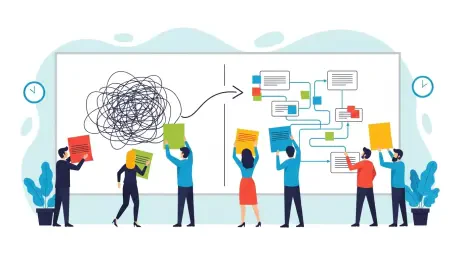
This really requires leaders to get out from behind their desks and away from the slide decks. The key is to structure for discovery. This means engaging directly with the people who live in the “day-to-day scramble.” One powerful method is simply observing the work and asking questions—not with an eye for blame, but with genuine curiosity. Another is to facilitate blameless process mapping sessions. Get the team in a room with a whiteboard or even just sticky notes and have them walk through a process step-by-step, including all the informal things they do. To make this work, you have to build psychological safety. A leader must explicitly state that the goal is to fix the process, not to blame the people. When employees see that their honest feedback about a workaround leads to a better, integrated solution rather than a reprimand, trust builds, and the floodgates of real information open up.
Dynamic Work Design emphasizes improving the handoffs between people, not just redesigning software. How can an AI-enhanced ERP system facilitate better human collaboration and decision-making during these handoffs? Please describe what an effective, technology-supported team “huddle” would look like in this context.
This is a critical point because technology is often a poor substitute for complex human interaction. An AI-enhanced ERP facilitates better handoffs by providing a single source of truth and clear, real-time visibility into the workflow. Instead of people working in silos and discovering a problem only when a handoff fails, the system makes the status of the work transparent to everyone involved. An effective, technology-supported huddle in this context wouldn’t involve a long slide deck. It would be a short, focused conversation around a shared digital dashboard powered by the AI system. The team would look at the visualized workflow, see an impending bottleneck, and the huddle becomes about answering one question: “What happens next?” The AI provides the data and the “what,” allowing the team to focus their human intelligence on the “how” and “why,” making a quick, informed decision to keep the work flowing smoothly.
The idea of not starting new work until there’s capacity is powerful but challenging to implement. Drawing on the principle of visualizing work, what are the most effective ways for a team to map out their processes to identify bottlenecks and regulate flow in real-time?
If you can’t see the work, you can’t manage it. Visualization is non-negotiable for regulating flow. The most effective methods are often the simplest. You can start with index cards on a wall, using string to show dependencies, which forces incredibly high-quality conversations about the process. A famous example is Fannie Mae, who documented their handoffs on a physical board with clothespins and string and managed to slash their monthly book-closing time from 13 days down to just 6. In a more digital environment, tools like Kanban boards are fantastic. The key is to map every single step, including the handoffs. Once the entire workflow is visible, the bottlenecks become painfully obvious. You can literally see where work is piling up. This visual proof makes it much easier to enforce the “airplane rule”—not starting more work until there’s capacity to finish it—because everyone can see that an overloaded system is an unstable system.
What is your forecast for AI-powered ERP transformation?
My forecast is that AI-based ERP augmentation will become the definitive strategy for any organization that wants to be nimble, competitive, and intelligent. We’re moving away from the era of massive, multi-year “big bang” ERP implementations that are obsolete before they even go live. The future is a more modular architecture, where the core ERP is a stable foundation, and AI provides a flexible, intelligent layer on top. This allows businesses to plug in new AI capabilities as they become available, continuously innovating and adapting. By its very nature, this approach embeds the principles of dynamic work design into the technology itself. It will force a complete understanding of workflows, making them transparent, documented, and adaptable, which is the key to unlocking true organizational speed, accuracy, and security.