
The sudden influx of highly capable autonomous agents into production pipelines has fundamentally altered the math behind software delivery, making the manual writing of boilerplate code an increasingly obsolete activity for the modern engineer. Organizations that once measured success by the sheer volume of commits are now finding that the bottleneck has shifted from the keyboard to the drawing board, where the precision of architectural requirements dictates the quality of the final product. While the industry spent the last decade perfecting the art of the two-week sprint, the emergence of systems that can generate thousands of lines of syntactically correct code in seconds has rendered small-batch tasking insufficient. This transition signifies a move toward a model where the primary artifact produced by a human is no longer the code itself, but a rigorous, unambiguous specification that an AI can interpret with surgical accuracy. As a result, the role of the developer is evolving into that of a systems architect, focusing on high-level logic, business constraints, and the complex interplay between modular components. Engineering leadership must now prioritize the clarity of thought and the robustness of documentation over traditional metrics of velocity, ensuring that the instructions provided to automated systems are foolproof and comprehensive.
1. The Traditional Agile Framework
For over two decades, the Agile manifesto and its various implementations, such as Scrum and Kanban, have defined the rhythm of software production through iterative cycles known as sprints. This methodology was designed to manage the inherent unpredictability of human-led development by breaking complex problems into manageable, bite-sized tasks that allow for steady feedback from stakeholders. Daily stand-ups, retrospectives, and backlogs provided a structured environment where progress was visible and adjustments could be made before significant resources were wasted on incorrect assumptions. However, this framework was built on the premise that the rate-limiting factor in software creation was the speed at which a human developer could translate a requirement into functional code. In the current landscape starting from 2026, where generative tools can bypass the slow process of manual syntax construction, the overhead of constant meetings and micro-tasking often becomes a hindrance rather than a benefit to rapid delivery.
The limitations of traditional sprint planning are becoming increasingly apparent as software teams attempt to integrate advanced AI agents into their existing workflows. Standard user stories, which were often intentionally vague to encourage developer creativity, lack the necessary depth and context required for an AI to generate production-ready systems without human intervention. When a developer receives a ticket with minimal details, they use their experience and intuition to fill in the gaps; an AI, conversely, may produce technically sound but logically flawed code that does not align with the broader business objectives. This mismatch creates a scenario where the speed of code generation outpaces the ability of the team to review, test, and validate the output within the confines of a traditional sprint. Consequently, the industry is witnessing a breakdown in the effectiveness of short-cycle planning, as the sheer volume of machine-generated code necessitates a more holistic and preparatory approach to development.
2. The Transition to Spec-Driven Development
Moving away from small, atomized tickets requires a fundamental shift toward a specification-driven model where AI agents are provided with comprehensive context before a single line of code is written. In this new paradigm, the focus shifts from writing user stories to crafting “specs” that describe the entire system architecture, including data schemas, API contracts, and complex business logic. AI agents thrive on these detailed blueprints because they provide the boundaries and constraints necessary to prevent the hallucination of non-existent functions or the introduction of security vulnerabilities. This approach prioritizes the creation of a “source of truth” that lives in the documentation, serving as the definitive guide for both the machine and the human overseer. By investing time in detailed planning, teams can ensure that the AI understands the intent behind the code, reducing the likelihood of generating a technical debt that would take weeks for a senior engineer to untangle.
The risk of ambiguity in this machine-heavy environment is significant, as even a minor oversight in a specification can lead to the production of thousands of lines of incorrect code. When instructions are vague, the AI makes assumptions that might appear correct during initial testing but fail under edge-case scenarios or high-load conditions. To mitigate this, effort must be redistributed toward front-loaded planning and more rigorous, automated code reviews that focus on logical consistency rather than syntax. Senior developers are increasingly spending their time as “prompt architects” or “spec authors,” ensuring that the business logic is sound and that all possible failure states are accounted for in the initial requirements. This redistribution of labor represents a move toward a high-leverage model of engineering, where the human provides the strategic vision and the machine handles the tactical execution, resulting in a significantly compressed development timeline.
3. The Emergence of the Forward-Deployed Engineer
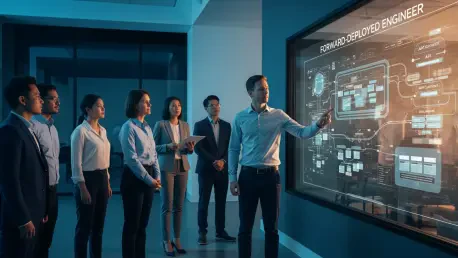
The rise of spec-driven development has catalyzed the emergence of the Forward-Deployed Engineer (FDE), a role that places senior technical experts directly within business units or client-facing teams. Unlike traditional back-end developers who might only see a requirement after it has passed through several layers of management, the FDE is present during the initial discovery phase to translate business needs into technical specifications. This proximity to the end-user or stakeholder reduces the “lost in translation” errors that frequently plague software projects, as the engineer can identify technical constraints and opportunities in real-time. By embedding technical expertise at the point of origin for a project, organizations ensure that the specifications handed to AI agents are grounded in reality and fully aligned with the desired business outcomes. The FDE acts as a bridge, ensuring that the rapid execution capabilities of modern AI are directed toward solving the right problems from the very beginning.
Accelerating delivery in this model involves the real-time discovery of requirements, which allows for the near-instantaneous creation of specs for AI agents to execute. When an FDE sits in a meeting with a product manager or a client, they can draft the architectural parameters of a solution as the conversation unfolds, testing the feasibility of ideas against the known capabilities of the system. This immediate feedback loop eliminates the weeks of back-and-forth typical of the legacy requirements-gathering process, moving a project from concept to a functional prototype in a fraction of the time. The ability of the FDE to define clear boundaries and edge cases directly from the source ensures that the AI-generated output requires less revision and debugging. This role is becoming the linchpin of the modern software team, as it combines the high-level strategic thinking of a senior architect with the hands-on operational agility needed to direct autonomous coding tools.
4. Comparing Development Models
When evaluating different development models, it becomes clear that Agile remains best suited for large, distributed teams working on mature products that require constant, iterative refinement and heavy stakeholder involvement. In these environments, the established ceremonies of Agile provide a necessary framework for communication and alignment across multiple departments. However, for senior-led, isolated efforts where precision and speed are prioritized over frequent meetings, the spec-driven model offers a superior path forward. This model empowers highly skilled individuals to work with high autonomy, using AI to amplify their output without the friction of traditional project management overhead. While Agile focuses on the process of collaboration, spec-driven development focuses on the clarity of the instruction, making it the preferred method for projects where the technical roadmap is well-defined and the objective is rapid execution.
The future outlook for most organizations suggests a hybrid model where legacy systems continue to be managed through Agile processes, while new “greenfield” projects favor spec-driven methods. Greenfield projects are particularly well-suited for this shift because they lack the baggage of existing technical debt and allow teams to establish modern documentation standards from day one. In these cases, the speed of AI-driven construction can be fully realized without the constraints of fitting into an older, slower release cycle. Conversely, maintaining complex legacy codebases often requires the nuanced, step-by-step approach of Agile to ensure that new machine-generated features do not inadvertently break existing functionality. This tiered approach allows companies to balance the need for stability in their core products with the need for aggressive innovation in new market segments, creating a flexible engineering organization that can adapt to the varying speeds of technology.
5. Strategic Steps for Implementation
Implementing a spec-driven approach begins with identifying areas of high uncertainty within the current development pipeline where vague requirements have previously led to significant rework. Engineering leaders should review past project failures to determine if the root cause was a lack of technical clarity or an inability to communicate business needs effectively. These identified “friction points” serve as the ideal locations for a pilot program, where a team can experiment with a spec-first methodology using a restricted set of AI tools. By starting small, organizations can refine their documentation standards and internalize the shift in mindset required to move from writing code to writing instructions. This phase is critical for establishing trust in the AI’s output and for demonstrating the efficiency gains that are possible when the human-machine collaboration is properly structured.
Another vital step in this transition is safeguarding the schedules of top talent to ensure they have the mental bandwidth to focus on high-level planning and architecture. Senior engineers are often pulled into routine maintenance and “firefighting” tasks that prevent them from dedicating the time necessary to craft high-quality specifications. By automating routine tasks and offloading maintenance to AI agents, leadership can reclaim this time, allowing their most experienced staff to act as the primary architects of the new spec-driven workflow. This also involves integrating rigorous verification into the final completion standards, where testing protocols are strengthened to ensure that the AI-generated code aligns perfectly with the initial specification. Finally, stakeholders must be informed that while the planning phase of a project may take longer than they are accustomed to, the actual build phase will be significantly faster, leading to an overall reduction in the total time-to-market.
6. The Evolution of Technical Quality Standards
Success in the modern era of software engineering was not determined by the number of AI tools a company integrated into its stack, but rather by how effectively its teams clarified their thinking before the coding process began. The industry transitioned from a focus on sheer developer headcount and sprint velocity to a model that rewarded high-quality specifications and senior-led oversight. Organizations that achieved the highest ROI on their AI investments were those that recognized the specification itself as the most valuable intellectual property, serving as a blueprint that could be executed across multiple tech stacks or platforms. This shift necessitated a reevaluation of the developer career path, where junior roles were increasingly focused on verification and testing, while senior roles required a mastery of logical modeling and systems architecture. The focus moved away from the “how” of writing syntax to the “what” and “why” of the underlying business objectives.
The teams that thrived were those that realized that the machine was only as effective as the instructions it received, leading to a renaissance in technical writing and architectural design. Strategic leaders positioned their engineers as orchestrators of complex systems, providing them with the authority to veto projects that lacked sufficient clarity or technical foundation. By the end of this transition, the definition of a high-performing engineering department had changed, emphasizing the creation of robust, self-documenting systems that were resilient to change. Actionable steps taken by these successful firms included the formalization of “Spec Reviews” as a core engineering discipline and the implementation of automated guardrails to prevent AI from deviating from established architectural patterns. These shifts created a more predictable and scalable development environment, where the human element focused on creativity and problem-solving while the mechanical element handled the labor-intensive tasks of implementation.