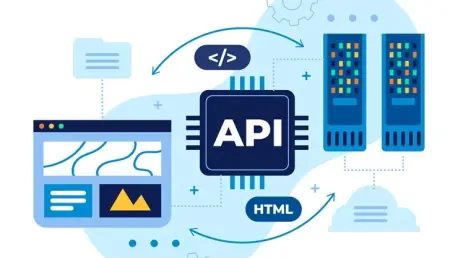

The quiet hum of servers powering artificial intelligence agents across global enterprises conceals a fierce, foundational conflict over the very resource that gives them life: real-time data. With an overwhelming majority of companies—nearly 80%—now deploying AI, the question of how to fuel its insatiable appetite for information has ignited a high-stakes debate. This dilemma pits the wild, untamed frontier of web scraping against the orderly, structured world of Application Programming Interfaces (APIs), forcing developers to navigate a complex landscape of agility, stability, cost, and legal risk.
This is not merely a technical squabble for engineers to resolve. The choice between scraping and integrating determines an AI agent’s reliability, its legal standing, and ultimately, its ability to deliver tangible business value. A recent Tray.ai study reveals that over 42% of enterprises need to connect their agents to eight or more data sources, highlighting the scale of this challenge. As AI moves from a predictive tool to an autonomous actor, the data it consumes is no longer just for analysis; it is the basis for action. The emerging consensus from industry leaders suggests that the future belongs not to a single victor, but to a pragmatic hybrid approach that strategically blends both methods to build AI systems that are both intelligent and trustworthy.
Why Today’s Data Is the Only Fuel for Tomorrow’s AI
The fundamental limitation of early-generation AI agents was that their knowledge was frozen at their last training time, rendering them functionally obsolete the moment they were deployed. Or Lenchner, CEO of Bright Data, captured this constraint perfectly: “Agents without live external data…can’t reason about today’s prices, inventory, policies, research, or breaking events.” For an AI to be more than a sophisticated search engine for a static database, it requires a constant, dynamic stream of information from the world it operates in. This necessity has transformed the role of external data from a supplementary asset into the very lifeblood of modern AI.
This shift toward real-time data consumption is what unlocks the most valuable and autonomous functions that businesses demand. In financial services, for instance, an AI agent can approve a loan not by referencing month-old credit reports but by performing instantaneous credit verification against live financial data. In logistics, an agent can dynamically reroute a delivery fleet based on current traffic conditions and warehouse capacity, a task impossible with static information. The same principle applies across sectors, from compliance agents verifying documents against the latest regulatory updates to marketing bots tailoring campaigns based on live social media sentiment. It is no longer about giving agents more data, but as Neeraj Abhyankar, VP at R Systems, stated, “about giving them the right data at the right time to provide the best possible outcomes.”
The Allure of the Open Web a Scraper’s Double-Edged Sword
For developers needing immediate access to the vast, unstructured information of the public web, web scraping presents an almost irresistible solution. Using automated tools like Playwright or Puppeteer that mimic human browsing, developers can extract data directly from a website’s code, bypassing the need for formal partnerships or costly subscriptions. This method grants unparalleled agility and independence, allowing an AI agent to tap into the “long tail of the public web” for everything from competitor pricing to breaking news. In many scenarios where an official API is nonexistent or prohibitively expensive, scraping becomes the only viable path forward. Gaurav Pathak of Informatica observed that as platforms increasingly lock data behind pricey APIs, “scraping allows alternate paths.”
However, this path is built on an unstable foundation. Deepak Singh, CEO of AvairAI, offered a stark warning: “Betting your operations on scraping is like building your house on someone else’s land without permission.” Scrapers are notoriously fragile; a simple website redesign can break them without warning, instantly cutting off the AI’s data supply. Furthermore, the extracted data is often messy and unstructured, requiring significant engineering effort to clean and validate, a process that Keith Pijanowski of MinIO described as “inexact.” Beyond the technical hurdles lies a significant legal and ethical minefield. Scraping can violate a website’s terms of service, exposing the company to liability. As Krishna Subramanian of Komprise noted, “Enterprises are hesitant to use AI produced via scraping because of the liability they could end up inheriting.” This combination of instability and risk confines scraping to non-critical applications like prototyping, market research, or internal tools where failure is an acceptable outcome.
The Enterprise Contract Finding Certainty with APIs
In stark contrast to the precarious nature of scraping, official API integrations offer a bastion of stability, structure, and certainty. An API is a formal contract between a data provider and a consumer, delivering clean, structured, and predictable data through a purpose-built channel. This eliminates much of the guesswork and preprocessing required with scraped data, providing a reliable stream of information that enterprises can build mission-critical operations upon. Backed by Service-Level Agreements (SLAs) and clear versioning, APIs minimize the risk of unexpected breakages and provide a foundation of trust essential for regulated industries like finance and healthcare, where data traceability and auditability are non-negotiable.
This reliability, however, comes at a price—both literal and figurative. Premium data accessed via APIs can be exceptionally expensive, and providers can enact sudden, steep price hikes that disrupt budgets and development roadmaps, as was seen with platforms like X and Google Maps. Access itself can be a significant hurdle, sometimes requiring months of negotiations and technical onboarding, with no guarantee that access will not be revoked at the provider’s discretion. Moreover, APIs do not always expose the full breadth of data publicly visible on a website, creating information gaps that can limit an AI agent’s capabilities. These limitations make APIs the undisputed choice for core business functions and transactional workflows, but they also highlight why they cannot be the sole solution in a comprehensive data strategy.
Beyond the Binary Crafting a Hybrid Data Blueprint
The complex and varied demands of modern AI agents render the “either/or” debate between scraping and APIs obsolete. A one-size-fits-all approach is no longer feasible. The most forward-thinking organizations are now moving toward a sophisticated hybrid data strategy that leverages the strengths of both methods in a complementary fashion. This model establishes a clear hierarchy: official APIs form the core, trustworthy foundation for any action that carries significant business or compliance risk, while web scraping serves as a “tag-along enhancement,” providing supplementary, contextual public data where the cost of an error is low.
Implementing this strategy requires developing intelligent “agentic layers” that can dynamically switch between data sources based on the task at hand. For example, an e-commerce agent might use a trusted internal API to process a customer’s payment but rely on scraped data from competitor websites to inform its dynamic pricing algorithm. The ultimate decision-making framework boils down to a single question: What is the cost of an error? As AvairAI’s Singh advised, “If errors could cost money, reputation, or compliance, use official channels. If you’re enhancing decisions with supplementary data, scraping might suffice.” This risk-based approach ensures that the data acquisition strategy is perfectly aligned with the organization’s governance, auditing, and business objectives.
The journey toward truly autonomous and reliable AI was always going to be paved with complex data challenges. By moving past the simplistic dichotomy of scraping versus APIs, organizations adopted a more nuanced and pragmatic hybrid model. This strategic fusion allowed them to build AI agents that were not only powerful and intelligent but also resilient, compliant, and fundamentally trustworthy. The decision was no longer about choosing a weapon but about building a versatile and adaptable arsenal, ensuring that AI could be safely and effectively integrated into the core of the modern enterprise.