
The traditional software development lifecycle has long been plagued by a fundamental disconnect where creative visions and technical realities collide at the point of delivery. For decades, the industry accepted a fragmented workflow where designers finalized high-fidelity mockups in isolated environments before tossing them over a metaphorical wall to engineering teams. This transition point, commonly known as the handoff, functioned as a bottleneck that introduced significant latency and often resulted in a degraded user experience as subtle nuances were lost in translation. However, the current technological landscape has undergone a radical transformation as Artificial Intelligence begins to dissolve these traditional professional boundaries. By integrating design constraints directly into the development environment, AI is effectively collapsing the silos that once separated these disciplines. The manual translation of pixels into code is rapidly becoming a relic of a less efficient era, replaced by a seamless continuum where intent and implementation exist as two sides of the same coin. This shift represents more than just a tool upgrade; it is a fundamental reconfiguration of how digital products are conceived and brought to life in a world that demands instant iteration and flawless execution.
The Structural Roots of Workflow Friction
The divide between design and engineering is often characterized by a persistent wall where essential creative nuances are lost during the technical implementation phase. While designers might spend weeks perfecting a prototype that features complex animations and intricate layout logic, the final product often reverts to standard, off-the-shelf components because the technical cost of custom implementation is perceived as too high for the current development sprint. This friction arises primarily because both teams operate within different conceptual frameworks and specialized toolsets, turning the handoff into a flawed attempt to translate a purely visual medium into a functional, logic-based one. When a developer receives a static file or a semi-interactive prototype, they are frequently left to guess at the underlying logic of responsive behaviors or state transitions, leading to a cycle of endless feedback loops and revisions that drain resources and kill momentum.
Much of this struggle is rooted in legacy organizational structures that separate talent into specialized departments with inherently conflicting performance metrics. Designers are typically evaluated on aesthetic quality, user experience innovation, and brand alignment, while developers are rewarded for speed of delivery, system stability, and adherence to technical deadlines. Without a single entity holding both teams accountable for the final synergy of the product, the resulting output inevitably reflects the gap between these misaligned goals rather than a cohesive, unified vision. This systemic separation has historically forced a compromise where the user ultimately pays the price through inconsistent interfaces or buggy interactions. In the current environment, companies are realizing that maintaining these silos is no longer economically viable, especially as the speed of product cycles accelerates between 2026 and 2028, necessitating a more integrated approach to digital creation.
The Paradox of Control and Responsibility
A core challenge in the traditional professional relationship between creators and builders is the accountability-versus-control problem, which creates a significant vacuum in product ownership. Designers are frequently held responsible for the overall user experience and the emotional impact of a product, yet they often have zero control over the final production code that actually reaches the end user. Conversely, software engineers hold total control over the production environment and the deployment pipeline but are rarely held accountable if the final user experience fails to match the original artistic intent or usability standards. This separation of powers leads to a phenomenon known as designing fiction, where creative work is produced in a vacuum without a realistic understanding of the technical constraints or the effort required to build specific features, leading to frustration on both sides of the aisle.
This lack of shared reality means that the most innovative design ideas are often the first to be cut when technical hurdles arise during the build phase. When a designer lacks visibility into the codebase, they cannot easily determine if a specific layout choice will cause a massive performance hit or require a complete refactor of the existing architecture. Engineers, focused on the logical integrity of the system, may overlook visual details that are critical to the user’s trust and engagement. AI-driven tools are now stepping into this gap by providing real-time feedback to designers about the technical feasibility of their choices while simultaneously giving developers the context they need to respect design integrity. By grounding both roles in a single technical reality, organizations can eliminate the guesswork and ensure that what is designed is exactly what gets built, removing the friction of mismatched expectations.
From Manual Translation to Automated Integration
Early attempts to resolve the handoff problem focused on intermediary tools that allowed for the sharing of specifications, but the real breakthrough arrived with the widespread adoption of design tokens. These tokens act as shared variables for styles such as colors, typography, and spacing, ensuring that design choices are instantly synchronized across both design tools and production codebases. By establishing this common language, organizations have been able to significantly reduce visual discrepancies and ensure that any person making a design choice is immediately aware of its technical consequences. This was the first major step toward a unified source of truth, but it still required manual oversight to ensure that the tokens were implemented correctly across different platforms and frameworks.
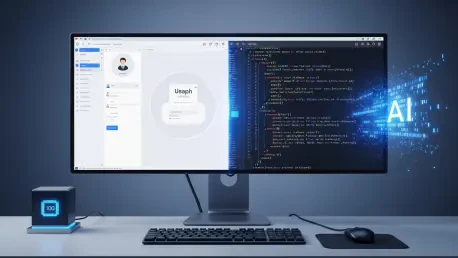
The rise of advanced Artificial Intelligence represents the most significant shift yet, as modern systems can now interpret complex design files or natural-language prompts to generate functional, production-ready code instantly. This technology automates the repetitive and error-prone parts of interface generation, such as writing CSS or setting up component structures, allowing teams to focus on high-level architectural decision-making and genuine user needs. AI effectively acts as a bridge that can read a designer’s intent from a canvas and translate it into clean, optimized React or Swift components without the need for a developer to manually inspect every pixel. This transformation forces a sharpening of expertise, as designers must become more systematic in their thinking and developers must evolve into curators of AI-generated implementations rather than manual keyboard-to-code translators.
Redefining Roles in the AI-Powered Era
Newer development platforms are taking this integration even further by embedding design systems directly into the continuous delivery pipeline. Instead of treating design as a separate upstream phase that ends before development begins, these modern systems use autonomous AI agents to generate and review applications while strictly adhering to pre-set architectural and aesthetic guardrails. This integration ensures that the original design intent is preserved throughout the entire software lifecycle without ever needing a formal, distinct transition point between different teams. The pipeline itself becomes the arbiter of quality, flagging any deviations from the design system before they can ever reach the production stage, which dramatically reduces the need for manual QA and visual regression testing.
Ultimately, the era of pervasive intelligence is blurring the lines between the traditional roles of designers and developers, shifting the professional focus toward shared accountability for the final output. As the economic cost of maintaining professional silos becomes too high for competitive businesses to ignore, the most successful teams will be those that embrace a hybrid identity where design and engineering are viewed as a single, fluid process. This transformation ensures that software is built faster and more consistently, reflecting a unified effort rather than a series of begrudging compromises between two different departments. As this trend continues to evolve through 2027, the concept of a handoff will likely vanish entirely, replaced by a collaborative environment where products are grown organically from a shared set of intelligent constraints and goals.
Strategic Implementation for Integrated Workflows
To navigate this transition effectively, forward-thinking organizations moved beyond traditional software silos by prioritizing the adoption of unified development environments that supported real-time synchronization. They recognized that the most significant barrier to efficiency was not a lack of talent, but the persistence of fragmented tools that forced professionals to work in isolation. By investing in platforms that treated design assets as live code components, these companies successfully eliminated the need for manual specification documents and lengthy handoff meetings. Leaders in the field shifted their hiring criteria to favor individuals who possessed a cross-disciplinary understanding of both user-centric logic and technical architecture, ensuring that every team member could contribute to the single source of truth.
The most successful implementations involved the deployment of AI-driven auditing systems that monitored the gap between visual prototypes and deployed code in real-time. These organizations established rigorous design systems that served as the foundational logic for their AI agents, allowing the technology to make autonomous decisions about layout and styling while remaining within the brand’s established guidelines. They also restructured their incentive programs to reward collective product outcomes rather than individual departmental milestones, which encouraged designers and developers to collaborate more closely on performance and accessibility. By treating the transition from concept to code as an automated pipeline rather than a manual exchange, these teams achieved a level of agility that allowed them to respond to market shifts with unprecedented speed and precision.