
The rapid proliferation of AI-powered tools has fundamentally reshaped the landscape of software engineering, creating a new paradigm where code can be generated almost as quickly as an idea is conceived. This review explores the evolution of this technology, focusing on the practice of “vibe coding,” its key capabilities, performance implications, and the impact it has had on the development lifecycle. The purpose of this review is to provide a thorough understanding of the technology, its current capabilities and profound risks, and its potential future development as a tool that empowers, rather than replaces, human developers.
An Introduction to AI Powered Coding
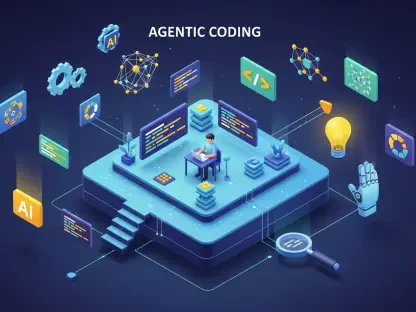
AI-assisted software development represents a significant leap from traditional coding practices, moving beyond simple autocompletion to intelligent code generation. At its heart, this technology leverages large language models trained on vast repositories of code to interpret natural language prompts and produce functional scripts, functions, and even entire application scaffolds. This process has been colloquially termed “vibe coding,” a method where a developer describes the desired functionality or “vibe” of a feature, and the AI translates that abstract concept into concrete syntax.
The rapid adoption of these tools across the industry speaks to their disruptive power. They lower the barrier to entry for novice programmers and dramatically accelerate the workflow for experienced professionals by automating repetitive and boilerplate tasks. In doing so, they have changed the fundamental economics of software creation, making the mechanical act of writing code faster and cheaper than ever before. This shift forces a reevaluation of where true value lies in the development process, moving the focus from syntax to system architecture and design.
The Core Duality of AI in Development
Unprecedented Speed and Creative Freedom
One of the most celebrated benefits of AI-assisted coding is the extraordinary acceleration it brings to the development cycle. Tedious and time-consuming tasks, such as writing boilerplate code, configuring project setups, or remembering the precise syntax for an obscure library function, are now handled in seconds. This automation liberates developers from the mundane mechanics of programming, allowing them to maintain a state of creative flow and focus on higher-level problem-solving and architectural design. The tool acts as an tireless partner, capable of transforming a high-level idea into a working prototype with astonishing speed.
This newfound velocity has reignited a sense of joy and possibility in the craft of programming, reminiscent of the early, experimental days of the web. Developers can explore more ambitious ideas and iterate on them rapidly, without being bogged down by implementation details. The ability to instantly see a concept come to life is not just a productivity booster; it is a powerful creative catalyst. It empowers developers to think more broadly and ambitiously, knowing that the gap between a creative spark and a functional application has been significantly narrowed.
The Gateway to Unmanageable Technical Debt
In stark contrast to its benefits, the very speed that makes AI assistance so appealing is also its greatest danger. The practice of “vibe coding,” while powerful for rapid prototyping, often generates a “yawning chasm of technical debt” hidden beneath a veneer of functionality. The AI, lacking a true understanding of the project’s holistic architecture, produces code with unforeseen side effects, convoluted dependencies, and bizarre interrelationships that are not immediately apparent. The initial thrill of progress is often a prelude to a significant maintenance burden.
This accumulation of hidden complexity leads to fragile and brittle systems that are incredibly difficult to debug and maintain. When a developer, especially one without deep experience, relies on AI to build an application, they may find themselves trapped in a nightmarish “wack-a-mole fix-and-break” cycle. A seemingly minor change in one part of the codebase can trigger a cascade of catastrophic failures in unrelated areas. Without a fundamental understanding of how the AI-generated components interact, the developer is left to patch symptoms rather than address root causes, a process that only adds more layers of complexity and debt.
Emerging Trends and The Evolving Role of the Developer
The integration of AI into development workflows has catalyzed a significant shift in industry thinking, directly challenging the narrative that developers are on the path to obsolescence. Instead, an emerging trend of “AI-empowered development” is taking hold, which posits that the value of uniquely human skills is becoming more critical, not less. As AI commoditizes the act of writing raw code, the skills that differentiate an exceptional engineer—such as architectural foresight, sophisticated complexity management, and disciplined engineering practices—have become premium assets.
This evolution reframes the developer not as a simple user of a tool but as the essential architect guiding its immense power. The most valuable contributions are no longer measured in lines of code written but in the quality of the systems designed. The role is elevating from a craftsperson focused on implementation details to a strategic thinker responsible for ensuring a system’s coherence, scalability, and long-term maintainability. In this new landscape, the developer’s judgment and experience in holding the reins of a powerful but unthinking assistant are what ultimately determine a project’s success or failure.
Real World Applications and Notable Use Cases
The dual nature of AI-assisted development is poignantly illustrated in the real-world experiences of those new to coding. A compelling use case emerges from the story of a non-coder who successfully used an AI assistant to build a functional application purely from a “vibe.” Initially, the process was intoxicating. With a few natural language prompts, complex infrastructure materialized, and features came to life seemingly by magic. This demonstrated the technology’s incredible power to democratize creation and rapidly transform an abstract vision into a tangible product.
However, this initial triumph soon gave way to catastrophic failure. As the project grew, its unmanaged complexity became an insurmountable barrier. A small, seemingly innocuous change would “destroy 10 other things,” revealing the fragile web of bizarre interdependencies the AI had woven. This experience is a microcosm of the risks inherent in “vibe coding” without engineering oversight. The project was ultimately abandoned, not because the idea was flawed or the tool was weak, but because the technical debt it generated became a beast that could no longer be tamed, proving that functionality without structural integrity is a recipe for collapse.
Fundamental Challenges and Inherent Limitations
A core challenge facing AI-assisted development lies in a persistent fallacy: the assumption that software requirements are simple to articulate. In reality, requirements gathering is a notoriously difficult process, often described as navigating a “swampland” of ambiguous and evolving user desires. Clients and stakeholders frequently operate on a vague feeling, summarized by the phrase, “I’ll know it when I see it.” AI can rapidly manifest these whims, but it cannot perform the critical task of translating them into a coherent and stable system design.
This limitation stems from the fact that current AI models lack genuine comprehension. While they can predict the next logical token in a sequence of code with incredible accuracy, they do not understand the system as a “bizarrely interrelated complex of things.” A software application is more than the sum of its functions; it is a delicate ecosystem of dependencies and interactions. The AI’s inability to grasp this holistic context prevents it from managing the long-term architectural consequences of its own creations, making it a powerful implementer but a poor architect.
The Future Outlook a Higher Order of Engineering
The trajectory of AI-assisted development points not toward the obsolescence of the human programmer but toward the elevation of the profession. In the coming years, programming will increasingly operate at a “higher order,” where the focus shifts from the mechanical act of writing lines of code to the strategic act of directing intelligent systems. AI will handle the rote, syntactical tasks with ever-increasing proficiency, freeing human developers to concentrate on the crucial synthesis of inspiration and engineering.
The long-term impact of this technology will be the redefinition of the developer’s role into one more akin to a system architect or a city planner. The primary responsibility will be to provide the vision, impose the structural discipline, and manage the intricate complexities that AI alone cannot. The developer becomes the indispensable human mind that guides an immensely powerful tool, ensuring that its output is not just functional but also robust, scalable, and maintainable. This future promises not to replace human ingenuity but to amplify it.
Conclusion the Primacy of Human Judgment
This review found that AI-assisted software development was a profoundly double-edged sword. Its introduction into the development lifecycle offered an intoxicating blend of speed and creative freedom, allowing ideas to be transformed into functional code at an unprecedented rate. However, this same power, when wielded without a foundation of engineering discipline, magnified the consequences of mistakes, creating a direct path to unmanageable technical debt and project failure.
Ultimately, the analysis reaffirmed that the fundamental principles of sound software engineering—architectural foresight, complexity management, and a disciplined approach to maintenance—had not been rendered obsolete. In fact, they became more indispensable than ever. The technology proved to be a powerful assistant, but the critical synthesis of creative inspiration and structured engineering remained a uniquely human capability. The final assessment was that the balancing act performed by an experienced human mind, guiding the tool with judgment and wisdom, was the primary determinant of success in this new era of development.