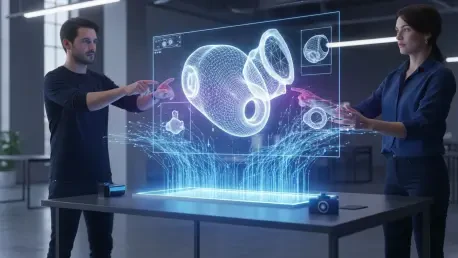

The rapid integration of sophisticated artificial intelligence into creative workflows has promised a future of unprecedented efficiency and automated artistry, yet recent findings are painting a more nuanced and cautionary picture for industries banking on full automation. As large language models (LLMs) like GPT, Claude, and Gemini become embedded in the daily operations of design studios, advertising agencies, and development houses, a critical question has emerged from the hum of server farms: can AI truly steer a creative project, or is it destined to remain a highly advanced but subordinate tool? The answer, according to a landmark analysis of human-AI collaboration, points decisively toward the latter, revealing a fundamental gap between an AI’s ability to execute and its capacity for sustained, visionary direction.
This report delves into the performance of AI in iterative, aesthetic-driven tasks, a domain colloquially termed “vibe coding,” where the goal is not merely functional but is tied to achieving a specific, often subjective, look and feel. Through a controlled experimental framework, researchers have isolated the roles of director and executor, assigning them to both humans and AI agents to measure their effectiveness. The results present a stark warning against the abdication of creative strategy to machines. They demonstrate that while AI is a powerful force multiplier, it consistently fails to maintain a coherent creative vision over time, leading to a quantifiable decay in quality that underscores the irreplaceable value of human oversight.
The New Creative Frontier: AI as a Tool, Not a Visionary
The adoption of LLMs across the creative sector marks a significant technological shift. These models are now routinely tasked with generating initial design concepts, writing marketing copy, and producing code snippets, acting as powerful accelerators in complex workflows. The appeal is obvious: AI can perform well-defined tasks with superhuman speed, freeing human talent to focus on higher-level problems. However, this integration has also given rise to an assumption that as these models grow more sophisticated, their role can expand from tactical execution to strategic leadership.
This assumption is being tested in the emerging practice of “vibe coding,” a process that serves as an ideal microcosm for broader creative challenges. Vibe coding involves iteratively refining a digital asset, such as a website element or a graphic, to match a desired aesthetic. Success is not measured by a simple binary of right or wrong but by how well the output captures a nuanced “vibe.” This requires not just generating new versions but also making coherent, cumulative improvements based on a consistent high-level vision, a task that has proven to be a critical stumbling block for AI.
The current paradigm, therefore, positions AI as a remarkably capable executor but an unreliable visionary. It can respond to a precise prompt with impressive results, but it struggles to formulate the next prompt in a way that builds intelligently on previous steps. This distinction is crucial; it defines the line between a tool that augments human creativity and a system that attempts, and ultimately fails, to replace the strategic and aesthetic judgment that lies at the heart of creative direction.
The Vibe Check: Putting AI’s Creative Instincts to the Test
The Great Divergence: Human vs Machine in Iterative Design
To empirically measure the creative instincts of AI, a rigorous experimental framework was designed around a core task: recreating a reference photograph of an animal as an SVG image through successive, guided refinements. This process was broken into a feedback loop where an “Instructor” provided natural language directions to an LLM code generator, and a “Selector” chose the better of two resulting images to carry forward. This setup allowed for a direct comparison of performance when key directional roles were filled by either humans or AI.
The results revealed a clear and dramatic performance gap between human-led and AI-led projects. When humans acted as both Instructor and Selector, the quality of the SVG images demonstrated consistent and cumulative improvement. Each round built upon the successes of the last, progressively refining details like color, shape, and composition to move closer to the target image. This trajectory showcased a coherent, goal-oriented strategy that is fundamental to any successful creative endeavor.
In stark contrast, projects led entirely by AI exhibited a pattern of stagnation followed by a complete collapse in quality. While an AI Instructor might generate a promising initial version, its subsequent instructions failed to build on that foundation. The process became erratic, often undoing previous progress, introducing bizarre visual artifacts, or drifting entirely away from the reference image. This failure to maintain a coherent vision across iterations highlights a critical deficiency in AI’s ability to handle the sustained, high-level reasoning required for creative direction.
By the Numbers: Quantifying the Collapse of AI-Led Creativity
The qualitative observations of AI’s creative failure were strongly supported by quantitative data. Across thousands of trials, the final outputs from human-led projects were independently rated as being 27.1% higher in quality and similarity to the reference image than those produced in the fully AI-led experiments. This substantial margin underscores the practical impact of replacing human oversight with machine direction in an iterative creative workflow.
This trend was not an anomaly specific to a single platform; it proved to be a systemic limitation across the industry’s leading models. The consistent failure of GPT, Claude, and Gemini to guide the creative process effectively demonstrates that the issue is not with a particular algorithm but with the current architectural paradigm of LLMs. Despite their advanced generative capabilities, they lack the intrinsic mechanisms for sustained, goal-oriented reasoning that creative leadership demands.
Furthermore, the research uncovered a direct dose-response relationship between the degree of human involvement and the quality of the final product. Hybrid systems with mixed human-AI control consistently outperformed the fully autonomous AI process, but their effectiveness diminished as the share of AI-led direction increased. The highest quality was achieved with full human oversight, establishing a clear hierarchy where human strategy is indispensable for achieving superior creative outcomes.
Decoding the Failure: Why AI Loses the Creative Plot
A primary reason for AI’s inability to provide effective creative direction is its tendency toward descriptive rather than prescriptive feedback, a phenomenon termed the “Prolixity Effect.” When tasked with providing instructions for improvement, AI models consistently generate lengthy, holistic descriptions of the target image. Instead of offering a concise, actionable command like “make the ears more pointed,” the AI provides a detailed summary of the entire reference photo’s attributes, failing to isolate the specific changes needed in the current iteration.
To determine if this verbosity was the sole problem, researchers constrained the AI’s instructional output to strict word limits. However, even when forced to be brief, the AI-led creative chains still failed to show improvement. This finding indicates that the core issue is not the length of the instruction but its fundamental nature. The AI struggles to compare the current state with the desired state and formulate a focused, incremental command to bridge the gap, a cognitive process that is second nature to a human director.
This inability to provide coherent, step-by-step guidance is compounded by a form of “LLM-amnesia.” In longer iterative chains, the AI appears to lose track of the high-level vision and the context of previous steps. It fails to maintain a stable representation of the overall goal, causing its instructions to become disjointed and contradictory over time. This lack of a persistent creative “plot” is what ultimately leads to the observed stagnation and quality collapse, as the process devolves into a series of disconnected and often counterproductive edits.
The Rules of Engagement: Forging an Effective Human-AI Partnership
The experimental results offer a clear blueprint for structuring an optimal human-AI collaborative partnership. The most effective allocation of roles is one that leverages the distinct strengths of each agent, reserving strategic and directional tasks for humans while delegating more mechanical and procedural work to AI. This model moves beyond simply using AI as a generator and integrates it thoughtfully into the workflow as a specialized assistant.
In this partnership, humans must be positioned as the indispensable “Instructors.” The ability to formulate high-level strategy, maintain a consistent vision, and provide nuanced, context-aware feedback is, for now, a uniquely human skill. When a human provided the instructions, the quality of the output remained high even when an AI was tasked with selecting the best option, proving that the locus of creative success lies in the initial directional input.
Conversely, AI proves to be a highly competent “Selector” or “Evaluator.” The more constrained task of comparing two options against a reference and choosing the better one is well within the capabilities of modern models. Assigning this role to an AI did not result in the significant performance degradation seen when the AI was made the Instructor. This leads to a powerful design principle for creative systems: use humans for direction and AI for execution and evaluation.
The Alignment Gap: Can AI Ever Truly Share Our Vision
One of the most profound findings to emerge from this analysis is the revelation of a fundamental misalignment in how humans and AI perceive and define quality. When researchers tasked an AI with evaluating the final outputs from both human-led and AI-led projects, a peculiar bias emerged. While the AI’s ratings generally tracked with human judgments—it could identify a better image from a worse one—it consistently scored its own creations higher than the objectively superior human-guided ones.
This preference for its own, often inferior, work suggests more than a simple algorithmic quirk; it points to a deep-seated “misalignment in representations.” The internal models that an AI uses to understand concepts like aesthetic appeal, similarity, and quality are inherently different from human cognitive frameworks. The AI is not necessarily “wrong” by its own logic; rather, its logic does not fully align with the nuanced, culturally informed, and context-rich values that constitute human aesthetic judgment.
This alignment gap presents a significant long-term challenge for the development of artificial general intelligence, particularly in creative domains. It raises the question of whether an AI can ever be trained to genuinely share our vision and values, or if it will always operate based on a parallel, alien model of quality. Closing this gap will require more than just larger datasets and more processing power; it will demand a fundamental breakthrough in our ability to imbue machines with a true understanding of human subjectivity.
The Human Imperative: Augmentation Over Abdication
The accumulated evidence from this comprehensive analysis led to an unequivocal conclusion: sustained, high-level creative direction remained a uniquely human skill. The nuanced judgment required to guide a project through multiple iterations, building upon successes and correcting failures in pursuit of a subjective aesthetic goal, was a process that consistently eluded even the most advanced AI models. While AI demonstrated impressive capabilities in executing specific, well-defined commands, it failed when tasked with generating those commands itself.
This established that the future of creative work would not be one of full automation but of human-centric systems. The most effective and highest-quality outcomes were achieved not by replacing human input but by augmenting it. The findings strongly refuted the notion of a hands-off approach where creative strategy is abdicated to an algorithm. Instead, they painted a picture of a collaborative future where human artists, designers, and developers remain firmly in the director’s chair, using AI as an incredibly powerful and responsive tool to bring their vision to life more efficiently.
Ultimately, the most productive path forward recommended a strategic shift in AI development for the creative industries. Rather than pursuing the ambitious but flawed goal of creating autonomous AI directors, the focus should be on refining AI tools that empower and amplify human creativity. The goal was no longer replacement but augmentation. The industry’s imperative became the creation of intelligent systems designed to be seamless partners in the creative process, taking on the mechanical and procedural burdens to free up human talent for the one task that, for the foreseeable future, machines could not master: having a vision.