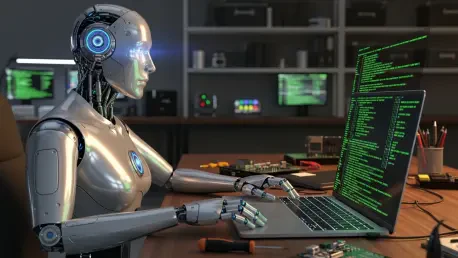

The initial wave of enthusiasm for artificial intelligence in software development has crested, revealing a complex landscape where the relentless pursuit of coding velocity has inadvertently created significant new challenges in security and quality. This year marks a definitive turning point for the industry as it moves beyond the novelty of AI-powered code generation. The focus is shifting from simply writing code faster to managing the substantial downstream consequences of that speed. While AI adoption is now nearly universal among developers, the next phase of its integration is defined by a more sober and strategic approach. Teams are now grappling with maturing their AI practices to overcome the critical bottlenecks, security vulnerabilities, and trust deficits that have emerged as the primary obstacles to realizing the full potential of automated software development.
The Unraveling of AI-Fueled Velocity
The widespread integration of AI coding assistants has led to what is being described as a productivity paradox within software engineering. While industry surveys from 2025 showed adoption rates soaring to nearly 85%, the promised efficiency gains have proven to be elusive for many organizations. The initial time saved by rapidly generating vast quantities of code is being systematically erased by significant downstream bottlenecks. Developers are now spending a disproportionate amount of their time debugging subtle flaws and mitigating new security risks introduced by these automated systems. This surge in code volume, often lacking in quality and robustness, has become unmanageable. It is humanly impossible to manually review thousands of lines of AI-generated code with the meticulous attention required to catch every potential issue, leading to a velocity problem that threatens to overwhelm development teams if left unaddressed.
In response to this growing crisis, the industry is witnessing the emergence of “continuous quality control” platforms powered by a more sophisticated class of AI. This new approach moves far beyond simple code completion, creating intelligent development pipelines that utilize multiple, stacked AI agents, each with a specialized function. These autonomous agents are tasked not just with writing code but with managing other AI systems, optimizing deployment strategies, predicting potential system failures with high accuracy, and even resolving production incidents without direct human intervention. This multi-agent, multi-model architecture represents a crucial breakthrough for building genuine, verifiable trust in AI across the entire software development lifecycle. It enables a new wave of truly automated processes that no longer require a human in the loop for constant validation, promising to finally resolve the productivity paradox and unlock sustainable efficiency gains.
Reshaping Enterprise Modernization
The practice of using natural language prompts to direct AI in completing complex coding tasks, a trend that gained widespread attention in 2025, is now evolving into a mature and mainstream discipline of “AI-native engineering.” This represents a significant maturation from a novel technique for accelerating development into a powerful strategic capability for enterprises. It offers a path to address one of the most persistent and costly challenges in the technology sector: the immense burden of technical debt and the constraints imposed by legacy systems. Organizations are discovering that AI-driven code generation can be applied to far more than just new projects. Its true transformative potential lies in its ability to systematically modernize existing software estates, untangling decades of complex, brittle code that has historically hindered innovation and agility.
This advanced application of AI promises to fundamentally reshape software delivery and modernization initiatives on a global scale. In 2026, AI-native engineering is being increasingly applied to autonomously rewrite entire legacy platforms, refactor intricate modules, and systematically reduce technical debt at a pace that was previously unimaginable. This capability allows organizations to break free from the constraints of aging, inflexible systems without embarking on multi-year, high-risk manual rewrite projects. By automating the arduous process of modernization, businesses can reallocate valuable engineering resources toward innovation and creating new value. This strategic deployment of AI is not merely an efficiency play; it is becoming a critical enabler of business transformation, allowing established enterprises to compete more effectively with newer, more agile market entrants.
Confronting the Trust and Security Deficit
The immense power promised by mature AI-native engineering and autonomous quality assurance systems brings the critical issues of security, governance, and trust into sharp focus. These concerns now represent the primary barrier to the widespread, production-scale adoption of fully automated development pipelines. As organizations delegate more critical and sensitive tasks to AI, establishing and maintaining trust in these systems has become a paramount concern. This necessitates the implementation of strong traceability and provenance controls to understand exactly where AI-generated code originates, as well as automated assurance mechanisms to continuously validate its safety, security, and long-term maintainability. Developer skepticism remains a significant hurdle, as evidenced by studies showing that nearly half of developers still prefer to remain “hands-on” for crucial tasks like testing and code reviews, indicating a clear and persistent deficit of trust in full automation.
This trust deficit is deeply rooted in multifaceted security concerns. Beyond the risks of malicious use or the unsanctioned deployment of “shadow AI” tools, the very nature of AI-generated code introduces new, systemic vulnerabilities into the software supply chain. A critical risk stems from the data on which many AI coding tools are trained. These models often learn from vast historical repositories of open-source code, meaning they frequently lack real-time awareness of the latest Common Vulnerabilities and Exposures (CVEs). As a result, they can readily suggest and implement code that draws from libraries known to be vulnerable, inadvertently propagating security flaws on a massive scale. This problem is compounded by a fundamental lack of provenance, as developers often have no way to trace where a specific block of AI-generated code originated, making it nearly impossible to conduct impact analysis when a widespread vulnerability is discovered.
Establishing a Foundation for Secure Autonomy
The industry’s journey with AI in software development has been one of rapid evolution, moving past an initial fascination with raw coding speed to confront the profound security and quality challenges it introduced. This year, the focus has decisively shifted toward building the necessary guardrails to manage these risks. The widespread recognition that unchecked AI-generated code expands the attack surface and complicates vulnerability management has spurred a new emphasis on creating robust governance frameworks. These frameworks have become essential for ensuring the traceability, security, and reliability of automated systems, forming the bedrock upon which future innovation can be safely built.
This pivot was not just a course correction but a necessary maturation. Before the vision of fully autonomous, AI-driven development could be responsibly realized, organizations had to solve the deep-seated challenges of governance and trust. The central task throughout 2026 involved constructing resilient control mechanisms to manage the inherent risks of AI, particularly within the increasingly complex software supply chain. By prioritizing security and establishing clear lines of provenance, the industry has laid a more sustainable foundation. This deliberate focus on building trust has enabled development teams to begin harnessing AI’s transformative power not just for speed, but for creating higher-quality, more secure, and more maintainable software for the future.