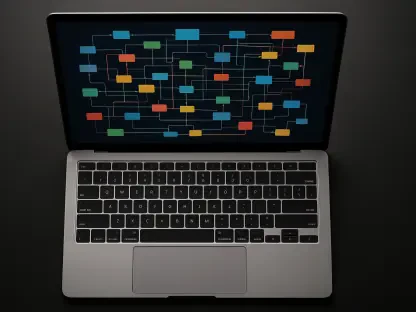

Traditional software development has long been tethered to the rigid architecture of manual code, but the arrival of Solaris marks a radical pivot toward interfaces that exist only as a fluid stream of generated pixels. Unlike the conventional applications we have used for decades, which rely on layers of HTML, CSS, and complex logic, this new system operates by hallucinating a functional environment in real time. It treats every user interaction not as a command for a processor, but as a visual prompt that guides a generative video model to produce the next logical frame of a digital experience.
The Solaris Interface World Models represent a significant advancement in the generative AI and software engineering sectors. This review explores the evolution of the technology, its key features, performance metrics, and the impact it has had on various applications. The purpose of this review is to provide a thorough understanding of the technology, its current capabilities, and its potential development from 2026 to 2028.
Understanding Interface World Models and the Solaris Framework
This technology operates on the principle that an interface does not need an underlying structural blueprint to be functional. By utilizing a “world model” approach, Solaris internalizes the physics of digital environments, understanding how menus should drop down, how windows should minimize, and how buttons should depress under a cursor. It moves away from symbolic logic toward a neural simulation of software, where the appearance and the behavior of the system are inextricably linked through a single generative process.
This shift has emerged as a response to the increasing complexity of cross-platform development. In the broader technological landscape, Solaris provides a way to bypass the fragmented nature of operating systems. Instead of writing code that must be interpreted by different browsers or kernels, developers can now describe the “intent” of an interface, allowing the model to render a consistent, interactive experience across any hardware capable of streaming video.
Technical Architecture and Performance Benchmarks
Gen-4.5 Video Architecture and Pixel-Based Rendering
At the heart of the Solaris system lies the Gen-4.5 video architecture, which uses a diffusion-based process to generate 720p resolution interfaces. The system works through a sophisticated three-stage pipeline that begins with autoregressive generation. In this stage, the model analyzes the current frame and the user’s input to predict the subsequent visual state. This ensures that the interface remains coherent, preventing the “melting” effect often seen in earlier generative video technologies.
The significance of this architecture lies in its ability to render materials and lighting with physical realism. When a user moves a slider, the model does not just move a graphic; it calculates how light should reflect off the virtual surface and how the surrounding elements should subtly react to the motion. This creates a grounded experience that feels more organic than the clinical precision of standard vector-based graphics.
Real-Time Interaction and Latency Reduction
To make these generative environments usable, the developers implemented a distillation process that drastically reduces denoising steps, bringing latency down to under 500 milliseconds. While this is still higher than the near-instant response of local code, it represents a massive leap for video-based generation. By condensing the model’s reasoning into fewer computational steps, Solaris can maintain a fluid interaction loop that feels responsive to the human hand.
This performance is measured through conditioning data, where every mouse click or keyboard stroke is treated as a high-priority temporal prompt. Real-world usage shows that users are beginning to prefer this “soft” software for creative tasks because the interface can morph to fit the user’s workflow. For instance, if a user is editing photos, the interface might subtly prioritize color-correction tools based on the visual context of the image being processed.
Emerging Trends in Generative Software Environments
The most significant trend influencing this trajectory is the shift toward “liquid software,” where the interface is no longer a static cage for data. As we move through 2026, we see a move away from rigid templates. Consumers are increasingly expecting digital tools to be as adaptive as human conversation, leading to environments that restructure themselves based on the user’s proficiency level and specific goals.
Moreover, industry behavior is shifting as venture capital flows into “model-as-an-app” startups. These companies are not hiring traditional front-end developers; instead, they are employing latent space engineers who fine-tune world models to exhibit specific UI behaviors. This trend suggests that the future of software design will be less about drawing lines and more about defining the rules of a simulated reality.
Real-World Applications and Training Simulation
In the current landscape, the most potent application of Solaris is in the training of autonomous AI agents. By generating millions of unique, randomized interfaces, Solaris provides a “gym” where agents can learn to navigate diverse digital environments. This prevents the agents from simply memorizing the layout of a specific website and instead teaches them the general logic of how computers function.
Beyond simulation, sectors like rapid prototyping are deploying Solaris to visualize complex software concepts before a single line of code is written. A designer can prompt a fully interactive dashboard and test the user flow immediately. This implementation has drastically cut the time between the ideation phase and user testing, as the “prototype” is a functional, albeit generative, piece of software from the start.
Critical Challenges and Technical Limitations
Despite the impressive visuals, Solaris faces a significant hurdle in text fidelity. Because the model generates pixels rather than rendering fonts, text can often appear blurry or “hallucinate” into nonsensical characters over long sessions. This limitation makes the technology currently unsuitable for data-heavy applications like spreadsheets or word processors, where absolute character precision is non-negotiable.
Furthermore, the lack of an underlying Document Object Model creates a massive accessibility gap. There is no code for screen readers to interpret, making these interfaces invisible to visually impaired users. Regulatory bodies are already looking at how generative interfaces must evolve to meet standard compliance, and ongoing development is focused on creating a “metadata layer” that can describe the generated pixels to assistive technologies.
The Future of Reactive Digital Ecosystems
Looking ahead, the evolution of Solaris will likely involve the integration of more efficient neural engines that can push resolution toward 4K while dropping latency below the 100-millisecond threshold. If achieved, this will blur the line between generative media and local software to the point of indistinguishability. We are moving toward a future where every user has a personalized operating system that exists only for the duration of their session.
The long-term impact on society could be a total democratization of software creation. If the barrier to entry is no longer learning syntax but describing a functional world, the variety of digital tools will explode. We will likely see the rise of hyper-niche applications that are generated on-the-fly to solve a single problem and then discarded, fundamentally changing how we perceive the value of digital products.
Conclusion and Strategic Assessment
The assessment of the Solaris framework demonstrated that the era of hard-coded logic began to yield to the era of neural simulation. The technology proved that the rigid Document Object Model could be replaced by a hallucinated, yet functional, stream of pixels that adapted to user intent with remarkable fluidity. While text legibility and accessibility remained significant obstacles, the system showed that AI agents could navigate unfamiliar environments with a level of generalizability previously thought impossible.
The industry recognized that the primary bottleneck in software development moved from syntax errors to latent space coherence. Strategic moves by major tech entities suggested that the integration of these models into broader ecosystems would define the standard for the next generation of user interaction. Moving forward, the focus should be on bridging the gap between pixel generation and structured data to ensure that these reactive ecosystems are both inclusive and precise enough for professional deployment.