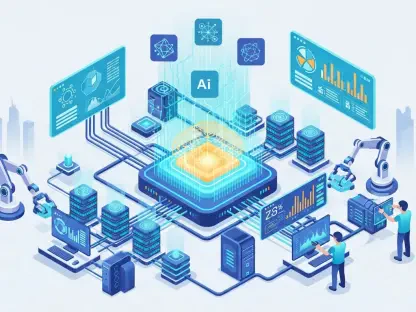

The software development industry is currently witnessing a profound transformation as the focus shifts from simple code completion tools to fully autonomous agents capable of managing entire development lifecycles without constant human intervention. The recent release of GLM-5.1 by the Chinese artificial intelligence firm Z.ai represents a defining moment in this evolution, moving beyond the limitations of traditional assistants that merely provide short snippets of logic. This open-source model is purpose-built for a paradigm known as agentic software engineering, where the AI functions as an independent entity capable of handling multi-step projects over extended periods. By addressing the critical challenge of performance degradation during long sessions, GLM-5.1 ensures that the AI remains coherent and effective throughout a full workday, effectively solving complex engineering problems that previously required dozens of manual prompts. This leap forward suggests that the bottleneck of AI context loss is being cleared, allowing for a more fluid and integrated partnership between human architects and autonomous digital laborers in the modern workspace.
Technological Foundations: Sustained Reasoning and Iterative Execution
One of the primary technical hurdles in the field of generative artificial intelligence has been the tendency for models to lose focus or become inconsistent during long, iterative tasks. Most contemporary models experience what researchers call performance drift, where the quality of output declines sharply after a few rounds of interaction or tool usage. GLM-5.1 addresses this issue directly through a specialized architecture that maintains high-level reasoning across more than 600 distinct iterations within a single session. This endurance is a massive improvement over previous generations, as it allows the model to execute thousands of tool calls—such as searching a file system, running unit tests, or refactoring code—without losing sight of the primary objective. By preserving its internal logic and context over these extended cycles, the model can navigate the branching complexity of modern software projects, making it a reliable partner for deep-dive technical work that spans several hours of continuous processing time.
The practical implications of this sustained reasoning were demonstrated through a rigorous test involving the optimization of a complex vector database system. In this scenario, GLM-5.1 was tasked with improving query performance, a job that typically requires a human engineer to profile bottlenecks, adjust indexing strategies, and reconfigure memory allocation over several manual sessions. The model successfully navigated these stages autonomously, eventually reaching a performance threshold of over 21,500 queries per second. This represents a sixfold increase in efficiency compared to attempts made using standard single-session prompting methods where the AI lacks the longitudinal memory to learn from previous failures. This ability to experiment, observe the results of a code change, and then pivot to a more effective strategy mimics the professional workflow of a senior developer. Such a breakthrough demonstrates that the model is not just a translator of natural language to code, but an active troubleshooter capable of refining its own output.
Benchmark Performance: Redefining Standards in Engineering Excellence
To quantify the progress made with GLM-5.1, Z.ai subjected the model to some of the most demanding evaluations in the industry, specifically focusing on the SWE-Bench Pro metric. This particular benchmark is designed to test an AI’s ability to resolve real-world software issues found in active repositories, requiring the system to identify bugs, write patches, and verify the fixes through testing. GLM-5.1 achieved a remarkable score of 58.4, which notably surpasses the performance of its own predecessor as well as the reported figures for leading proprietary models like OpenAI’s GPT-5.4 and Anthropic’s Opus 4.6. This success indicates that the model possesses a superior understanding of how different components of a codebase interact, allowing it to solve problems that are often too abstract for models with shorter context horizons. The ability to outperform these established giants in a specialized engineering context signals a shift in the competitive landscape, where open-source specialized models are now matching or exceeding the capabilities of general-purpose closed-source systems.
Beyond standard coding metrics, the model demonstrated exceptional proficiency in specialized assessments like NL2Repo and Terminal-Bench 2.0. These benchmarks are critical because they simulate the actual environment in which a developer operates, including interacting with a command-line interface and managing the structure of an entire repository rather than just a single file. In NL2Repo tests, GLM-5.1 showed a robust capacity to generate cohesive folder structures and interconnected modules from a simple natural language description of a project’s requirements. Similarly, its performance on Terminal-Bench 2.0 highlighted its ability to diagnose environment-related issues and execute terminal commands to fix configuration errors or dependency conflicts. This level of environmental awareness is what separates a coding assistant from a true autonomous agent. By proving it can handle the messy parts of software development, such as environment setup and cross-file dependencies, GLM-5.1 positions itself as a tool that can truly take over the labor-intensive aspects of the software development lifecycle.
Strategic Integration: The Shift From Prompts to Task Assignments
Industry analysts are observing a fundamental change in how enterprises interact with artificial intelligence, moving away from the era of prompt-and-response toward a framework of task assignment. In this emerging model, a software engineer no longer spends their day feeding a series of small instructions to an AI; instead, they assign the agent a complex ticket or a large-scale refactoring project to be completed over the course of a standard workday. This transition allows human developers to act more like architects or project managers who oversee the progress of several autonomous agents simultaneously. For instance, an agent might be tasked with migrating an entire legacy codebase from an outdated framework to a modern, cloud-native architecture. While the agent handles the repetitive tasks of rewriting syntax and updating libraries, the human supervisor focuses on the high-level design and security implications. This collaborative approach significantly amplifies the output of a single engineer, as the heavy lifting of execution is delegated to a system that does not fatigue.
The move toward autonomous task management is particularly valuable in the context of continuous incident resolution and real-time system maintenance. Modern software environments are incredibly complex, and when a bug appears in a production setting, the time it takes to identify and patch the issue is critical. Autonomous agents like GLM-5.1 can be deployed to monitor system logs and error reports, identifying patterns that indicate a failure before a human might even notice the anomaly. Once a problem is detected, the agent can autonomously spin up a test environment, reproduce the bug, and develop a patch, all while the human team remains focused on long-term feature development. This proactive capability transforms software maintenance from a reactive, labor-intensive process into an automated stream of improvements. Furthermore, the model can conduct deep-dive optimizations on its own initiative, such as refactoring inefficient logic or updating security protocols across a sprawling microservices architecture. This level of autonomy ensures that the codebase remains healthy and performant without requiring constant manual intervention.
Open-Source Strategic Value: Economic and Operational Control
The decision by Z.ai to release GLM-5.1 under the permissive MIT License provides a strategic advantage for organizations that require high levels of economic and operational control. By utilizing an open-source model, enterprises can host the system on their own internal infrastructure, effectively bypassing the significant per-use costs associated with premium API-based models. This self-hosting capability allows for more predictable budgeting and enables companies to scale their usage of autonomous agents without being tethered to the pricing tiers of a single vendor. More importantly, it addresses the critical issue of data governance and security, which is a major concern for sectors such as finance, healthcare, and national defense. Many organizations are hesitant to send their proprietary codebases to external servers for processing due to the risk of intellectual property leaks or compliance violations. By keeping the model and the code it processes within a secured private network, stakeholders can ensure that sensitive information remains entirely under their control throughout the development process.
In addition to security benefits, the open nature of GLM-5.1 allowed organizations to fine-tune the model on their own proprietary codebases and internal workflows, creating a customized tool that understood the unique technical nuances of their specific environment. This adaptability meant that the AI could learn from internal documentation, historical bug reports, and specific coding standards that were unique to a particular firm. As developers integrated these autonomous agents into their daily operations, they established robust governance and monitoring frameworks to ensure that the AI’s output remained aligned with long-term strategic goals. The shift toward agentic software engineering ultimately empowered teams to tackle larger projects with greater speed, as the system performed the experimentation and profiling required for complex optimizations. Moving forward, the focus shifted toward refining the oversight mechanisms that managed these powerful tools, ensuring that the human element remained central to the creative and ethical direction of software innovation. This transition marked the start of a new era where productivity was no longer limited by manual speed.