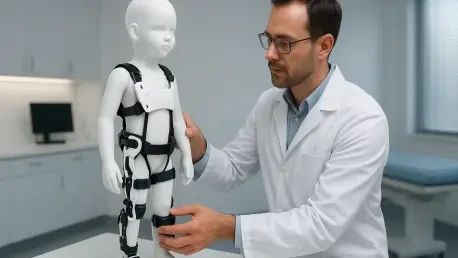

Maintaining a consistent control loop is critical for pediatric exoskeletons, where jittery movements can interfere with the gait assistance provided to children with cerebral palsy. For years, the intersection of robotics and clinical therapy has been plagued by a persistent software wall that prevents innovative designs from reaching the patients who need them most. While robotic hardware has advanced rapidly, the software required to operate these systems remains prohibitively complex for many clinical teams. Therapists, kinesiologists, and biologists often lack the extensive software engineering background required to build real-time control systems from scratch. Consequently, many promising prototypes never leave the laboratory setting. To address this fundamental gap, researchers from the National Institutes of Health Clinical Center recently developed the Biomedical Robotics Architecture for Clinical Experimentation, known as BRACE, to provide a streamlined, standardized platform for medical robotics.
A Python-Based Solution for Clinical Innovation
The Goal: Standardizing the Development Process
BRACE functions as an open-source, pure-Python software framework designed to modernize how robotic devices are managed within the clinical environment. By utilizing a foundation of established libraries such as NumPy for numerical computation, PySide6 for graphical interfaces, and pandas for data manipulation, the framework establishes a reliable infrastructure for complex experimentation. One of the primary objectives of this project is to handle the tedious underlying plumbing of robotic systems, which includes communication protocols, safety checks, and data acquisition tasks. By providing these essential services out of the box, the framework allows clinical researchers to dedicate their limited time and resources to the core scientific questions of their studies. Published under the GNU GPL-3.0 license, BRACE encourages a collaborative approach where improvements can be shared across the global research community starting in 2026.
Lowering Barriers: The Role of Accessible Programming
The strategic choice to build BRACE entirely in Python serves as a deliberate effort to bridge the widening gap between high-level academic prototyping and the rigorous demands of clinical trials. Python is celebrated for its readability and massive ecosystem, which makes it significantly more accessible to researchers who may possess basic programming skills but lack the deep technical expertise required for low-level C++ firmware development. Managing complex real-time operating systems has traditionally been a major hurdle for clinical teams, often requiring the addition of specialized software engineers to every research project. By abstracting these complexities, the framework empowers a broader range of biomedical professionals to lead robotic research initiatives. This accessibility does not come at the expense of functionality, as the framework maintains a professional-grade scaffolding that supports sophisticated medical applications while simplifying the user experience.
Structural and Operational Efficiency
The Structure: Implementing Hierarchical Robotic Control
At the core of the BRACE architecture is a three-layer hierarchical control strategy, which is widely recognized as the gold standard for rehabilitation robotics. This structured approach begins with the Supervisory Layer, which is responsible for high-level decision-making and intent recognition, such as determining if a patient intends to transition from sitting to standing. Below this, the Action Layer acts as a bridge, translating identified states into specific actuator commands, such as the exact torque needed for a robotic joint to assist a human step. Finally, the Execution Layer ensures these commands reach the hardware with extreme precision while monitoring safety limits to prevent injury. This modularity follows the Strategy pattern in software engineering, allowing researchers to test various control algorithms by simply swapping the Action Layer module without needing to overhaul the entire codebase for sensors or user interfaces.
Operational Logistics: Real-Time Communication and Control
To facilitate seamless interaction between hardware and software, BRACE employs a client-server architecture that typically links a laptop-based graphical user interface to an embedded controller like a Raspberry Pi 4B. Communication between these components is managed by an MQTT message broker using the Mosquitto implementation, which provides the soft real-time performance necessary for most rehabilitation tasks. One of the most impactful features for clinicians is the support for Remote Procedure Calls, which allows for the adjustment of robot parameters on the fly during an active trial. For example, a therapist can tune the stiffness of a virtual spring or adjust sensor sensitivity without pausing the experiment or reflashing the controller. To maintain participant safety, the system includes a supervised switching procedure that temporarily disables motor torque during mode transitions, effectively preventing the sudden movements that could cause physical distress.
Data Management and Clinical Resource Optimization
Data Infrastructure: Streamlining Analysis and Visualization
Managing the immense volume of data generated during clinical research is a significant challenge that BRACE addresses through a sophisticated and automated pipeline. Incoming data streams are classified using picklable NamedTuple datatypes, which provide a portable schema that clearly identifies what every value represents within the system. For immediate oversight, the framework utilizes a specialized AnimatedGraphManager class to display live data visualizations on the clinical workstation’s graphical interface. Once an experimental session is finished, the data is saved in the Apache Parquet format, which is highly efficient for large time-series datasets. Because the system uses NamedTuples, the saved files naturally include clear column headers, which drastically simplifies the post-hoc analysis process in common tools like Excel, Python, or MATLAB. Additionally, every remote command sent during a session is logged, allowing for high-fidelity reconstruction of the experimental sequence for future review.
Efficiency Gains: Minimizing Patient Fatigue via Simulation
Perhaps the most forward-thinking aspect of the BRACE framework is its integrated offline simulator, which directly addresses the problem of participant fatigue in clinical trials. In studies involving children with disabilities or elderly populations, the number of physical trials is often limited by the patient’s physical stamina. The BRACE simulator allows researchers to take a small amount of data collected during a brief initial session and replay it through various new control algorithms in a virtual environment. During validation tests, the research team found that this simulator could replicate real-world robotic performance with a high degree of accuracy, reaching 98.1 percent fidelity. This capability significantly reduces the need for trial and error during live sessions with patients, ensuring that the most valuable physical energy is reserved for critical testing phases. By perfecting the software in a simulated space, clinicians can arrive at the bedside with a more refined and safer tool.
Versatility Across Medical Applications
Broad Utility: From Wearable Exoskeletons to Lab Research
The adaptability of the BRACE framework has been thoroughly demonstrated through two distinct and diverse clinical applications that highlight its versatility. In the first instance, the software managed a pediatric lower-limb exoskeleton for children with cerebral palsy, maintaining a consistent 200 Hz control loop to assist with crouch gait. This application required high-stakes reliability and the ability to switch between walking and squatting modes effortlessly. In a completely different context, the framework was used in a neurobiology laboratory to control a linear actuator that applied mechanical forces to tissue for mechanosensation research. Unlike manual testing methods that are often prone to human error, this system provided a programmable and highly repeatable method for measuring stimulus thresholds in touch receptors. The fact that the same underlying framework can power both a wearable assistive device and a benchtop scientific instrument underscores its potential to unify various biomedical disciplines.
Navigating Limitations: Current and Future Technical Requirements
While BRACE offers a robust set of tools for medical research, the developers have been transparent about certain technical limitations that potential users must consider. As a soft real-time system running on standard consumer hardware, it is not optimized for ultra-high-speed robotics that require microsecond-level synchronization. Furthermore, the current implementation uses Python’s pickle module for data serialization, which poses security risks if the system is operated on an unencrypted or public network. It currently lacks the heavy-duty encryption necessary for immediate deployment in commercial medical devices. Additionally, while the framework simplifies many development tasks, it remains a professional-grade tool rather than a no-code solution. Users still require a foundational understanding of object-oriented programming to fully leverage the modular interfaces. These factors represent important considerations for researchers as they plan their transition from initial prototyping to broader clinical validation.
Strategic Implementation: The Future of Robotic Medical Research
The launch of the BRACE framework represented a fundamental shift in how robotic technology was integrated into medical environments. By offering a free and modular foundation, the system successfully lowered the technical barriers that once prevented engineering breakthroughs from reaching patient care. Moving forward, clinical departments should prioritize the training of staff in basic Python programming to maximize the utility of these open-source tools. This investment in human capital allowed for faster iteration cycles and more robust clinical trials starting in 2026. Furthermore, the community-driven nature of the project encouraged the sharing of control modules across different institutions, creating a more collaborative research ecosystem. For those looking to implement similar systems, the focus shifted toward utilizing standardized data formats like Parquet to ensure long-term data viability and cross-platform compatibility. Ultimately, BRACE provided the necessary scaffolding to transform complex laboratory prototypes into reliable diagnostic and rehabilitative tools.