
Listen to the Article
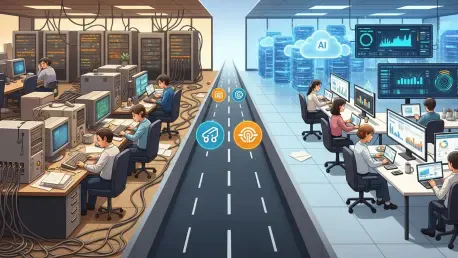
Executives do not lose sleep because a mainframe still runs. They worry because their best ideas keep hitting the same wall: brittle systems that cost more every year and slow down everything that matters. Executives do not lose sleep because a mainframe still runs. They worry because their best ideas keep hitting the same wall: brittle systems that cost more every year and slow down everything that matters.
According to research from Mechanical Orchard, maintaining legacy systems can be a costly burden, with an average of 60-80% of IT budgets allocated to keeping them running, while a 2018 Deloitte survey found that the average enterprise spends 57 percent of its IT budget on supporting business operations and only 16 percent on boosting innovation.
Legacy systems create a growth constraint, a security exposure, and an avoidable drag on valuation. The organizations that treat legacy as a board-level risk move faster, price more competitively, and capture data advantages that late movers cannot match.
Legacy systems create a growth constraint, a security exposure, and an avoidable drag on valuation. The organizations that treat legacy as a board-level risk move faster, price more competitively, and capture data advantages that late movers cannot match.
Why the Cost of Legacy Systems Is a Board-Level Topic
Legacy is not just old code. It is lock-in, slow change, and organizational friction that compound every quarter.
Disproportionate run spend: Budgets tilt toward “keeping the lights on,” which crowds out investment in new revenue streams and artificial intelligence initiatives.
Latent execution tax: Developers and business users build workarounds that mask problems while consuming headcount, cycles, and attention.
Escalating risk profile: Older stacks struggle with today’s threat surface, real-time customer expectations, and audit requirements. The risk does not stay constant; it accumulates.
What “Legacy Costs” Actually Include
Leaders often look at licenses and servers. The balance sheet tells only part of the story. The full cost spans five buckets.
Direct Information Technology Spend
Licenses and support for aging platforms that rise in price as vendor ecosystems shrink. On-premise infrastructure requiring power, cooling, patching, and eventual replacement. Vendor consulting for upgrades and bespoke fixes that keep the status quo alive. Integration maintenance for point-to-point connectors that break with minor changes.
Hidden Productivity Loss
Customer service teams are waiting for slow screens or batch updates. Finance teams are reconciling data manually because systems do not integrate cleanly. Engineers firefighting incidents instead of shipping features. Multiplied across hundreds of employees, the time cost often dwarfs the license line.
Security, Compliance, and Outage Risk
Older software was not designed for permanent internet exposure, modern identity, or supply-chain risks. Monitoring blind spots and patch backlogs drives longer detection and response windows. Each audit adds manual work because controls are not automated or evidenced by default.
Average cost of a data breach by industry:
Healthcare: $7.42 million
Finance: $5.56 million
Industrial: $5 million
Technology: $4.79 million
Hospitality: $4.73 million
Education: $3.8 million
Retail: $3.54 million
Source: IBM Cost of a Data Breach Report 2025
Vendor Lock-In and Data Captivity
Proprietary data models and interfaces make change expensive. Data export can be complex or metered. Migration looks risky, long, and costly, which encourages deferral until a crisis forces action.
Talent and Hiring Problems
Strong engineers prefer modern stacks and automated delivery. Dependency on a shrinking pool of legacy specialists increases cost and key-person risk. Retention suffers when teams spend years paying down the same debt.
How Much Does a Legacy System Really Cost?
There is no universal number, but there is a practical way to bound the problem and build a business case.
Map Direct Costs: For each application, list annual licenses, support, hosting, or hardware, and any vendor services tied to that system. Capture integration maintenance separately.
Estimate People Time: Ask engineering leaders what share of time goes to maintenance, incident response, or working around constraints. Ask business managers how many hours per week are lost to manual exports, re-entry, and checks. Convert totals to annual fully loaded cost.
Account for Incidents and Outages: Review the last 12 to 24 months for high-severity incidents tied to the system. Include hard costs such as Service Level Agreement penalties and overtime, and soft costs such as churn or reputational damage. Use conservative assumptions.
Industry Snapshots: Where Legacy Hits Hardest
Financial Services and Insurance: Mainframes and monolithic cores slow regulatory updates, payments modernization, and new product launches. Layered compliance on top of old architectures drives manual control testing and audit fatigue. Open banking and real-time rails expose batch-era limits.
Healthcare and Life Sciences: Fragmented Electronic Health Records and lab systems block longitudinal data and research reuse. Integrating telemedicine, remote monitoring, and patient apps becomes fragile and costly. Security and privacy obligations meet outdated identity and logging.
Retail, Logistics, and eCommerce: Legacy Enterprise Resource Planning, Order Management System, and Warehouse Management System stacks choke during peak demand. Limited real-time inventory visibility inflates safety stock and markdowns. Promotions and personalization require slow-release trains and manual uploads.
Across sectors, the same pattern appears: modernizers compress cycle time and convert data into revenue. High-performing engineering organizations deploy far more frequently and recover faster, which correlates with stronger business outcomes.
Why Artificial Intelligence Makes Modernization Both Urgent and Achievable
Artificial intelligence changes the economics in two ways. First, it rewards clean data, open interfaces, and scalable infrastructure. Without them, artificial intelligence pilots stall at proof of concept. Second, artificial intelligence now accelerates modernization work itself.
Where Artificial Intelligence Helps:
Static analysis of large codebases and dependency graphs to identify dead code and high-risk modules. Test generation and missing documentation creation to raise safety nets and speed refactoring. Automated migration assistance for stored procedures, interface stubs, and schema mapping. Intelligent prioritization that aligns refactoring with business-critical user journeys.
Guardrails That Matter:
Do not allow models to make architectural decisions without review. Require human acceptance criteria and code owners. Keep sensitive code and data within approved boundaries and audit model usage. Track model output quality with the same rigor used for human contributions.
Modernization Options: From Lowest Risk to Highest Impact
There is no single path. The right portfolio matches system criticality, risk tolerance, and near-term outcomes.
Rehost (Lift and Shift): Move to cloud infrastructure with minimal change. Pros: fast, reduces data center overhead, buys time. Cons: Debt and scaling limits remain.
Replatform: Keep core logic, replace underlying components with managed services. Pros: reliability, scalability, and performance gains. Cons: more engineering effort than rehosting.
Refactor: Improve code structure, modularity, and testability. Pros: lower debt and safer releases. Cons: needs discipline, observability, and strong test coverage.
Rearchitect: Redesign around Application Programming Interface-first, microservices, event-driven, or domain-driven approaches. Pros: unlocks real-time data and faster change. Cons: highest effort; proceed incrementally.
Encapsulate and Strangle: Wrap legacy with Application Programming Interfaces, then replace capabilities slice by slice. Pros: reduces big-bang risk. Cons: requires careful interface design and dual-run periods.
Replace With Software-as-a-Service or Commercial Off-The-Shelf: Retire custom code where differentiation is low. Pros: shifts roadmaps to vendors and reduces run costs. Cons: customization limits and potential data portability concerns.
How to Measure Return on Investment
Executives fund outcomes, not refactoring. Anchor the case in metrics that map to revenue, cost, and risk.
Financial Metrics: Lower run costs per transaction, not just total spend. Reduced unplanned downtime expense and Service Level Agreement penalties. Capital Expenditure to Operating Expenditure shift with predictable unit economics.
Execution Metrics: Lead time for changes, deployment frequency, change fail rate, and Mean Time To Recover. The DevOps Research and Assessment metrics are a strong baseline.
Customer and Risk Metrics: Cycle time for core customer journeys such as order-to-cash or claim-to-pay. Net Promoter Score or Customer Satisfaction movement is tied to latency and reliability improvements. Audit findings were reduced, and control evidence was automated.
Artificial intelligence-enabled development can compress analysis and testing time, which brings time-to-value forward. That benefit should be explicit and tracked.
The Cost of Inaction
Legacy debt does not stay constant. It compounds. Every quarter of delay adds to the cost of eventual migration, deepens vendor lock-in, and widens the gap with competitors already operating on modern infrastructure. The organizations that quantify the true cost, tie modernization to measurable business outcomes, and treat artificial intelligence as an accelerator with appropriate guardrails will reduce risk and increase optionality. Those who defer will continue paying the tax until a crisis forces action on worse terms.