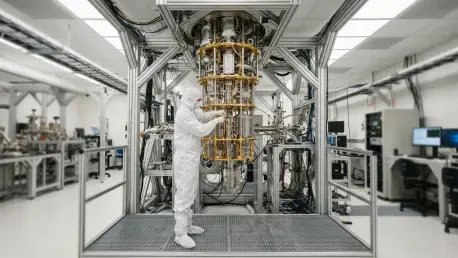

Navigating the High-Stakes Evolution of the Quantum Industry
The global quantum computing sector has officially transitioned from a speculative laboratory venture into a foundational pillar of the modern enterprise technology stack, marking a pivotal moment in computational history. As of today, the industry is no longer characterized by what-if scenarios but by the rigorous integration of quantum systems into classical high-performance computing environments. Organizations are rapidly moving from exploratory phases toward strategic readiness, recognizing that the first movers in this space will likely redefine competitive advantages for decades. The convergence of hardware precision and software sophistication is driving this momentum, with full-stack providers leading the charge toward commercial utility.
This evolution is defined by a shift in how enterprises perceive quantum value, moving beyond academic experimentation to focus on real-world industrial applications. The current state of the market necessitates a seamless blend of hardware innovation and advanced error-correction protocols to satisfy the demands of global businesses. As quantum processing units become more reliable, they are increasingly integrated into the existing high-performance computing and artificial intelligence infrastructure. This integration allows for a hybrid approach where quantum power is used as a specialized accelerator for the most complex scientific and logistical problems, ensuring that the technology delivers measurable value in a commercial context.
Deciphering Key Market Trends and Performance Metrics
Bridging the Gap with Full-Stack Development and Co-Design
A defining trend in the current landscape involves the consolidation of qubit fabrication and high-level software into unified platforms that simplify developer interaction. This co-design approach allows engineers to optimize software compilers specifically for the physical nuances of the hardware, such as the unique characteristics of trapped-ion qubits. By controlling every layer of the stack, providers can abstract the underlying complexities of quantum physics, enabling developers to build resilient algorithms. This synergy ensures that the transition from noisy intermediate-scale hardware to more stable systems is a continuous process rather than a series of disjointed technological leaps.
Furthermore, the development of integrated environments like the Nexus platform allows organizations to manage quantum workflows with the same efficiency as classical software development. These platforms enable researchers to run hybrid algorithms that leverage both quantum and classical resources without needing deep expertise in the underlying physics. By lowering the barrier to entry, full-stack companies are fostering a more inclusive ecosystem where software developers can experiment with logical qubits and error-correction protocols. This strategy not only accelerates the pace of innovation but also creates a migration path for enterprises to scale their applications as the hardware evolves toward universal fault tolerance.
Analyzing Growth Projections and Developer Adoption Rates
The market is currently witnessing a significant uptick in developer engagement, with adoption curves turning sharply upward as cloud-based quantum services become more accessible to global users. Recent financial disclosures from industry leaders indicate revenue growth exceeding 200 percent year-over-year, alongside a tenfold increase in job submissions for quantum computing tasks. Forecasts suggest that the period from 2026 to 2030 will be defined by a surge in demand for quantum-as-a-service models. This growth is underpinned by achievements in hardware fidelity, where error rates have dropped to parts per million, bringing the vision of universal fault tolerance within reach.
Moreover, the influx of capital into the quantum sector has enabled providers to accelerate their hardware roadmaps, reaching key milestones ahead of original projections. The expansion of developer networks is a leading indicator of the industry’s health, as more professionals are trained in quantum-specific languages and tools. Large enterprises are increasingly dedicating portions of their research budgets to long-term quantum partnerships, seeking to secure access to the next generation of processors. As these performance metrics continue to improve, the industry is moving away from venture-backed speculation toward a sustainable business model driven by subscription revenue and specialized consulting services.
Overcoming Hardware Limitations and Error-Correction Hurdles
Hardware scalability remains the most daunting technical barrier, yet the industry is making steady progress through iterative roadmaps that prioritize precision over raw qubit counts. Moving beyond current high-qubit systems requires more than just adding physical components; it necessitates a drastic reduction in noise through sophisticated error-correction protocols. Leading firms are focusing on successive hardware generations that prioritize fidelity, aiming for logical qubit stability that mimics the reliability of classical bits. This evolution is supported by specialized programming languages designed to manage the overhead of error suppression automatically, allowing for more complex and sustained computations.
The move from current trapped-ion architectures to fully fault-tolerant systems involves overcoming massive cryogenic and connectivity challenges while maintaining high precision. The roadmap for the late 2020s focuses on scaling these modular systems without sacrificing the high connectivity that makes them effective for complex problem-solving. By implementing advanced control systems and better physical shielding, researchers are successfully extending coherence times, which is a prerequisite for executing long-depth circuits. These hardware improvements are essential for the eventual deployment of applications in material science and cryptography that require millions of perfectly executed gates to be effective.
Mapping the Regulatory and Compliance Landscape
With the commercialization of quantum power comes a heightened focus on the regulatory framework governing its use and dissemination across international borders. Governments and international bodies are increasingly concerned with data sovereignty and the security implications of quantum-enhanced decryption capabilities. Consequently, compliance with post-quantum cryptographic standards has moved from a theoretical discussion to a mandatory requirement for sectors handling sensitive data. This shifting legal environment forces providers to implement rigorous security protocols that ensure their platforms are resilient against both classical and future quantum-based threats.
International technical standards are also being established to facilitate collaborative research while protecting national interests in critical technology sectors. These regulations influence how quantum processing units are deployed in global data centers and how technical knowledge is shared between scientific communities. Organizations must navigate a complex web of export controls and certification requirements to maintain their position in the global market. Adhering to these standards is not just about legality; it is about building the trust necessary for large-scale enterprise adoption in a highly sensitive geopolitical and economic climate.
Projecting the Future of Quantum-Classical Integration
The next stage of evolution involves the deep structural integration of quantum systems with existing supercomputing and artificial intelligence infrastructures worldwide. Rather than acting as standalone machines, quantum processors are being positioned as specialized accelerators that handle specific high-complexity workloads within broader data centers. This hybrid model allows for the optimization of AI training cycles and chemical simulations by delegating specific tasks to whichever architecture is most efficient. Innovation in this space is driven by strategic partnerships between quantum hardware manufacturers and global telecommunications firms looking to integrate quantum logic into their networks.
Furthermore, the development of interoperable programming frameworks ensures that quantum power is accessible through familiar cloud-based workflows for nonspecialist users. As these systems become more integrated, the focus shifts toward developing specific applications in areas like material science, logistics optimization, and financial modeling. The goal is to create a seamless experience where a researcher can launch a job that utilizes CPUs, GPUs, and QPUs simultaneously without needing to manually manage the distribution of tasks. This holistic approach is essential for making quantum computing a standard tool in the scientific and commercial toolbox by the end of the decade.
Summary of Strategic Findings and Industry Outlook
The analysis of recent technological advancements indicated that a unified hardware-software strategy was the only viable path toward achieving commercial-grade fault tolerance. Industry leaders shifted their focus toward co-designing systems that allowed for seamless transitions between hardware generations, ensuring that early software investments remained valuable. This strategic pivot underscored the importance of building developer ecosystems long before the arrival of perfect qubits. It was observed that the ability to provide a clear migration path through the late 2020s was the primary factor in securing long-term enterprise partnerships and significant capital investment.
Moving forward, organizations needed to prioritize the integration of quantum capabilities into their existing hybrid cloud architectures to maintain a competitive edge. The focus moved from individual qubit performance to the scalability of logical qubits and the resilience of error-correction layers across the entire stack. The sector benefited from increased transparency in hardware roadmaps, which allowed stakeholders to plan for the eventual replacement of legacy cryptographic systems with more secure alternatives. Ultimately, the industry moved away from the hype of laboratory breakthroughs and toward a disciplined engineering culture that prioritized reliability, security, and real-world utility over theoretical potential.