
The question of whether an organization’s next storage administrator will be human or a piece of sophisticated code is no longer a distant theoretical debate but a pressing reality for IT leaders confronting the limitations of manual data management. Does the thought of your storage infrastructure managing, securing, and optimizing itself sound like science fiction? For IT teams grappling with relentless data growth and the constant threat of cyberattacks, it is rapidly becoming a necessity. As manual administration fails to keep pace with the scale and complexity of modern data environments, a new era of autonomous operations dawns, raising fundamental questions about the future role of human expertise in the data center. The answer is beginning to take shape not in research labs, but in commercially available technology that promises to transform the very nature of infrastructure management.
The End of “Business as Usual” for Data Management
The conventional approach to storage administration, characterized by manual configuration, reactive troubleshooting, and constant performance tuning, is reaching a definitive breaking point. For years, IT professionals have been the indispensable human intelligence behind the hardware, meticulously balancing workloads and responding to alerts. However, the sheer volume and velocity of data generation, coupled with the increasing complexity of hybrid cloud environments, have rendered this model unsustainable. The system is overloaded not just with data, but with the cognitive burden placed on the teams tasked with its stewardship, pushing organizations toward an inevitable inflection point where automation is the only viable path forward.
This shift represents more than a simple desire for efficiency; it is a strategic imperative for survival and growth. The transition toward autonomous systems is driven by the recognition that human administrators, no matter how skilled, cannot process the billions of telemetry data points required to make optimal decisions in real-time across a sprawling infrastructure. By offloading these tactical, repetitive tasks to an intelligent agent, the promise is to elevate the storage system from a passive utility to an active, self-sufficient partner. This new paradigm allows the infrastructure to manage itself, freeing human talent to focus on architecture, strategy, and aligning data resources with overarching business objectives.
Navigating the Perfect Storm Why Storage Needs a Revolution
Today’s IT departments face a convergence of critical pressures that legacy storage solutions were not built to handle. The first and most visible driver is the explosive growth of unstructured data, fueled by the widespread adoption of AI, machine learning, and Internet of Things (IoT) applications. This digital deluge creates immense challenges in capacity planning, performance scaling, and data placement, overwhelming traditional management tools and processes. The demand for infrastructure that can intelligently and automatically adapt to these dynamic workloads is no longer a luxury but a fundamental requirement for any organization seeking to leverage its data as a competitive asset.
Compounding the data growth challenge is the escalating sophistication of cyber threats, particularly ransomware attacks that specifically target critical backup and primary storage systems. Modern attackers no longer just encrypt files; they seek to cripple an organization’s entire operational backbone, making data resilience a primary concern for business continuity. Traditional, software-based security measures often introduce performance penalties and react too slowly to these fast-moving threats. This has created an urgent need for security intelligence to be embedded directly into the storage hardware itself, enabling instantaneous threat detection and response at the point where data lives.
Finally, these technological pressures are intensified by a relentless business demand to achieve greater operational efficiency and reduce costs. In an economic climate that scrutinizes every dollar of expenditure, IT leaders are tasked with supporting more data and more complex workloads without a proportional increase in budget or headcount. This economic reality makes manual, labor-intensive management an untenable long-term strategy. The mandate is clear: infrastructure must become smarter, more consolidated, and more automated to deliver the performance and resilience the business needs while lowering the total cost of ownership.
Inside the Autonomous System a Three-Tiered Innovation
At the core of this new generation of autonomous storage is a cohesive strategy built on three interconnected pillars: next-generation hardware, an AI-powered software brain, and a uniquely resilient storage medium. The foundation is laid by a refreshed portfolio of hardware, including the new FlashSystem 5600, 7600, and 9600 models. These systems deliver monumental gains in performance and density, tailored for needs ranging from the network edge to the core data center. The flagship 9600, for instance, can deliver up to 6.3 million input/output operations per second (IOPs) and store up to 11.8 petabytes (PBe) of effective capacity in a compact 2U chassis, enabling organizations to consolidate workloads and reduce their physical data center footprint by as much as 75%.
The intelligence driving this powerful hardware is FlashSystem.ai, an “agentic AI co-administrator” that functions as the system’s brain. This platform moves beyond simple automation by learning the unique behavior of an organization’s applications, making thousands of automated decisions daily to optimize the entire data path. It proactively tunes workloads for peak performance, streamlines complex compliance and audit tasks by generating explainable reports, and provides recommendations with clear reasoning. By incorporating administrator feedback, the AI continuously refines its actions, effectively transforming the storage array from a passive repository into an active and adaptive partner in data management.
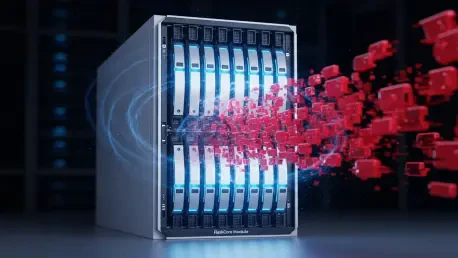
This intelligent system is fortified by the fifth-generation FlashCore Module (FCM), a proprietary hardware shield that pushes security to an unprecedented level. The FCM’s groundbreaking capability is its hardware-accelerated ransomware detection, which analyzes I/O patterns in real-time to identify threats in under 60 seconds—a speed unachievable by software alone and without any impact on system performance. This innovation embeds security directly into the storage media, creating a powerful last line of defense. By computing complex statistics at the hardware level, the module can trigger autonomous recovery actions, ensuring data is protected at its most fundamental layer.
The Data-Backed Promise Putting the Claims to the Test
The shift toward autonomous storage is not merely a conceptual evolution; it is defined by tangible, measurable outcomes that challenge traditional operational metrics. The most profound impact is on operational efficiency, with the introduction of an agentic AI poised to fundamentally alter the daily responsibilities of IT teams. The claim that this AI co-administrator can reduce the manual effort required for routine storage management—tasks like performance diagnostics, capacity planning, and remediation—by up to 90% signals a radical departure from hands-on administration. This allows highly skilled personnel to be redeployed from mundane system maintenance to strategic initiatives that drive business value.
On the critical front of cyber resilience, the technology delivers a quantifiable leap forward in threat detection. The ability of the integrated FlashCore Module to identify the statistical anomalies of a ransomware attack in under 60 seconds provides a crucial advantage when every moment counts. This sub-minute detection is a metric unattainable by traditional software-based security tools, which often take much longer to identify an active threat, by which time significant damage may have already occurred. This hardware-accelerated capability provides a robust and immediate defense mechanism, safeguarding an organization’s most critical asset.
These advancements in efficiency and security culminate in a compelling financial case. For instance, the flagship FlashSystem 9600 is projected to lower total operational costs by as much as 57% compared to its predecessor. This significant cost reduction is achieved through a combination of factors: the consolidation of multiple older systems onto a single, dense platform, the dramatic reduction in power and cooling requirements, and the extensive automation of management tasks powered by FlashSystem.ai. Together, these elements present a powerful argument for modernizing infrastructure, promising not just better performance but also a more sustainable economic model for data management.
Redefining the IT Role Your Strategic Partnership with AI
The emergence of a true AI co-administrator fundamentally rewrites the job description for the human storage professional. With autonomous systems capably handling the day-to-day tactical operations—the performance tuning, diagnostics, and remediation that once consumed the majority of an administrator’s time—the role is set to evolve significantly. The focus shifts away from the granular, reactive management of hardware and toward a more strategic, architectural oversight of the entire data ecosystem. This is not a story of human replacement, but of human elevation.
In this new dynamic, the administrator becomes the strategist who directs the AI, rather than the technician who executes the commands. Their responsibilities will transition to setting high-level, business-aligned policies that guide the autonomous system’s decision-making processes. They will focus on long-term capacity planning, designing resilient data architectures, and ensuring that the infrastructure is optimized to support future business initiatives and emerging technologies like generative AI. The human expert remains indispensable, but their value is now measured by their ability to architect and orchestrate, not just operate.
Ultimately, this evolution fosters a synergistic partnership between human intellect and machine intelligence. The AI co-administrator excels at processing massive datasets and executing tasks at a scale and speed that is beyond human capability, while the human administrator provides the critical context, strategic foresight, and business acumen that AI lacks. This collaborative model promised to unlock new levels of innovation and efficiency, allowing organizations to harness the full potential of their data while empowering their IT professionals to become true architects of their digital future.
The journey toward autonomous infrastructure marked a pivotal transition in enterprise IT. The focus shifted decisively from manual intervention to intelligent automation, driven by the undeniable pressures of data growth and persistent cyber threats. Technologies that integrated AI as a core operational partner did not aim to replace human administrators but to empower them, freeing them from tactical burdens to assume more strategic roles. The advancements in hardware-accelerated security and AI-driven management provided a clear blueprint for a more resilient, efficient, and self-sufficient data center. This evolution represented more than a technological upgrade; it was a fundamental rethinking of the relationship between people and the infrastructure they manage, setting a new standard for what organizations could expect from their most critical data platforms.