
The recent deployment of the Autonomous AWS Emulator marks the first time a major cloud provider has successfully shipped a production-ready tool containing zero human-written code. This release represents a significant advancement in the software engineering sector, fundamentally shifting how the industry perceives the necessity of human authorship. The review explores the evolution of this technology, its core features, and its broader impact on the development landscape. By removing human intervention from the syntax-writing process, the tool establishes a landmark in the transition toward fully automated, enterprise-grade development.
Evolution of Autonomous Engineering and AWS
The emergence of the Autonomous AWS Emulator signifies a departure from the traditional paradigm where AI merely assisted human developers with autocomplete suggestions. Historically, engineers spent hours refining code that AI drafted; however, this project has inverted the hierarchy by placing autonomous agents in the lead role. This transition culminates years of investment in local development tools, signaling a shift toward an era where software creation is an entirely automated pipeline.
By pioneering this AI-led methodology, Amazon is not just providing a utility but setting a new standard for the industry. The technology represents a move away from manual craftsmanship toward a system where high-level architectural requirements are the primary input for production. This achievement stands as a landmark, proving that complex, integrated software can maintain enterprise-grade stability without a single human commit in its primary codebase.
Architecture and Core Functionality
Multi-Agent Orchestration and Synthesis
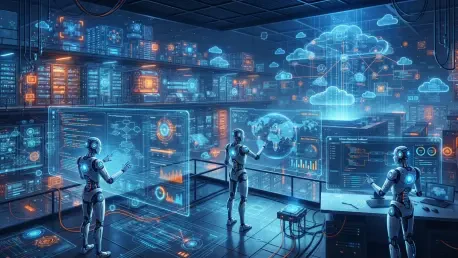
The underlying architecture relies on a sophisticated orchestration layer that manages thousands of synchronized AI agents. This system ensures that individual components, which are developed in isolation by different agents, function as a cohesive whole once integrated. Unlike traditional development where humans handle merge conflicts, the orchestration layer uses advanced synthesis protocols to maintain logical consistency across the entire project.
The complexity of managing such a large-scale autonomous workforce requires a specialized management framework that oversees code generation in real time. This orchestration allows for the creation of modular components designed for inherent compatibility, minimizing the friction typically found in human-led projects. The result is a seamless software package that maintains high stability despite its highly distributed and automated origin.
Service Replication and API Fidelity
A primary technical achievement of the emulator is its ability to accurately mirror the behaviors of the sprawling AWS service catalog. It provides high-fidelity replicas of S3, Lambda, and DynamoDB, allowing for precise local testing that matches the performance characteristics of the live cloud environment. This fidelity is crucial for developers who need to ensure that local tests translate directly to production without unexpected latency.
By replicating these complex services, the emulator provides a sandboxed environment that responds to requests exactly like the remote infrastructure. The agents involved in building these replicas were trained on massive datasets of API specifications, ensuring that even the most nuanced behaviors are preserved. This high level of accuracy eliminates common synchronization problems, providing a reliable baseline for modern cloud-native application development.
Current Trends in Autonomous Development
The industry is witnessing a strategic divide between companies that restrict AI agents due to security concerns and those that integrate them into core pipelines. The launch of this emulator highlights a trend where software creation is reimagined as a management problem rather than a linguistic one. The focus has shifted from manual syntax writing to defining high-level specifications that an autonomous digital workforce can execute with precision.
Moreover, this shift highlights how organizations are prioritizing speed and efficiency over the traditional human-centric development lifecycle. As AI agents become more capable of handling complex integration tasks, the competitive landscape is changing. Firms that embrace this AI-led production are finding that they can iterate much faster than those relying on manual coding. This creates a new baseline for productivity where the bottleneck is no longer the speed of typing, but the clarity of the vision.
Real-World Applications and Use Cases
Local Cloud Simulation and Testing
Developers utilize the emulator to build and debug cloud-native applications without the necessity of a persistent internet connection. This provides a cost-effective environment for testing Lambda functions, which significantly reduces cloud usage fees during the early stages of the development lifecycle. By simulating cloud behavior locally, teams can run thousands of tests per hour without worrying about the financial implications of high-volume API calls.
Furthermore, the emulator allows for development in secure environments where cloud access might be restricted or unreliable. This capability is particularly useful for sensitive projects that require data to remain within a specific local perimeter until the deployment phase. The ability to simulate a full cloud stack on a workstation has streamlined the process, making it more accessible to individual developers and small teams with limited budgets.
Rapid Prototyping for Enterprise Systems
Enterprises are deploying the emulator to accelerate the prototyping of complex, distributed architectures. By leveraging a tool built through autonomous means, organizations can validate their integration strategies in an isolated environment that maintains strict parity with production AWS environments. This allows for rapid iteration of system designs, where different architectural patterns can be tested and discarded within hours rather than weeks.
The use of the emulator in enterprise settings also provides a safer way to test experimental features without risking live production data. It acts as a bridge between the conceptual design phase and the final deployment, ensuring that all components interact correctly before they are pushed to the cloud. This trend toward local, high-fidelity prototyping is reducing the overall risk associated with large-scale digital transformation projects.
Technical Challenges and Implementation Obstacles
Security and Code Validation Protocols
One of the primary hurdles in this new era is the “black box” nature of AI-generated code. There are ongoing concerns regarding how to validate thousands of simultaneous commits for security vulnerabilities without human oversight. Because the agents work at a scale that surpasses human review capacity, new automated security protocols must be implemented to scan for hidden flaws that could be exploited in production.
The challenge lies in creating a validation system that is as intelligent and fast as the generative agents themselves. Without these safeguards, the risk of introducing systemic vulnerabilities into the software supply chain increases. Consequently, the industry is racing to develop validator agents that can perform deep semantic analysis of the code, ensuring that the final product adheres to strict security standards while maintaining the speed benefits of autonomous generation.
Accountability and Debugging Complexity
The shift to agent-built software raises complex questions about liability and accountability when systems fail. Identifying the root cause of an error in a codebase with zero human authorship requires entirely new debugging methodologies. Traditional tools designed for human-written logic often struggle to map the intricate, non-linear dependencies created by an autonomous workforce, leading to a potential gap in system oversight.
This ethics gap in autonomous teamwork poses a challenge for legal and compliance departments. When no human developer can be pointed to as the author of a specific bug, the responsibility falls on the architects of the requirement specifications. Bridging this gap requires a new framework for digital accountability, ensuring that even though machines do the building, humans remain responsible for the outcomes. Developing these oversight frameworks is as critical as the technical advancement of the agents.
Future Outlook for AI-Led Production
The trajectory of this technology suggests a future where human engineers transition into the permanent role of Requirement Architects. We can expect breakthroughs in how AI agents handle edge-case management and sophisticated version control. Over the next few years, from 2026 to 2028, the focus will likely shift toward the complete automation of routine software maintenance and the patching of legacy systems, fundamentally altering the traditional methods of manual craftsmanship.
As these autonomous systems evolve, they will likely become more adept at self-optimization, rewriting their own code to improve performance without human prompting. This could lead to a self-sustaining software ecosystem where human intervention is only required for high-level creative direction and strategic decision-making. The boundary between software and the AI that creates it will continue to blur, making the role of the developer more about defining what needs to be done.
Final Assessment of the Technology
The Autonomous AWS Emulator served as a successful proof of concept that demonstrated the viability of an autonomous workforce in delivering stable software. While challenges regarding transparency and liability persisted throughout the development phase, the impact on the industry was undeniable. The project proved that large-scale, autonomous code generation was no longer a goal for the distant future but a current reality that demanded immediate adaptation from engineering professionals.
Ultimately, the release signaled the beginning of an era where results and efficiency took precedence over traditional craftsmanship. The emulator stood as a testament to the power of coordinated AI agents and their ability to solve complex engineering problems with minimal human guidance. Organizations that embraced this shift positioned themselves at the forefront of the next technological revolution, while the rest of the sector began the difficult work of catching up to this new standard of productivity.