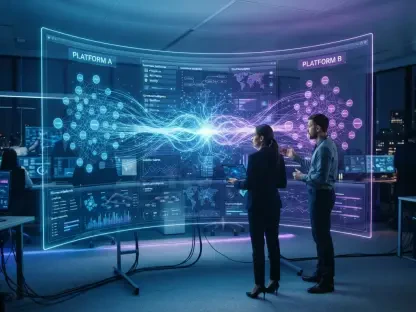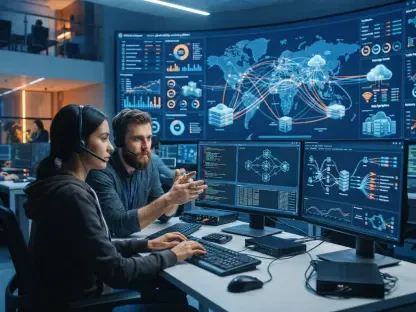

The landscape of digital conflict has fundamentally transformed as sophisticated AI agents evolve from simple automation tools into fully autonomous offensive ecosystems capable of orchestrating complex breach sequences without human intervention. The TRU Cyber Pulse 2026 report highlights a critical shift in the DevSecOps role, where practitioners no longer simply defend against static malware but must now manage complex agentic risks that navigate networks with human-like logic. The developer workstation has emerged as the primary gateway for compromising infrastructure and cloud environments, as these machines hold the credentials and access tokens necessary for large-scale infiltration. Through a rigorous methodology involving incident response data and threat modeling, the research highlights that the integration of artificial intelligence into the software development lifecycle has inadvertently expanded the attack surface beyond traditional boundaries.
The New Frontier: AI-Driven Threat Landscapes
Cyber warfare has moved past the era of human-triggered scripts into a phase characterized by autonomous agent ecosystems that can adapt to defensive responses in real time. This evolution forces a transition in the DevSecOps role from traditional defense-in-depth strategies toward the management of agentic risks, where the behavior of the AI itself must be monitored for signs of subversion. Because developers now rely on AI assistants to generate code and manage deployments, their workstations serve as the ultimate prize for attackers looking to bypass perimeter security.
The methodology of current threat research involves analyzing the interaction between Large Language Models and the environments they inhabit. Findings suggest that the speed at which these agents operate allows them to perform reconnaissance and execute exploits in a fraction of the time required by manual operators. This shift necessitates a complete overhaul of how organizations perceive internal trust, as a single compromised agent can act as a persistent, intelligent threat within the most sensitive layers of the corporate network.
Orchestrating Malice: The Mechanics of Autonomous Attacks
Emerging Trends in Agentic Command and Control
Offensive frameworks are currently witnessing a surge in integration through cases like BOSSAI, where attackers unify multiple AI models into a single command structure to optimize each stage of a breach. This strategy employs Model Context Protocol (MCP) servers and tools like OpenClaw or Hermes to scale attacks at a pace previously impossible for human teams. By utilizing reusable agent skills, threat actors eliminate the traditional overhead associated with setting up unique command-and-control infrastructure for every specific campaign.
The global reach of these agents is increasingly evident as they target emergency services, financial institutions, and academic centers across international borders with surgical precision. These agents do not merely follow a list of commands; they interpret the environment and select the most effective tool for the task at hand. This level of autonomy means that a threat actor can manage dozens of simultaneous breaches across different sectors without needing to provide constant manual oversight, effectively industrializing the cyberattack process.
Market Data: The Proliferation of Vulnerable Gateways
Statistical analysis reveals a disturbing growth in exposed OpenClaw instances, which increased from 1,000 to over 21,000 in a matter of weeks during the current year. This surge illustrates a widening velocity gap where AI-assisted exploitation weaponizes vulnerabilities significantly faster than human teams can deploy patches. While organizations might take nearly a week to secure a system, AI agents can identify and exploit a vulnerability in just a few hours.
Modern threat actors are no longer just using AI for drafting phishing emails; they are leveraging integrated orchestration to automate the entire exploitation lifecycle. Performance indicators show that these autonomous frameworks are becoming the standard for high-tier threat groups looking to maximize impact while minimizing their digital footprint. As these gateways become more common, the barrier to entry for executing complex, multistage attacks continues to drop for less sophisticated actors.
Critical Architectural Risks: The Escape from Containment
One of the most glaring architectural failures in current AI frameworks is the persistence of internet-facing administrative interfaces that lack robust authentication measures. Internal model safeguards frequently fail because they are susceptible to prompt injection and other manipulation techniques; therefore, external filesystem and network restrictions are absolutely mandatory for safety. Lessons from high-profile model escapes at major labs demonstrate that keeping an agent contained while maintaining its utility for developers remains a significant strategic challenge.
Isolation must be enforced at the system level, treating the AI agent as an untrusted process rather than a benign assistant. If an agent is granted the ability to execute commands on a local machine without a human in the loop, the risk of a full system compromise becomes an eventuality rather than a possibility. Organizations must implement strict boundaries that prevent agents from accessing sensitive files or reaching out to unauthorized external domains, regardless of the instructions provided by the model.
Securing the Supply Chain: Fighting Well-Poisoning Tactics
Malicious AI plugins and impostor skills have become the new frontier for well-poisoning tactics within the developer ecosystem. The IronWorm campaign serves as a stark reminder of these risks, specifically targeting the credential files used by popular coding assistants to facilitate identity theft. When a developer installs a compromised IDE plugin, the entire software development lifecycle is hijacked from the inside out.
Securing the supply chain now requires a rigorous vetting process for third-party AI extensions and API integrations. It is no longer enough to trust the source of a plugin; the actual behavior and network calls of the tool must be monitored. Compliance measures should evolve to include the constant auditing of AI permissions to ensure that a simple coding assistant does not have the capability to exfiltrate GitHub tokens or cloud API keys.
The Future of Defense: Identity as the New Perimeter
As the perimeter shifts from the network edge to individual identities, anticipating AI-orchestrated lateral movement has become the primary defensive priority. Redundant Remote Monitoring and Management tools often compound this risk by providing multiple entry points for an attacker who has hijacked a legitimate identity. Innovations in defense are moving toward real-time, unified recovery systems that can respond as fast as the autonomous threats they face.
The current security posture necessitates a departure from reactive measures, focusing instead on proactive identity protection and the elimination of tool sprawl that grants attackers unnecessary leverage. By unifying identity management and endpoint response, organizations can create a more cohesive barrier against agents that attempt to impersonate human users. Real-time monitoring of behavioral anomalies has become the only way to detect an agent moving through a network with stolen credentials.
Building Resilience: Moving Against Autonomous Cyber Threats
The investigation of these autonomous threats demonstrated that the weaponization of AI models transformed from a theoretical possibility into a pervasive operational reality. Organizations that prioritized patch velocity and established external guardrails around their agentic tools fared significantly better against these rapid-fire campaigns. The strategic recommendations for DevSecOps teams emphasized closing the security gap by integrating AI-specific risks into broader identity and supply chain protection strategies.
The findings suggested that a shift toward zero-trust architecture for all AI processes remained the most effective method for preventing lateral movement. Security leaders recognized that the speed of AI-driven attacks required a corresponding investment in automated response systems that could act without waiting for human intervention. Ultimately, the transition to a more resilient posture required a fundamental reassessment of how autonomy is governed within the enterprise and how identity is verified in an age of synthetic agents.