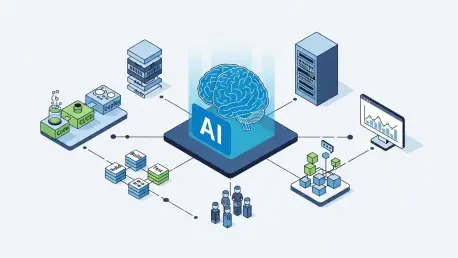

The seamless integration of high-speed machine learning models into software delivery pipelines has fundamentally disrupted the traditional balance between engineering velocity and systemic reliability across the modern enterprise landscape. This evolution represents a departure from human-centric programming, moving instead toward a hybrid development environment where artificial intelligence provides the initial logic and human engineers act as final arbiters. Large enterprises now find themselves at a crossroads, attempting to leverage the extreme speed of AI-driven generation without sacrificing the operational integrity that has been the hallmark of stable infrastructure.
The digital transformation of the current decade relies heavily on the efficiency of the Continuous Integration and Continuous Deployment (CI/CD) pipeline. Dominant market players have increasingly embedded AI-driven orchestration into these workflows, making automation the primary driver of infrastructure management. However, this reliance introduces new pressures, as the existing regulatory landscape begins to demand rigorous standards for responsible AI usage. Companies must now navigate a complex environment where the velocity of delivery is no longer the sole metric of success; the ability to prove safety and compliance has become equally critical.
Navigating the Shift Toward Intelligent Automation
Emerging Technological Drivers and Evolving Engineering Behaviors
Engineering teams are currently witnessing a profound transition from manual coding to a workflow dominated by prompt engineering and AI-suggested configurations. This shift is not merely a change in tools but a total redefinition of engineering behavior, as developers spend more time refining AI outputs than writing raw code. To maintain control over this machine-generated output, industry standards have converged on the adoption of Policy as Code and Shift-Left Security. These foundational practices ensure that security checks are not an afterthought but are integrated into the very beginning of the development cycle.
The growing influence of Large Language Models has extended beyond simple code snippets into the automation of entire cloud infrastructures and microservices. This movement is leading the industry toward the realization of self-healing systems and autonomous incident response. In such environments, the role of the human engineer is increasingly focused on high-level design rather than the granular execution of tasks. As these autonomous systems become more prevalent, the need for a robust framework to manage the interaction between machine logic and organizational policy becomes undeniable.
Market Projections and the Growth of AI-Enhanced Delivery Cycles
Data-driven insights suggest that the acceleration of deployment frequency is entering a period of exponential growth, primarily fueled by AI-native DevOps platforms. Market analysts forecast a significant surge in investment trends for these technologies through 2030, as enterprises seek to eliminate manual review bottlenecks. Performance indicators such as Mean Time to Recovery and Lead Time for Changes are showing marked improvement in organizations that have successfully integrated AI. This efficiency gain allows for a more fluid delivery cycle, though it requires a corresponding increase in monitoring capabilities.
Looking toward the immediate future, the displacement of traditional manual review processes appears inevitable. The sheer volume of code being generated by AI tools makes it impossible for human reviewers to provide the same level of scrutiny as in the past. Consequently, the industry is shifting toward automated, data-centric validation methods. This evolution promises to shorten the feedback loop between development and production, enabling a more responsive and agile approach to software delivery that can keep pace with rapidly changing market demands.
Identifying the Technical and Organizational Risks of the Governance Gap
A primary concern in this new era is the illusion of functional correctness, where AI-generated code passes unit tests while harboring deep-seated structural flaws. Because these models prioritize the immediate success of a function, they often neglect the broader architectural context, leading to code that works in isolation but fails under production stress. This creates a dangerous precedent where a lack of overt bugs is mistaken for high-quality engineering. Furthermore, the expansion of privileges within cloud environments has become a common failure point, as AI tools frequently default to excessive permissions to ensure a script runs without interruption.
Hidden dependency webs and the decay of individual accountability represent additional organizational challenges. As AI introduces third-party libraries that may not be immediately visible to human overseers, the risk of supply chain vulnerabilities increases. Moreover, the composite author problem complicates the traditional peer-review process, as it becomes difficult to assign responsibility when a failure occurs in a hybrid-authored block of code. This accumulation of silent technical debt can result in risk clusters that bypass traditional oversight, eventually manifesting as catastrophic system failures that are difficult to trace and resolve.
The Regulatory Landscape and the Evolution of Compliance Standards
Global regulations are rapidly catching up to the realities of machine-augmented development, with frameworks such as the EU AI Act setting a new baseline for software delivery. Enterprises are now required to shift their focus from mere performance validation to a more comprehensive model of provenance and safety verification. This means that organizations must be able to document the origin of every line of code and configuration change within their pipeline. Ensuring the Principle of Least Privilege in automated environments is no longer just a best practice but a legal necessity in many jurisdictions.
Compliance standards like SOC2 and ISO 27001 are also evolving to incorporate specific mandates for AI-driven infrastructure. The role of auditability has expanded, leading to the adoption of a flight recorder approach to DevOps documentation. This method ensures that every interaction between an AI model and the production environment is logged, timestamped, and stored for future review. By creating a transparent record of automated decisions, organizations can satisfy the demands of regulators while maintaining the speed and efficiency required to stay competitive in a fast-moving market.
Future-Proofing DevOps Through a Unified Governance Model
The most effective way to bridge the governance gap is through a model based on architectural ownership, where systems are categorized by their risk level. Mission-critical components, such as authentication and financial transaction engines, require more stringent human-led oversight, while low-stakes automation can be managed with higher degrees of AI autonomy. This structured approach allows enterprises to apply the right level of control to the right systems, ensuring that governance does not become a bottleneck for innovation. Integrating AI-aware policy enforcement into the CI/CD pipeline ensures that security is maintained without manual intervention.
End-to-end observability serves as the final pillar of this unified governance model, tracking the footprint of AI from the initial prompt to the final production behavior. This level of visibility turns governance into a competitive advantage, as it allows organizations to identify and mitigate risks before they escalate into production outages. The market is currently moving toward fully autonomous, governed DevOps ecosystems that can manage themselves within the boundaries set by human architects. By treating governance as an enabler rather than a restriction, enterprises can achieve a level of agility that was previously impossible.
Building Resilience in the Era of Machine-Augmented Engineering
The analysis of the modern engineering landscape demonstrated that visibility had to keep pace with the velocity of AI generation to prevent systemic failure. Organizations successfully transitioned by redefining the engineer as a system architect and governor rather than a simple author of code. This shift required a fundamental rethink of how software was validated and deployed. The industry moved toward a reality where automated policy enforcement became the primary safeguard against the risks inherent in machine-generated logic.
Strategic recommendations for enterprises involved the prioritization of architectural ownership and the implementation of robust audit logs. By categorizing systems according to risk and maintaining a clear record of AI interactions, companies mitigated the decay of accountability. The ultimate finding suggested that the balance between rapid innovation and systemic stability was achieved through the integration of governance into the heart of the delivery pipeline. This approach allowed for the full benefits of AI to be realized while maintaining the high standards of safety and reliability required for enterprise-scale operations.