
Modernizing how volumetric content is handled brings the familiar convenience of desktop windowed multitasking to the immersive world of mixed reality. For years, the extended reality landscape has been defined by siloed experiences where a single application dominated the user’s entire field of vision, often forcing a binary choice between total immersion or flat, two-dimensional interfaces. The Khronos Group is now dismantling these digital walls by introducing a standardized framework for spatial containers, allowing diverse 3D applications to exist simultaneously within a shared operating environment. This transition represents a fundamental shift in user experience design, moving away from isolated apps toward a more cohesive and productive computing paradigm. By enabling multiple volumetric entities to inhabit the same physical space, the industry is finally addressing the fragmentation that has long restricted the utility of mixed reality headsets for daily professional and personal tasks.
Redefining Digital Boundaries: The Power of Spatial Containers
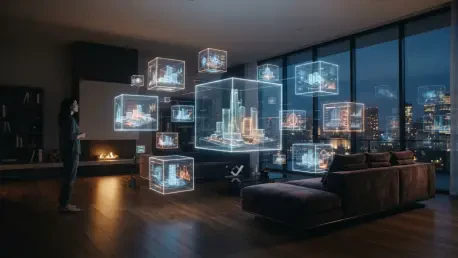
At the heart of this technical evolution is the concept of a “Spatial Container,” a system-managed volume that houses 3D content while maintaining awareness of the broader environment. Historically, mixed reality developers had to manage the entire coordinate system of a device, which meant that when one application was active, others were relegated to the background or closed entirely. These new OpenXR extensions shift the responsibility of spatial positioning from the individual application to the underlying operating system. This allows the OS to act as a true window manager for the third dimension, orchestrating how various digital objects and panels interact with one another and the user’s physical surroundings. This architecture is vital for creating a fluid workflow, as it permits users to keep a 3D design tool open in one area while a communication panel floats nearby, ensuring that no single piece of software can monopolize the user’s focus or the physical room’s layout.
Beyond simple positioning, this framework introduces sophisticated behaviors such as persistent digital anchoring and dynamic “follow-me” functionality. In a standard immersive environment, digital objects often vanish or reset if the user moves too far from the initial launch point, but spatial containers allow the operating system to maintain these objects as stable fixtures. For instance, a virtual calendar or a 3D representation of a task list can remain pinned to a physical wall indefinitely, even while the user is engaged with other immersive software. Furthermore, the system-level control enables developers to implement containers that move with the user, ensuring that critical information remains within the line of sight without requiring manual repositioning. This level of environmental persistence is a cornerstone of the shift toward spatial computing as a viable alternative to traditional monitors, providing a sense of permanence that was previously impossible to achieve.
Building the Foundation: Registry Implementation and Performance
The initial release within the OpenXR Registry specifically highlights two primary extensions that serve as the building blocks for this new ecosystem. The first, designated as XR_EXT_spatial_container, provides the logic necessary for applications to request and manage these volumetric bounds, defining the size and scale of the 3D workspace. The second extension, XR_EXT_spatial_container_self_rendering, empowers developers to use familiar composition layers to push content directly into these spaces. This standardized approach allows a “build once, deploy everywhere” strategy that significantly reduces the engineering overhead previously required to port 3D applications across different hardware. By providing a common language for spatial boundaries, the Khronos Group is helping to bridge the gap between high-end tethered systems and standalone mobile headsets, ensuring that the visual intent of the developer is preserved regardless of the processing power available.
Looking toward the immediate future of this rollout, the working group is refining additional extensions designed to support system-provided renderers. These enhancements are particularly crucial for the latest generation of lightweight AR glasses, where power consumption and thermal management are constant challenges for developers. By offloading certain rendering tasks to the operating system’s optimized pipeline, spatial containers can maintain high visual fidelity while minimizing the impact on battery life. This optimization ensures that even complex 3D objects can be rendered efficiently alongside simpler 2D windows, creating a balanced and responsive user interface. The ability to scale performance across a spectrum of devices—from high-performance VR rigs to battery-sipping wearable glasses—is a major step toward making mixed reality a ubiquitous part of the mobile computing experience, rather than a specialized tool limited to short, high-power sessions.
Industry Convergence: Aligning the Global XR Landscape
The arrival of these extensions has prompted a rapid realignment among major industry players who are eager to standardize their software stacks. Google has emerged as a vocal proponent of this initiative, signaling its intent to integrate spatial container support directly into the core of Android XR. This move is a substantial departure from earlier iterations of the platform, which primarily treated immersive content as a full-screen override. Similarly, ByteDance’s Pico has embraced the shared space model with Pico OS 6, utilizing a dedicated spatial engine that allows for the simultaneous execution of 2D and 3D applications against a high-fidelity passthrough background. This growing consensus among operating system vendors highlights the demand for a unified multitasking environment that can compete with proprietary solutions. By adopting these open standards, these companies are fostering a more open marketplace where software can travel seamlessly across various hardware ecosystems.
While Meta’s Horizon OS has traditionally functioned as a single-application environment, the new OpenXR standards provide a strategic path for the company to modernize its approach to persistent digital objects. Earlier attempts at creating “Augments”—digital items that persist in a user’s home—faced significant technical hurdles due to the lack of an industry-wide container standard. By leveraging the spatial container framework, Meta and other manufacturers can rebuild these features on a foundation that ensures interoperability and long-term stability. This trend toward shared space architectures suggests that the era of proprietary “walled gardens” in the XR space is slowly being eroded by the practical needs of developers and users alike. As more platforms adopt these extensions throughout 2026 and into 2027, the friction involved in managing multiple immersive tools will continue to decrease, paving the way for a more integrated and user-friendly digital reality that feels like a natural extension of the physical world.
Future Horizons: Transforming XR into a Versatile Ecosystem
The widespread implementation of spatial containers fundamentally altered the development lifecycle for immersive software, moving the industry toward a more mature software distribution model. Developers no longer felt compelled to build custom windowing systems or complex environment-tracking logic for every unique piece of hardware, as the operating system began to handle these heavy-lifting tasks through the standardized API. This shift allowed smaller studios to focus their resources on creating high-quality content rather than troubleshooting low-level system conflicts. Moreover, the transition from isolated silos to a unified environment lowered the barrier to entry for professional users who required multiple tools to be open simultaneously. By establishing a reliable set of rules for how 3D content interacts, the Khronos Group provided the essential “glue” that turned a collection of fragmented technologies into a cohesive computing platform.
As these technical standards became the norm, organizations began to prioritize the integration of spatial multitasking into their long-term digital strategies. Companies that adopted these extensions early on found themselves better positioned to deliver versatile tools that could adapt to the shifting needs of a mobile workforce. The next logical step for the industry involves refining how these containers interact with cross-platform cloud services and collaborative multi-user environments. By the end of this current cycle, the limitations of single-app experiences were largely viewed as a relic of the past, replaced by a robust ecosystem where digital and physical realities coexisted without compromise. Moving forward, the focus will likely shift toward improving the accessibility and discoverability of these spatial tools, ensuring that the benefits of volumetric multitasking reach a broader audience. The foundation laid by the OpenXR registry has effectively redefined the scope of immersive computing.