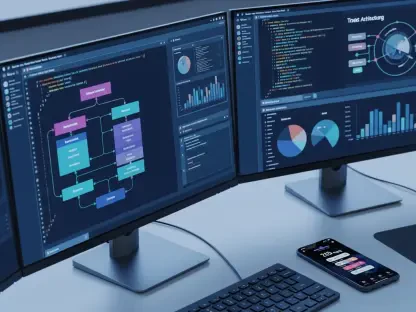

The historical reliance on human-initiated prompts to trigger artificial intelligence is rapidly collapsing under the weight of a new paradigm where proactive agents operate as silent, background orchestrators of our digital lives. This shift marks the transition from reactive Large Language Model (LLM) backends to user-centric agent frontends, a development that signifies the true maturation of the artificial intelligence sector. While the preceding years focused almost exclusively on the reasoning capabilities and parameter counts of underlying models, the current technological landscape prioritizes the interface—the actual “frontend” that determines how this intelligence interacts with reality. The proactive agent frontend represents the missing link between raw computational power and seamless utility, transforming AI from a tool that requires constant supervision into an autonomous participant in the workforce.
The Evolution of AI Interfaces: From Reactive Chat to Proactive Agents
The primary constraint of early generative artificial intelligence was its fundamental passivity, confined within a dialog box that awaited human input before performing any operation. This reactive model, though revolutionary at the time, mirrored the limitations of early search engines rather than the potential of a truly cognitive assistant. Users were burdened with the “cognitive threshold” of remembering to use the AI, framing every interaction as a distinct, manual task. The emergence of proactive agent frontends has dismantled this barrier by introducing an architecture where the AI possesses the initiative to monitor environments, identify needs, and execute solutions without a specific, real-time command.
This evolution represents a critical pivot toward a “frontend-first” philosophy in AI development. For a significant period, the industry assumed that more powerful models would naturally lead to more useful products. However, the persistence of the turn-based interaction loop proved that even the most advanced reasoning engine remains limited if it cannot independently engage with the user’s digital ecosystem. By decoupling the agent’s initiative from the user’s prompt, these new frontends allow for a continuous presence, shifting the focus from generative output to autonomous outcome. This context is essential for understanding why lean frameworks are currently outperforming bloated, traditional platforms in user adoption and practical efficiency.
Core Architectural Components and Innovative Features
The Shift from Turn-Based Interaction to Autonomy
The transition away from passive dialog boxes is rooted in the implementation of “proactive triggers” that function independently of a terminal or chat interface. Technically, this involves the integration of persistent background processes and long-term memory modules that allow an agent to “remember” a user’s overarching goals rather than just the last sentence typed. This shift is significant because it moves the intelligence from a stateless function to a stateful entity. Instead of resetting after every message, the proactive frontend maintains a constant awareness of the user’s schedule, incoming data streams, and historical preferences, enabling it to act at the most opportune moments.
Furthermore, this autonomy is powered by a departure from linear logic toward more complex, looped execution cycles. Traditional AI interfaces operate on a simple request-response trajectory, whereas proactive agents utilize autonomous loops that can self-correct and verify results before presenting them to the user. This technical refinement reduces the “hallucination of action,” where an agent might claim to have completed a task without actually doing so. By incorporating internal verification layers within the frontend architecture, these agents provide a level of reliability that reactive systems simply cannot match, as they essentially act as their own quality assurance managers.
Cross-Platform Integration and Distribution
A major breakthrough in the current landscape is the distribution of AI agents through existing communication channels such as Telegram, iMessage, and Feishu. This integration removes the friction of downloading new applications or learning unfamiliar interfaces, allowing the AI to live where the user already spends their time. By utilizing these established “pipes,” proactive agents benefit from built-in notification systems and cross-device synchronization. This strategy turns the messaging app into a command center where the agent can send a quick status update or ask for a minor clarification, maintaining a conversational flow that feels like a human-to-human interaction rather than a software session.
Moreover, this approach leverages the native permissions and APIs of these platforms to bridge the gap between different software silos. An agent residing in a messaging app can pull data from a calendar, process it through a reasoning model, and then execute an action in a separate project management tool. This cross-pollination of data is what makes the agent “proactive” in a real-world sense. It transforms the AI from an isolated brain into a connective tissue that binds together disparate parts of a user’s digital life, effectively serving as an intelligent overlay that operates across the entire operating system regardless of the specific app in focus.
Current Trends and the “Slow API” Paradigm
One of the most provocative theories currently circulating in the tech sector is the idea that traditional software applications are becoming “slow APIs” for agents to navigate. In this paradigm, the graphical user interface (GUI) designed for human eyes is increasingly viewed as a bottleneck. Proactive agents are beginning to bypass the buttons and menus of standard software, instead interacting directly with underlying data layers or using browser automation to “scrape” the functionality they need. This trend suggests a future where software companies might prioritize agent-friendly endpoints over human-friendly layouts, as the majority of their “users” may soon be autonomous digital entities rather than people.
This shift has also led to the “Winner’s Curse” affecting big tech companies. Established giants like Google or Microsoft find themselves trapped by their own success, forced to maintain legacy user interfaces and business models that rely on human attention and ad clicks. In contrast, agile agent frameworks like OpenClaw have gained massive traction because they are unencumbered by the need to keep users on a specific page. These lean frameworks prioritize efficiency and “zero-touch” interactions, allowing users to achieve results without ever opening a traditional app. This agility is why small, open-source projects are currently setting the pace for innovation, forcing larger corporations to reconsider their “walled garden” strategies.
Real-World Applications and Industry Implementation
The implementation of proactive agents has already yielded substantial results in personal productivity and workflow orchestration. For instance, in automated monitoring, agents no longer simply alert a user to a problem; they investigate the cause, draft a potential fix, and present the entire package for a single-click approval. This type of deep-task completion is fundamentally different from a chatbot providing a list of instructions. In the corporate sector, these agents are being used to manage complex, multi-step tasks such as coordinating international travel or synchronized project launches across different time zones, handling the minutiae of time-zone conversions and logistics autonomously.
Beyond individual productivity, industry-specific applications are emerging in sectors like logistics and customer support. In these environments, agents operate across different software ecosystems to bridge the communication gap between vendors, clients, and internal databases. A proactive agent can detect a shipping delay in a logistics portal, cross-reference it with a customer’s order history, and proactively offer a discount or an alternative solution via a messaging platform before the human customer even realizes there is an issue. This level of autonomous, cross-platform service is redefining expectations for efficiency and responsiveness in the digital economy.
Technical Hurdles and Market Obstacles
Despite the rapid progress, several technical hurdles remain, most notably the high cost of context switching. When an agent moves between different platforms—such as shifting from a spreadsheet to a communication app—there is a risk of losing the fine-grained context necessary for complex decision-making. Developing a “unified memory” that can translate data across different software environments without loss of nuance is a significant engineering challenge. Additionally, the computational resources required to have an agent constantly “listening” or monitoring in the background are much higher than those required for simple, on-demand chat interactions.
Market obstacles also persist, particularly regarding privacy and the security of third-party integrations. Granting an autonomous agent the power to act on one’s behalf across multiple platforms creates a massive security surface area. If an agent has the credentials to move money or delete files, the potential for catastrophic failure or exploitation is high. Furthermore, regulatory frameworks have not yet caught up with the concept of “autonomous digital actions.” Questions of liability—such as who is responsible if an agent makes an unauthorized purchase or breaks a service’s terms of use—remain largely unanswered, creating a hesitant environment for widespread enterprise adoption.
The Future of the Digital Ecosystem
Looking ahead, the digital ecosystem appears to be moving toward the eventual disappearance of traditional user interfaces in favor of Agent-to-Agent (A2A) communication. In this scenario, the human user becomes a high-level director who sets goals, while the “frontend” becomes a purely conversational or even invisible layer. Instead of a person navigating a website to buy a product, their agent will negotiate directly with the retailer’s agent. This transition will likely lead to a new set of “initiative-based” metrics, where the value of a piece of software is measured not by how long a user spends on it, but by how effectively it serves as an endpoint for autonomous agents.
Breakthroughs in initiative-based technology will likely focus on making agents more “human-like” in their judgment of when to interrupt and when to stay silent. The next generation of proactive frontends will need to master the art of “social timing,” understanding the nuances of a user’s current workload or emotional state before presenting information. As these agents become more integrated into the physical world through wearables and ambient computing, the distinction between a “software application” and a “personal assistant” will blur entirely. The long-term impact will be a digital world that feels significantly less cluttered, as the heavy lifting of navigation and coordination is handled by a layer of proactive intelligence.
Final Assessment and Strategic Impact
The analysis of proactive AI agent frontends demonstrated that the true value of artificial intelligence was never contained within the reasoning models alone, but in the interface that allowed those models to impact the physical and digital world. The transition from reactive chat systems to autonomous agents represented a fundamental shift in the power dynamic between humans and software. By prioritizing distribution through existing communication channels and embracing a proactive interaction model, these frontends successfully lowered the threshold for AI adoption. This move away from the traditional dialog box signaled the end of the “tool” era of AI and the beginning of the “partner” era, where software began to share the burden of initiative.
Ultimately, the emergence of the proactive frontend proved to be the most significant strategic development in the computing landscape of the current era. It highlighted the limitations of established tech giants while providing a roadmap for agile developers to create immense value through integration rather than raw scale. The technology showed that while backends provide the “brain,” it is the frontend that provides the “hands.” As the digital ecosystem continued to evolve toward agent-centric models, the strategic importance of the user entry point remained the primary battlefield for innovation. The shift toward autonomy transformed how work was perceived, executed, and delivered across every sector of the modern economy.