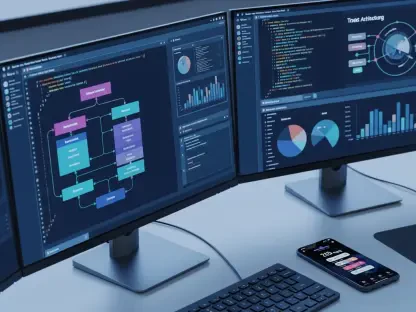

The rapid migration of global commerce into the palm of the consumer’s hand has transformed the smartphone from a mere convenience into the primary engine of the modern economy. For years, businesses treated mobile applications as secondary extensions of their desktop presence, but this hierarchy has finally collapsed. Today, an organization’s digital lifeblood flows through mobile-first ecosystems where user attention is the most valuable currency. Silverback Digital Marketing has recognized this tectonic shift, pivoting its strategic focus toward high-level mobile development to meet the demands of an environment that no longer rewards static web presence.
The Evolving Landscape of Digital Presence and Mobile Integration
The transition from desktop dominance to mobile as the primary interaction point is not just a change in screen size; it is a fundamental shift in how global consumers live and transact. As we navigate the current landscape, the desktop has retreated into a specialized tool for heavy-duty tasks, while the mobile device has become the constant companion for everything from banking to enterprise resource management. This shift necessitates a new way of thinking about digital architecture, moving away from simple web responsiveness and toward deep-seated mobile integration that anticipates user needs in real time.
Silverback Digital Marketing approaches this shift through a methodology known as structured digital engagement. Rather than chasing the latest aesthetic trends or engaging in ad-hoc development, the focus remains on operational consistency and technical stability. By prioritizing a solid foundation over superficial features, the agency ensures that digital assets can withstand the rigors of high-volume traffic and diverse hardware environments. This disciplined approach allows for a seamless transition between different stages of the development lifecycle, ensuring that the end product is as reliable as it is functional.
Within this landscape, several key market segments have emerged as critical areas for innovation. The enterprise sector is seeking sophisticated internal tools to streamline operations, while the consumer-facing market demands high-fidelity experiences that feel native to the device. Additionally, internal utility applications are becoming essential for maintaining workforce productivity in a decentralized world. These segments are heavily influenced by the proliferation of cloud computing and high-speed connectivity, which allow mobile devices to act as thin clients for powerful edge processing systems.
Navigating this terrain also requires a deep understanding of the regulatory environment. With data privacy laws like GDPR and CCPA setting stringent standards for how information is collected and stored, development must be compliant from the very first line of code. Silverback integrates these legal frameworks into the development lifecycle, ensuring that every application is built with privacy by design. This proactive stance not only protects the organization but also builds a bridge of trust with the end user, which is increasingly difficult to maintain in a data-sensitive era.
Market Dynamics and the Drive for Mobile Innovation
Emerging Trends in Cross-Platform and Responsive Frameworks
The days of choosing between iOS and Android as a primary development target are largely over, as the industry moves toward the end of platform silos. Modern development now demands visual and functional fidelity across all devices, including tablets and wearable technology. Silverback utilizes adaptable codebases and responsive frameworks to ensure that a brand’s digital identity remains consistent, regardless of the hardware it is viewed on. This strategy reduces the need for redundant development teams and speeds up the time-to-market for new features, allowing businesses to remain agile.
Inclusivity has transitioned from an ethical consideration to a standard requirement for any globalized market. This means that accessibility features and multilingual support are no longer optional additions but are woven into the fabric of the application. By designing for a diverse range of physical abilities and linguistic backgrounds, developers can tap into broader demographics and ensure that no user is left behind. This commitment to inclusivity is paired with a focus on frictionless user experience design, where logical workflows are mapped out to minimize cognitive load and maximize user retention.
Projecting Growth and the Future of Enterprise Applications
Mobile applications are rapidly evolving into primary conduits for capturing actionable organizational insights. By moving beyond simple data entry and into the realm of data-driven decision making, these apps allow executives to monitor key performance indicators in real time. The surge in demand for mobile-centric digital transformation services has led to a significant increase in market valuation for specialized development firms. As organizations move away from legacy systems, the mobile application becomes the central interface for the modern enterprise, driving efficiency and transparency across all departments.
Measuring the success of these digital assets requires a sophisticated approach to performance indicators. Utilizing real-time analytics and user behavior tracking, developers can identify exactly where users are encountering friction or where engagement is peaking. This data-driven feedback loop allows for the continuous refinement of the application, ensuring that it remains a high-value asset. Instead of relying on gut feeling, organizations can now base their digital strategies on hard evidence, allowing for more precise resource allocation and a higher return on investment.
Navigating Technical Debt and Operational Complexity
Building a mobile application without a clear architectural foundation is a recipe for long-term failure. Many organizations fall into the trap of choosing short-term coding shortcuts to meet aggressive deadlines, only to find themselves burdened by technical debt that makes future updates nearly impossible. Silverback’s approach emphasizes sustainability through systematic planning, creating maintainable codebases that facilitate easy troubleshooting. By investing more time in the initial design phase, the agency prevents the structural risks that often lead to system instability as the application scales.
One of the greatest challenges in modern development is the mitigation of fragmentation. Integrating sleek mobile front-ends with aging legacy backend databases and content management systems is a complex task that requires specialized expertise. The goal is to create a unified experience where data flows freely between old and new systems without compromise. To achieve this, a lifecycle management model is employed, utilizing modular design and strict version control. This prevents technological obsolescence by ensuring that individual components can be upgraded or replaced without necessitating a complete system overhaul.
Prioritizing Security and Data Integrity in Development
In an era where cyber threats are becoming increasingly sophisticated, a security-first development culture is the only viable path forward. Protection measures are implemented at the foundational level, ensuring that security is not a post-development addition but a core feature of the architecture. This involves using advanced encryption for data at rest and shielding communication between mobile interfaces and server-side backends through secure API interactions. By treating security as a baseline requirement, organizations can protect their intellectual property and their customers’ sensitive information from potential breaches.
Compliance with international data standards has moved from a legal necessity to a competitive advantage. When users know that their data is handled according to the highest global standards, their loyalty to the brand increases. This alignment with regulatory bodies also streamlines the process of entering new international markets, as the application is already designed to meet varying legal requirements. Furthermore, a rigorous quality assurance process involving staged validation and stress testing ensures that the application remains resilient under pressure, preventing costly downtime or performance degradation during critical usage periods.
The Future of Digital Transformation through Mobile Assets
Looking ahead, the role of artificial intelligence and machine learning in personalizing the mobile user experience cannot be overstated. Intelligent automation will allow applications to learn from user behavior, providing hyper-personalized content and predictive functionality that anticipates what a user needs before they even ask. This turns the mobile app into a strategic nerve center for an organization’s communication strategy, moving away from a one-size-fits-all approach toward a highly tailored interaction model. These feedback loops ensure that the digital asset evolves alongside the shifting preferences of the consumer base.
The impact of high-speed 5G connectivity and the Internet of Things (IoT) will further deepen the integration between mobile devices and the physical environment. We are moving toward a world where the mobile application is the remote control for the physical world, managing everything from smart office environments to complex industrial machinery. This level of connectivity requires a new generation of mobile assets that are capable of handling massive data streams with minimal latency. As these technologies mature, the mobile application will remain the central pillar of digital transformation, bridging the gap between digital strategy and physical reality.
Concluding Perspective on Silverback’s Strategic Expansion
The analysis of the current digital economy has demonstrated that a structured and disciplined approach to mobile development is no longer a luxury but a fundamental requirement for survival. By expanding its capabilities, the agency addressed the critical need for technical precision and operational security in an increasingly fragmented market. The findings suggested that the long-term value of a mobile application is found in its resilience and its ability to serve as a stable foundation for future innovation. Organizations that viewed their mobile assets as central to their broader strategy were the ones most likely to achieve sustained growth.
The investment outlook for the coming years indicated that mobile applications will continue to appreciate as resilient corporate assets. Moving forward, it was recommended that businesses prioritize the integration of user-centric design with robust backend architecture to avoid the pitfalls of technical debt. Future success will likely depend on the ability to harmonize emerging technologies like machine learning with the core principles of data integrity and security. By fostering a culture of continuous improvement and research-driven refinement, organizations positioned themselves to lead the next wave of digital transformation, ensuring their presence remained relevant in a mobile-dominated world.