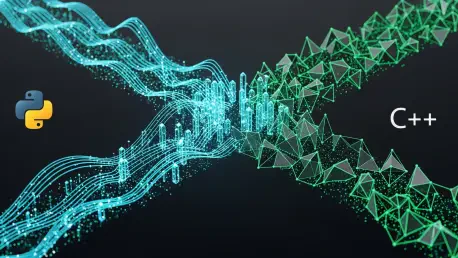

The friction between rapid Python prototyping and high-performance C++ deployment has long been the primary bottleneck in the artificial intelligence development lifecycle, costing engineering teams thousands of hours in code translation. For years, researchers favored Python for its flexibility and massive ecosystem of libraries like PyTorch and JAX, while systems engineers relied on the raw power of C++ to squeeze every millisecond of performance out of data center hardware. This dual-language dependency necessitated a cumbersome rewrite phase where experimental models were reconstructed from scratch to meet production latency requirements. NVIDIA CUDA 13.3 fundamentally alters this dynamic by introducing a more cohesive execution model that allows developers to maintain a single source of truth across both environments. By streamlining the interoperability between high-level logic and low-level acceleration, this update ensures that the leap from a local workstation to a global GPU cluster is no longer a disjointed or destructive process for modern software architects. This evolution represents a shift toward a more holistic view of AI infrastructure, where the language of choice no longer dictates the ceiling for performance or scalability. Developers now possess the tools to iterate quickly without fearing that their high-level designs will eventually fail under the weight of real-world production demands. This bridge between the abstract and the mechanical defines the next era of development.
Interoperability Protocols: Bridging Memory and Logic
This release focuses on eliminating the boilerplate code traditionally required to synchronize data structures across the language barrier, particularly through enhanced memory management protocols. In previous iterations, developers had to manually manage data migration between Pythonic objects and the raw pointers required by CUDA kernels, a process prone to subtle memory leaks and synchronization errors. CUDA 13.3 introduces a sophisticated virtual memory management system that allows Python-native structures to be mapped directly into the GPU address space with minimal overhead. This means that a data scientist working in a Jupyter notebook can now invoke complex, custom C++ kernels without the usual performance penalty associated with context switching or data serialization. This deep integration is particularly beneficial for generative AI applications where massive parameter counts require precise memory layout optimizations that were previously inaccessible to those working primarily in interpreted languages. Furthermore, the updated compiler toolchain now supports cross-language debugging, enabling developers to trace a single execution path from a Python script down into the low-level PTX code. This transparency is vital for identifying race conditions and memory access violations that typically occur when moving data between disparate runtime environments. By lowering these technical hurdles, the platform allows engineers to focus on refining their algorithms rather than fighting the limitations of their memory management strategy.
Beyond memory management, the unification effort extends to the execution API, which now supports a shared asynchronous task graph that coordinates workloads regardless of their origin language. This architectural shift allows for much more aggressive pipelining of operations, as the CPU-side Python interpreter no longer acts as a rigid gatekeeper for every GPU command. Instead, CUDA 13.3 leverages a unified scheduler that can interleave Python-driven inference calls with C++ pre-processing tasks in a way that maximizes overall hardware utilization. Engineers are finding that this reduces the tail latency often seen in complex multi-model pipelines, where a single slow Python call could previously stall an entire high-speed execution stream. The ability to define and optimize these task graphs in a language-agnostic manner represents a significant milestone in the evolution of heterogeneous computing. By treating the GPU as a first-class citizen for both languages simultaneously, the platform reduces the cognitive load on developers who formerly had to master two vastly different programming paradigms to ship a single product. This shift is already accelerating the deployment of real-time edge computing solutions where every microsecond of overhead matters. Ultimately, the shared execution model fosters a culture of collaboration between research and engineering, as both teams can now work within the same performance-optimized framework without compromising their specific needs.
Performance Optimization: Refined Just-in-Time Compilation
One of the most impactful features within this update is the refinement of Just-in-Time compilation techniques that bridge the performance gap between interpreted and compiled code. CUDA 13.3 introduces an enhanced NVRTC library that allows for more granular control over how kernels are specialized at runtime based on the specific data types and dimensions encountered in Python. This means that instead of relying on generic, pre-compiled kernels that might not be perfectly optimized for a specific neural network architecture, the system can generate highly tuned machine code on the fly. This capability is crucial for the latest generation of dynamic models that change their internal structure based on input data, such as sparsity-aware transformers or graph neural networks. By automating the specialization process, the runtime environment ensures that Python developers achieve a level of hardware efficiency that was once the exclusive domain of expert-level C++ optimization specialists. The compiler now also provides better feedback loops, offering suggestions on how to restructure Python code to better align with the underlying SIMT architecture of the hardware. This proactive approach to optimization shifts the focus from manual tuning to algorithmic innovation, which is essential as the complexity of AI models continues to scale. Moreover, the integration of these compilation tools into standard Python package managers has simplified the deployment process for cross-platform applications.
The transition toward a unified ecosystem in CUDA 13.3 provided a clear roadmap for organizations aiming to collapse the distance between research and deployment. Teams that adopted these new workflows reported a significant reduction in the time required to move from an initial hypothesis to a fully functional, high-performance service. Moving forward, the emphasis shifted toward maintaining this architectural simplicity by prioritizing codebases that leverage unified memory and shared task graphs from the outset. Strategic implementation involved auditing existing legacy translation layers and replacing them with the native interoperability features provided in the latest toolkit to eliminate technical debt. This transition required a disciplined approach to versioning and environment management, ensuring that both Python and C++ components remained synchronized throughout the continuous integration cycle. By standardizing on this cohesive framework, developers successfully mitigated the risks of performance regressions and significantly lowered the barrier to entry for high-performance computing. The industry learned that the true value of hardware acceleration lay not just in raw compute power, but in the accessibility and flexibility of the software layers that managed it. The successful deployment of these unified workflows ensured that the next generation of AI systems remained both highly performant and exceptionally maintainable. Organizations that embraced these standards positioned themselves to lead in a rapidly evolving technological landscape.