
Anand Naidu stands at the intersection of complex code and practical business application, serving as a resident development expert with a deep mastery of both frontend and backend architectures. With years of experience navigating the intricacies of coding languages and the evolving landscape of Enterprise Resource Planning, he offers a unique vantage point on how technology reshapes the physical world of commerce. As the hospitality industry grapples with razor-thin margins and increasing operational noise, his insights provide a roadmap for how unified systems can transform a chaotic kitchen or a sprawling global franchise into a streamlined, data-driven machine.
This conversation explores the fundamental shift from fragmented legacy systems to unified, AI-enhanced platforms that bridge the gap between financial reporting and daily floor operations. We delve into the mechanics of predictive inventory management, the role of real-time visibility in workforce productivity, and the strategic necessity of industry-specific ERP verticalization. By examining how global brands manage the pressures of multi-currency and multi-region expansion, the discussion highlights the critical balance between automated efficiency and the human element of the guest experience.
Fragmented back-office systems often lead to delayed insights and manual reconciliation across different departments. How does centralizing point-of-sale data with financial reporting change daily decision-making, and what specific manual hurdles are eliminated once a single source of truth is established?
The most immediate change is the elimination of the “data lag” that forces managers to make decisions based on what happened yesterday rather than what is happening right now. When you integrate point-of-sale systems like Oracle Simphony Cloud directly into your financial core, you remove the grueling hours spent on manual reconciliation, where staff often have to export CSV files and pray the numbers match up across different spreadsheets. This centralization establishes a single source of truth that allows a general manager to see their labor-to-sales ratio in real-time, preventing the common mistake of overstaffing a slow Tuesday afternoon. By automating these inputs, the system removes the human error inherent in manual data entry, which Alex Alt notes is essential when leaders are under immense pressure to drive efficiencies and do more with less. Ultimately, it shifts the manager’s role from a frustrated bookkeeper to a proactive leader who can spot a trend in the mid-day rush and adjust their strategy before the dinner shift even begins.
AI can now analyze historical demand patterns to optimize purchasing and reduce food waste. What are the practical steps for implementing these predictive insights, and how do operators balance automated inventory suggestions with the unpredictable nature of daily foot traffic?
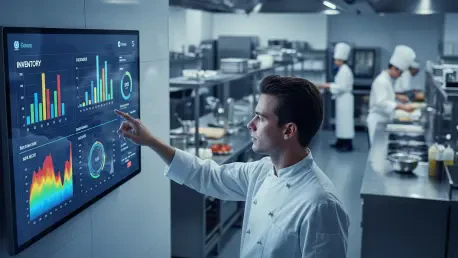
Implementing these insights begins with feeding the AI a clean diet of historical data, which the system then uses to identify subtle patterns that a human eye might miss, such as a 15% spike in avocado usage every third weekend of the month. The practical workflow involves the platform generating suggested purchase orders based on these anticipated needs, which drastically reduces the physical waste of perishable goods that would otherwise end up in the bin. To balance this with the inherent unpredictability of the hospitality world, the system serves as a highly intelligent co-pilot rather than an autopilot, providing the visibility needed to make fast, informed adjustments when a local event suddenly triples foot traffic. Brian Chess points out that by connecting operational and financial data, businesses gain the real-time visibility required to reduce complexity even in high-pressure environments. This synergy ensures that while the AI handles the bulk of the predictive heavy lifting, the operator still has the final word to account for local nuances or sudden market shifts.
Modern hospitality platforms integrate workforce management directly with core operational data. In what ways does this visibility improve employee productivity, and how can managers use real-time performance metrics to adjust staffing levels without sacrificing the guest experience?
Visibility acts as a catalyst for productivity because it highlights exactly where bottlenecks are forming, allowing managers to move resources to the “front lines” before a guest ever feels a delay in service. By streamlining repetitive administrative processes and utilizing an enhanced interface, the platform reduces the cognitive load on staff, letting them focus on the guest rather than struggling with a clunky backend system. Managers can look at real-time performance metrics across multiple locations and see that one site is struggling with order fulfillment times while another has excess capacity, enabling them to make instant staffing pivots. This level of insight ensures that the “exceptional customer experience” Alex Alt mentioned remains the priority, as labor is deployed precisely where it is needed most to maintain high service standards. It transforms workforce management from a static schedule on a wall into a dynamic, responsive strategy that evolves alongside the ebb and flow of the business day.
Scaling a restaurant brand globally involves managing multiple currencies, languages, and regional regulations. What infrastructure is necessary to maintain standard operations across international borders, and how do unified systems help franchises maintain agility while controlling costs in high-pressure environments?
To scale globally, you need a foundational infrastructure that is inherently flexible, capable of translating complex regional regulations and multiple currencies into a standardized reporting format that the home office can actually understand. A unified system like Oracle NetSuite Restaurant Operations provides this by offering a scalable foundation that supports various geographies while keeping the core business logic consistent across every continent. For a global franchise, this means they can roll out a new menu or a cost-saving initiative across five countries simultaneously without having to rebuild their tech stack for each local market. This infrastructure bridges the gap between high-level financial control and the gritty reality of local operational execution, which is an area where many expanding organizations historically struggle. By having a single platform handle the heavy lifting of compliance and localization, franchises can maintain their agility and pivot quickly to meet local tastes without losing their grip on global cost structures.
General-purpose platforms often struggle with the thin margins and high complexity of the hospitality sector. Why is the shift toward verticalized, industry-specific workflows necessary now, and what long-term competitive advantages do businesses gain by embedding AI directly into their operational layers?
The shift toward verticalized ERP is a response to the fact that a generic system simply doesn’t speak the “language” of a kitchen or a high-volume bar, often leading to friction that erodes already tight margins. Industry-specific workflows are designed to handle the high transaction volume and the unique inventory challenges of hospitality, such as tracking theoretical versus actual food costs down to the gram. By embedding AI directly into these operational layers, businesses gain a long-term competitive advantage because the system becomes more intelligent and tailored to their specific needs the longer they use it. This move toward integrated, intelligence-driven systems represents a fundamental evolution in how businesses compete, moving away from just “managing” data to actually “weaponizing” it for better performance. In an industry where a 1% shift in food or labor costs can be the difference between profit and loss, having a system that automates the mundane and highlights the critical is no longer a luxury—it is a survival requirement.
What is your forecast for the role of AI in restaurant operations?
My forecast is that AI will move from being an “extra feature” to becoming the invisible nervous system of the entire restaurant enterprise, where data, automation, and real-time insights define who wins the market. We are entering an era where the ability to unify disparate data sets and deliver actionable intelligence in an instant will be the primary factor in how brands scale and maintain their competitive edge. As AI continues to reshape enterprise software, it will eventually automate the most complex parts of the supply chain and labor forecasting so thoroughly that human managers will spend 100% of their time on innovation and the guest experience. The integration of these intelligence-driven systems is not just a trend; it is the new baseline for any hospitality business that intends to be around five or ten years from now.