
Anand Naidu is a seasoned development expert with a deep understanding of the intricate layers of frontend and backend systems. With the rise of agentic AI platforms like Dyna Software’s new Copilot, Anand offers a unique perspective on how automation is reshaping the developer’s role from a manual coder to a strategic orchestrator of business intent. His proficiency in various coding languages allows him to bridge the gap between traditional manual development and the new era of autonomous enterprise service management.
Technical bottlenecks often delay ServiceNow deployments because they require specialized expertise. How does shifting configuration upstream to natural language inputs change the developer’s daily role, and what specific steps ensure that business intent translates accurately into complex system logic?
The shift to natural language inputs effectively removes the “translation wall” that often stops a creative project in its tracks. Instead of spending weeks in back-and-forth emails to clarify a single workflow step, developers can now see the system interpret business intent in real-time. This changes our daily grind from writing repetitive boilerplate code to overseeing high-level architectural integrity and ensuring the system is robust. To ensure accuracy, the Platform Copilot interprets these requirements and generates complete configurations, allowing us to focus on the outcomes rather than the syntax. It feels like moving from being a bricklayer to an architect where you supervise the construction rather than laying every single stone yourself.
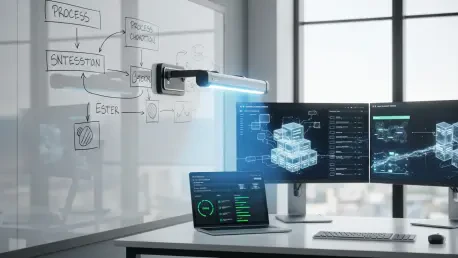
Organizations frequently use diagrams or whiteboard sessions to map out enterprise processes. How does the transition from an image-based input to a live system configuration actually function, and what safeguards are necessary to prevent logic errors during this automated translation?
Transitioning from a rough sketch on a whiteboard to a functioning ServiceNow instance is a massive leap forward for technical agility in the enterprise. The Platform Copilot uses image-based inputs to recognize the visual logic of a diagram and map it directly to system workflows and configurations. To prevent logic errors, the system doesn’t just “guess” the intent; it utilizes built-in safeguards and live previews so that human experts can validate the structure before it is applied. You can literally watch the business logic materialize on the screen, which provides a tangible sense of progress that static documentation never could. This automated translation ensures that the final configuration reflects the messy, creative brainstorming of a whiteboard session without losing any technical precision.
Increasing development speed often risks breaking existing data schemas or security protocols. How do features like live previews and automated testing maintain system integrity, and can you share an example of how audit tracking manages changes in these autonomous environments?
In a high-stakes enterprise environment, the fear of breaking a schema or violating a security protocol is a constant pressure for any development team. Dyna Software addresses this by embedding automated testing and live previews into the core of the configuration process, providing a “look before you leap” experience. We can see exactly how a change will ripple through the system before a single byte of data is permanently altered or moved. Audit tracking serves as our essential safety net, providing a clear, chronological record of every autonomous change, which is vital for maintaining strict governance. This level of transparency means that even as we accelerate delivery timelines, we aren’t flying blind or risking the integrity of sensitive company data.
Reducing development backlogs is a primary goal for enterprise leaders seeking faster time-to-value. What metrics indicate a successful shift from manual coding to AI-driven execution, and how should non-technical business users be trained to handle these direct configuration responsibilities?
Success in this new era isn’t just about how many lines of code are written, but about the drastic reduction in development backlogs and the overall speed of delivery. We look at metrics like time-to-value and the significant reduction in manual configuration hours to gauge if the AI-driven approach is actually delivering on its promise. Training non-technical business users involves shifting their mindset toward “outcome-based” descriptions rather than technical “how-to” steps. By giving these users the tools to generate production-ready configurations, we empower them to solve their own problems while maintaining a level of control and consistency that wasn’t possible before. It creates a sense of collaborative ownership that bridges the old, frustrating divide between “the business” and “IT.”
Consumption-based credit models are becoming a standard for scaling enterprise AI across various departments. How does this pricing structure influence project scoping during an initial rollout, and what technical preparations should teams prioritize before autonomous configuration tools become generally available?
Moving to a credit-based consumption model allows organizations to treat AI as a scalable utility rather than a massive, intimidating upfront capital expense. During the initial rollout, this pricing structure forces teams to be very intentional about project scoping, focusing on high-impact workflows that provide the most value first. Before these tools become generally available in the third quarter of 2026, technical teams need to prioritize cleaning up their existing data schemas and refining their governance frameworks. Preparing for autonomous configuration requires a rock-solid foundation; you want your system to be ready to handle the incredible speed that agentic AI brings to the table. It’s about building the runway now so that the platform can take off smoothly when it officially launches.
What is your forecast for agentic AI in enterprise service management?
I believe we are entering a phase where the term “manual configuration” will soon feel as dated as “dial-up internet” does today. My forecast for agentic AI in enterprise service management is that it will move from being a helpful assistant to becoming a foundational execution layer for all business processes. We will see systems that not only build workflows but also proactively adapt them based on changing business needs without needing a human to initiate every single change. This shift will redefine professional roles, turning ServiceNow partners and developers into transformation consultants who focus entirely on high-level innovation. The friction between a business idea and a live technical solution is going to evaporate, making enterprise software feel more like a living, breathing organism than a static tool.