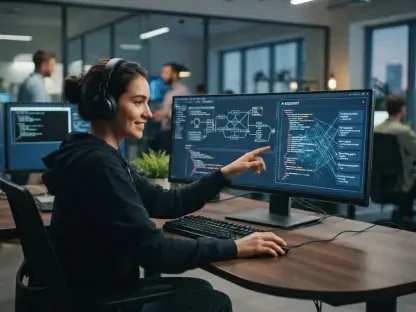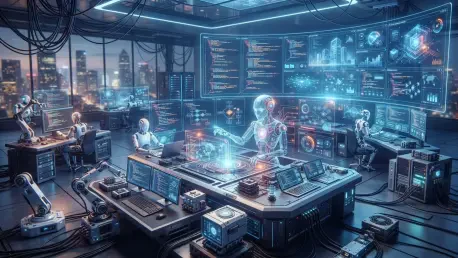

The rapid transition from simple code suggestion tools to autonomous engineering entities has permanently altered how software is conceived and maintained in the modern technical landscape. This shift signifies a departure from the era of basic language model wrappers toward integrated agentic systems that operate with a degree of situational awareness previously reserved for senior engineers. These agents do not merely suggest lines of text; they navigate full file systems, execute shell commands, and conduct multi-step reasoning to resolve architectural bottlenecks.
The Paradigm Shift in Software Engineering
Modern software development has moved beyond the “copilot” phase, where AI served as a sophisticated dictionary for syntax. Today, autonomous coding agents represent a fundamental change in workflow, acting as independent entities capable of performing complex reasoning across an entire repository. Unlike earlier iterations that relied on human prompting for every line, these agents use a recursive loop to read, write, test, and debug code within a terminal or integrated development environment.
The emergence of tools such as Claude Code and Cursor has established a new standard where the AI possesses direct agency over the execution environment. This transition allows the developer to step back from the granular mechanics of writing syntax and focus on high-level logic. By integrating directly with the file system and debugger, these agents have redefined the traditional role of a developer from a manual laborer of code to an overseer of automated production cycles.
Technical Foundations and Superior Performance Metrics
Cognitive Capacity and Massive Context Windows
One of the most profound technical advantages of modern agents is their ability to ingest and reason across millions of lines of code simultaneously. While a human developer possesses a limited cognitive load—often struggling to keep more than a few files in active memory—these agents maintain a persistent understanding of the entire codebase structure. This massive context window allows for the immediate identification of side effects that a human might overlook when modifying deeply nested dependencies.
This technical capacity effectively eliminates the “onboarding time” traditionally required for new team members. An agent can be introduced to a legacy codebase from decades ago and provide architectural insights or refactoring suggestions within minutes. By bypassing the weeks of documentation reading and manual exploration usually necessary for humans, these systems provide an immediate return on investment for complex enterprise projects.
Technical Breadth and Polyglot Proficiency
The versatility of coding agents extends across virtually all programming languages and frameworks, offering a level of polyglot proficiency that few humans can match. Whether a project requires transitioning a legacy backend to a modern stack or managing a complex cross-platform mobile deployment, the agent maintains consistent performance. This breadth of knowledge allows for seamless full-stack development without the friction of context-switching between specialized roles.
Such flexibility has significant implications for team composition and project agility. Organizations no longer need to halt progress while searching for niche specialists; instead, a generalist architect can utilize an agent to bridge the gap between different technical silos. This capability facilitates rapid migrations and the adoption of cutting-edge frameworks, as the agent can learn and implement new standards at the speed of data processing.
Operational Diligence and Scalability
A distinguishing feature of AI agents is the complete absence of ego, which ensures that repetitive and tedious tasks are handled with unwavering consistency. Humans often neglect unit testing, documentation, and dependency management due to the perceived boredom or lack of immediate reward associated with these tasks. Agents, however, approach these essential duties with a mechanical precision that prevents the accumulation of technical debt.
Furthermore, the concept of the “legion” allows a single lead architect to deploy multiple agents concurrently. This enables a scaling of output that was previously impossible without a massive increase in payroll. By running parallel agents to handle bug remediation, feature development, and security auditing simultaneously, a small team can produce the output of an entire department at a fraction of the traditional cost.
The Evolution of the Developer Persona
As these tools become ubiquitous, the identity of the software engineer is undergoing a radical transformation. The focus is shifting from the manual implementation of algorithms toward a role that resembles a conductor or a system architect. Proficiency is no longer measured by the speed of one’s typing or the memorization of library functions, but by the ability to direct autonomous agents toward the most efficient architectural solutions.
This shift has turned prompt engineering into a sophisticated form of high-level system design. Adopting these agents has moved from being a competitive advantage to a professional necessity for remaining relevant in the industry. As the barrier to entry for building complex software lowers, the value of a developer increasingly resides in their ability to govern the AI and validate its outputs against business requirements.
Real-World Applications and Industrial Impact
The industrial application of these agents is most visible in rapid prototyping and the modernization of aging infrastructure. Startups are now able to bring products to market in days rather than months, leveraging AI to handle the heavy lifting of boilerplate and infrastructure setup. In larger enterprises, agents are being used to automate the remediation of thousands of bugs that were previously logged and ignored due to resource constraints.
Beyond mere productivity, these systems are enhancing security through real-time patching and the automated generation of exhaustive test suites. In high-stakes environments, agents can proactively scan for vulnerabilities and implement fixes before they are exploited. This proactive stance on code quality is transforming how companies manage risk, making software more resilient by default rather than as an afterthought.
Navigating Challenges and Technical Constraints
Despite their capabilities, coding agents are not without significant challenges, most notably the risk of hallucinations. When an agent generates plausible-looking but functionally incorrect code, it requires a human-in-the-loop to identify the error before it enters production. Without diligent supervision, the speed of AI development can lead to a new form of technical debt where the codebase becomes too complex for the original human creators to understand.
Security and ethical concerns also persist, particularly regarding the handling of proprietary code and the impact on entry-level employment. There is a valid concern that by automating junior-level tasks, the industry may struggle to train the next generation of senior architects. Ongoing development is currently focused on improving the logical reasoning of these agents and creating more robust validation frameworks to ensure code safety and ownership.
The Future of Autonomous Development
The trajectory of this technology suggests a move toward even greater autonomy, where agents manage the entire software lifecycle. This includes everything from initial requirement gathering to deployment and post-launch maintenance without constant human intervention. Breakthroughs in multi-agent collaboration are expected to allow different AIs to debate architectural choices, leading to more optimized and secure software designs.
Such advancements will likely accelerate digital innovation across the global economy. As the cost of creating and maintaining software drops, industries that were previously limited by technical barriers will see a surge in digital transformation. This environment will prioritize the speed of ideation and the quality of strategic oversight over the mechanical process of coding.
Final Assessment: The End of Manual Coding?
The evidence gathered during this review indicated that AI-driven coding agents surpassed traditional manual methods in speed, consistency, and technical breadth. These systems proved that the mechanical act of writing code was no longer the primary bottleneck in software production. By handling the exhaustive details of syntax and testing, the technology allowed human intelligence to be applied to higher-level creative and strategic challenges.
The discipline of software creation entered its most productive era through this partnership between human intent and autonomous execution. While the traditional role of the manual coder began to fade, the demand for sophisticated architects who could orchestrate these agents grew significantly. Ultimately, the adoption of agentic workflows represented a necessary evolution that ensured the continued growth and security of the global digital infrastructure. Actionable steps for developers now involve mastering agent orchestration and focusing on architectural integrity to thrive in this new landscape.