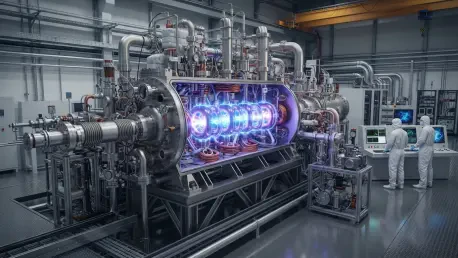

The sheer scale of modern particle accelerators is almost impossible to comprehend without witnessing the thousands of magnets and superconducting cavities that must operate in perfect harmony. These machines are the backbone of high-energy physics, yet their day-to-day operation is often hindered by the friction between low-level industrial controls and high-level scientific objectives. Managing millions of Process Variables within the Experimental Physics and Industrial Control System requires operators to navigate intricate interlock logic and granular hardware states. Historically, this has meant that highly trained physicists spend a disproportionate amount of their time troubleshooting hardware “plumbing” and deciphering cryptic naming conventions rather than focusing on the actual beam physics. This procedural burden was the catalyst for a collaborative effort to develop a new middle-layer framework that translates these complex signals into a more intuitive, human-readable format, effectively bridging the gap between engineering complexity and scientific research.
Streamlining System Architecture and Validation
Configuration Management: Decoupling Hardware From Logic
The reliance on YAML configuration files represents a fundamental shift in how accelerator parameters are managed and maintained over the long term. By using a human-readable format to define the relationship between hardware components and the control system, engineers can update the infrastructure without ever touching the underlying Python source code. This decoupling is essential for large-scale facilities where hardware names or network addresses might change during maintenance cycles, as it allows the high-level research applications to remain completely agnostic of these minor physical adjustments. This modularity ensures that the software environment remains stable and predictable, even as the physical machine undergoes significant upgrades or reconfigurations over a period of several years.
Beyond mere naming, this architecture allows for the centralisation of device metadata, such as physical location within the beam tunnel and specific functional categories. When a scientist needs to access a specific set of magnets, the system pulls the necessary information from these structured files rather than requiring a hard-coded list of variables. This approach significantly reduces the potential for human error and simplifies the onboarding process for new researchers who may not be familiar with the facility’s specific legacy naming schemes. By providing a clear roadmap of the machine’s hardware through simple text files, the framework turns a complex web of industrial data into an organized and accessible resource that serves the specific needs of the experimental community.
System Stability: The Role of Robust Data Validation
Ensuring the stability of a particle accelerator’s control system is paramount, as even a minor configuration error can lead to significant downtime or potential hardware damage. To mitigate these risks, the framework incorporates advanced validation tools that scrutinize configuration files the moment they are loaded into the system. By checking for missing fields, incorrect data types, or invalid range settings before the code ever interacts with the real-time control system, the platform effectively eliminates the “silent failures” that often plague complex industrial environments. This proactive approach to error handling gives operators the confidence to make changes to the system configuration, knowing that any logical inconsistencies will be flagged immediately with descriptive and actionable feedback.
In addition to static validation, the system introduces sophisticated data types that streamline how physicists interact with live stream data. For instance, the inclusion of statistical buffering allows researchers to automatically track the average, standard deviation, and history of a specific variable without having to write custom polling loops or timing logic. This is particularly useful in high-precision experiments where beam stability is the primary metric of success. Instead of manually collecting and processing thousands of individual data points, the operator can simply query the high-level object for a statistical summary. This shift from raw data acquisition to automated analysis allows for faster decision-making during active beam time, ensuring that the machine is always operating at its peak performance.
The Hierarchical Approach to Device Management
Operational Logic: Organising Hardware and Bulk Actions
The hierarchical structure of the framework is designed to mirror the physical and functional layout of the accelerator itself, starting with a base Hardware class. This layer is where the “tribal knowledge” of the facility is codified, embedding specific operational sequences—such as the exact steps required to degauss a magnet or safely ramp up a high-voltage supply—directly into the software. When an operator wants to activate a component, they no longer need to remember a dozen discrete steps or interlock checks; they simply call a standardized function, and the software handles the underlying complexity. This encapsulation of logic not only protects the machine from improper use but also ensures that best practices are followed consistently across all shifts and experimental runs.
Building upon this foundation, the system utilizes a Factory class to manage groups of similar devices, which is a game-changer for large-scale machine tuning. In a typical legacy environment, adjusting or disabling a whole sector of the accelerator would require a tedious manual process of iterating through individual process variables. With the new hierarchical approach, a scientist can issue a single command to the “Magnet Factory” to modify the entire group simultaneously. This capability for bulk operations is essential for efficient machine setup and rapid response to changing experimental requirements. It allows the team to move from a component-by-component mindset to a holistic view of the machine, where entire functional areas can be managed as single entities.
System Integration: Managing Disparate Components as Units
Modern accelerators often utilize complex sub-systems, such as photoinjector lasers or diagnostic stations, which consist of a wide variety of different hardware types. Previously, an operator might have had to open four or five different control screens just to manage the shutters, energy meters, and cameras associated with a single laser system. The framework addresses this by providing a unified interface that wraps these disparate devices into a single unit. This high-level abstraction allows the user to interact with the laser as a coherent system, rather than a collection of separate parts. By streamlining these interactions, the software reduces the cognitive load on the researcher, allowing them to focus on the physics of the electron source rather than the specifics of the hardware interface.
This unified approach also facilitates more complex automated routines, such as characterization scans that require the coordinated movement of multiple devices. Because the sub-system is treated as a single object, the automation scripts can be much simpler and more robust, as they don’t need to manage the low-level communication for every individual component. This has a direct impact on the productivity of the facility, as tasks that once took hours can now be completed in a fraction of the time with higher repeatability. By abstracting away the noise of the underlying control system, the framework provides a clean and powerful workspace that empowers scientists to push the boundaries of what is possible with their experimental hardware.
Advanced Tools for Safe Development and Deployment
Machine Protection: Utilizing Snapshots for State Recovery
One of the most practical tools introduced by this framework is the ability to take comprehensive snapshots of the machine’s state at any given moment. These snapshots capture not only the current set points and readbacks but also the metadata and statistical history of the devices involved. This functionality is invaluable for researchers who need to compare the performance of the accelerator across different shifts or restore a known-good configuration after a period of maintenance. Unlike simple save-and-restore tools of the past, this system respects the internal logic and safety constraints of the hardware when applying a snapshot. It ensures that sensitive components are in their correct states before adjustments are made, effectively preventing accidental damage during the restoration process.
This robust snapshot capability also supports long-term data analysis by providing a structured record of how the machine was configured during specific breakthroughs or successful runs. If a particular beam quality was achieved on a Tuesday, the team can easily pull up the snapshot from that day to analyze the exact settings of every magnet and cavity in the system. This historical context is vital for understanding the nuances of accelerator physics and for refining the models used to predict machine behavior. By turning the configuration of the accelerator into a searchable and restorable asset, the framework enhances the scientific rigor of the facility and provides a solid foundation for continuous improvement in machine performance.
Rapid Development: Virtualization and Container Technology
To ensure that new control scripts and applications are safe for use on the actual accelerator, the development team leveraged modern containerization to create a virtual accelerator environment. This allows a developer to run an identical copy of the facility’s control system on their personal laptop, complete with simulated hardware responses. By using Docker to mirror the production environment, the team can debug complex logic and test new features without ever needing to request valuable beam time on the physical machine. This sandbox environment has significantly accelerated the development cycle, as engineers can experiment with radical new ideas in a zero-risk setting, knowing that their code will perform exactly the same way when deployed to the real accelerator.
The transition from this virtual environment to the live machine was designed to be as seamless as possible, often requiring nothing more than a change in a configuration file. This “trivial” deployment process is a direct result of the abstraction layers that separate the application logic from the specific network protocols used by the hardware. As a result, the facility can adopt new software tools much more quickly than in the past, keeping the control system at the cutting edge of technology. This virtualization strategy also serves as a powerful training tool for new operators, who can practice controlling the machine in a simulated environment that perfectly mimics the behavior and interfaces of the real system, ensuring they are fully prepared before they ever touch the live controls.
Proving Scalability Across Global Facilities
Cross-Facility Success: Applications at CLARA and LCLS
The true test of any control framework is its ability to scale from small research labs to world-class national facilities, a feat that has been successfully demonstrated at both CLARA and LCLS. At the CLARA facility in the United Kingdom, the software was used to automate the characterization of the electron source, a task that involves the precise coordination of laser timing and magnet settings. By utilizing the high-level system abstractions, the team was able to significantly reduce the time required for these scans, allowing for more frequent and detailed measurements. This improved efficiency has led to a deeper understanding of the photoinjector’s performance, directly contributing to the success of the facility’s broader research mission.
In contrast, the deployment at the Linac Coherent Light Source at SLAC in the United States showcased the framework’s ability to handle the immense scale of a three-kilometer-long linear accelerator. With millions of process variables and hundreds of diagnostic stations, LCLS represents one of the most demanding control environments in the world. The framework successfully replaced legacy applications and automated the management of beam position monitors across the entire facility, demonstrating that its abstraction principles remain effective regardless of the machine’s size. Whether managing a compact research ring or a massive X-ray free-electron laser, the system provides a consistent and reliable interface that empowers operators to manage complexity with ease.
Sustaining Expertise: Code Generation and Tribal Knowledge
A significant challenge in long-term facility management is the preservation of specialized knowledge as personnel and hardware evolve over time. To address this, the developers utilized templating tools that allow for the automatic generation of boilerplate code based on site-specific requirements. This ensures that the core logic of the framework remains standardized across different facilities while allowing local engineers to bake their specific operational “secrets” directly into the software. By codifying how certain magnets behave or why specific delays are necessary into the generated classes, the facility ensures that this critical information is preserved and accessible to future generations of engineers and researchers.
This approach to code generation also makes the framework highly adaptable to different control protocols beyond the initial implementation. By simply updating the templates, the system can be configured to support other industry-standard protocols, ensuring that it remains relevant as the technological landscape changes. This flexibility is key to the long-term viability of the project, as it allows for a unified community of developers to contribute to a shared codebase while still meeting the unique needs of their individual facilities. By fostering this collaborative environment, the framework is helping to establish a new standard for accelerator control that prioritizes usability, scalability, and the continuous advancement of scientific discovery.
Advancing Collaborative Accelerator Operations
The implementation of CATAP has fundamentally altered the landscape of particle accelerator management by prioritizing the needs of the scientific user. By successfully abstracting the granular complexities of industrial control systems, the project allowed researchers to engage directly with the physical properties of the beam rather than the underlying software protocols. The integration of YAML-driven configurations and robust data validation protocols ensured that machine settings remained both flexible and secure, while the hierarchical organization of hardware simplified the daily tasks of large-scale facility operation. These advancements moved the field away from the traditional, component-heavy mindset and toward a more holistic, system-oriented approach that significantly improved experimental throughput.
Looking ahead, the community should continue to expand these abstraction layers to support an even broader range of hardware and control protocols across international borders. The success seen at facilities like CLARA and LCLS proved that a standardized middle layer can be adapted to almost any scale, provided that the underlying architecture remains modular and open-source. Future developments would likely benefit from integrating machine learning models directly into these hardware classes to automate complex tuning procedures further. By continuing to refine these tools and fostering a shared repository of operational logic, the global physics community ensured that its most powerful instruments remained as accessible and productive as possible for the next generation of scientific inquiry.