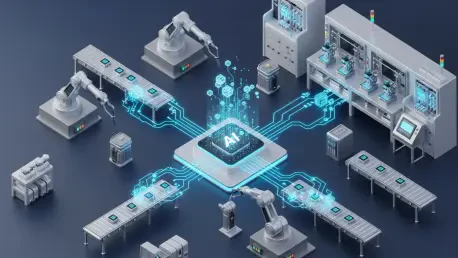

The rapid migration of complex machine learning workloads from centralized data centers to the periphery of the network has created an urgent demand for hardware solutions that simultaneously offer high throughput and extreme energy efficiency. Engineers currently face a significant bottleneck when attempting to port sophisticated neural networks onto hardware platforms that must operate within strict thermal and power envelopes. This challenge is particularly acute in industrial automation and automotive applications where latency is a critical factor and reliability cannot be compromised. Microchip has addressed these mounting pressures through the release of the VectorBlox 3.0 Software Development Kit, which specifically targets the optimization of artificial intelligence at the edge. By removing the traditional barriers associated with field-programmable gate array development, this new iteration provides a streamlined path for data scientists to leverage specialized hardware. This evolution ensures that sophisticated algorithms can run locally without the inherent delays of cloud connectivity or the excessive power drain often seen in general-purpose processors.
Streamlining Hardware Acceleration: Enhancing Neural Network Portability
Simplifying Transitions: Moving From Software to Silicon
One of the most significant hurdles in hardware-accelerated machine learning has been the steep learning curve associated with hardware description languages like Verilog or VHDL. The VectorBlox 3.0 SDK effectively eliminates this requirement by allowing developers to utilize familiar frameworks such as TensorFlow, PyTorch, and ONNX. This abstraction layer enables a seamless translation of pre-trained models into a format that the underlying FPGA hardware can execute with high efficiency. By providing a comprehensive set of libraries and conversion tools, the toolkit allows software engineers to treat the FPGA as a programmable accelerator rather than a complex logic fabric. This approach significantly reduces the time-to-market for new products, as the development cycle no longer requires specialized hardware teams to hand-tune every logic gate for a specific neural network architecture. Consequently, teams can focus on iterating their models and improving algorithmic accuracy while the SDK handles the intricate mapping of mathematical operations to the physical silicon resources available on the device.
Flexible Workloads: Managing Machine Learning via Bitstream Updates
Beyond simple model conversion, the latest update introduces enhanced capabilities for dynamic workload management through a bitstream-only approach to hardware acceleration. Traditionally, changing a machine learning model on an FPGA often required a complete redesign of the hardware configuration, which is a time-consuming and risky process for systems already deployed in the field. VectorBlox 3.0 permits developers to swap different neural networks or update existing ones without needing to modify the underlying FPGA bitstream itself. This flexibility is achieved by utilizing a pre-configured neural network processor core that is flexible enough to handle a variety of layer types and connectivity patterns. Such an architecture allows for field updates that are as simple as loading a new set of weights or a different network topology into memory, thereby extending the lifecycle of the hardware. This capability is essential for applications where the environment or the data characteristics evolve over time, requiring the AI system to adapt without undergoing expensive maintenance.
Optimizing Performance: Power Efficiency at the Edge
Energy Management: Maximizing Throughput in Constrained Environments
Efficiency in edge computing is not merely about execution speed; it is fundamentally about the performance-to-power ratio that determines the viability of a battery-operated or thermally constrained device. The PolarFire FPGA family, supported by this updated SDK, demonstrates a clear advantage over traditional system-on-chip solutions by offering significantly lower static and dynamic power consumption. When paired with the optimized instructions generated by the VectorBlox 3.0 environment, these chips can perform complex matrix multiplications and convolutions with a fraction of the energy required by alternative architectures. This efficiency is critical for modern smart cameras, portable medical diagnostic tools, and robotic sensors that must process high-resolution video streams in real-time while remaining within a narrow power budget. By maximizing the utilization of available logic elements and minimizing off-chip memory access, the toolkit ensures that the hardware remains cool and operational for longer durations. This specialized focus on architectural optimization allows organizations to deploy more intelligent features into smaller form factors.
Future Implementation: Scalable Solutions for Decentralized Intelligence
The successful integration of advanced software tools with highly efficient silicon paved the way for a more decentralized approach to industrial and consumer intelligence. Stakeholders who adopted these optimized development environments discovered that the transition to edge-based processing was far less daunting than previous generations of hardware had suggested. By leveraging the automated conversion and optimization features of the SDK, engineering teams moved rapidly from conceptual models to field-ready hardware implementations. This strategic shift highlighted the importance of choosing flexible hardware platforms that could adapt to the fast-moving pace of neural network research. Future considerations involved the consolidation of multiple AI tasks onto a single device, further reducing the total cost of ownership and the physical footprint of electronic assemblies. Organizations that prioritized this kind of scalable efficiency were better positioned to meet the rigorous demands of the market. The move toward standardized software interfaces for hardware acceleration effectively bridged the gap between high-level data science and low-level system design.