
The sudden collapse of predictability in enterprise AI budgets has forced a reckoning among chief technology officers who find themselves handcuffed to fluctuating token costs and proprietary black boxes. The Featherless GLM 5.2 Private Cloud enters this volatile market as a sophisticated rebuttal to the metered utility model, offering a self-contained ecosystem for high-stakes engineering. It represents more than a mere software update; it is a fundamental reconfiguration of how large-scale models are integrated into the modern corporate stack. By prioritizing open-source sovereignty and local control, this platform addresses the twin anxieties of data privacy and uncontrollable operational expenditures.
Evolution of Private AI Infrastructure: Introducing Featherless GLM 5.2
The transition from public API consumption to dedicated private infrastructure marks a maturing phase in the artificial intelligence lifecycle. In the early stages of the AI boom, corporations leaned heavily on tokenized services because they offered immediate access to frontier capabilities without the need for specialized hardware knowledge. However, as organizations moved from experimental prototypes to production-ready applications, the limitations of “black box” APIs became glaringly apparent. Concerns over data leakage, latency variability, and the lack of fine-grained control over model updates sparked a demand for localizable, high-performance alternatives.
Featherless emerged to bridge this gap by refining Z.ai’s underlying architecture and packaging it for enterprise deployment. This evolution centers on the premise that a company’s most valuable intellectual property should not be processed through third-party servers. The GLM 5.2 Private Cloud offers a managed environment where the model remains within the client’s jurisdictional boundaries, whether hosted in a secure European facility or a domestic American data center. This shift signifies the end of the “experimentation era” and the beginning of a period defined by industrial-grade, private AI assets.
Core Technical Pillars and Architectural Innovations
The Mixture-of-Experts (MoE) Architecture and Reasoning Capabilities
At the heart of the GLM 5.2 lies a massive 744-billion parameter model, yet its efficiency stems from a sophisticated Mixture-of-Experts design. By activating only 39 billion parameters per token, the system bypasses the “compute wall” that typically slows down dense models of similar scale. This selective activation allows for incredibly deep reasoning without the associated latency penalties, making it particularly effective for complex logic tasks. The architecture ensures that specialized sub-networks handle different types of queries, which refines the output quality in niche domains like advanced mathematics or structural engineering.
Native AMD Hardware Optimization: Breaking the Nvidia Monopoly
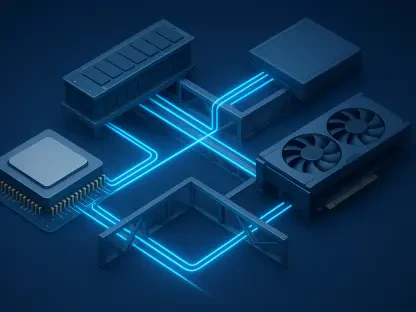
Perhaps the most significant technical achievement is the platform’s native optimization for AMD architecture. While the broader industry remains paralyzed by the supply chain bottlenecks of the Nvidia ecosystem, Featherless has successfully pivoted to utilize high-performance AMD chips. This transition involved deep-level kernel optimizations that allow the GLM 5.2 to run with comparable, and in some cases superior, efficiency to CUDA-reliant counterparts. By diversifying the hardware requirements, the platform provides enterprises with a viable path forward that does not depend on a single chip manufacturer’s production capacity.
Massive Context Windows and the IndexShare Mechanism
Managing large-scale data requires more than just raw processing power; it demands the ability to hold vast amounts of information in active memory. The GLM 5.2 supports a 1-million token context window, a feature that is further enhanced by the proprietary IndexShare mechanism. This technology optimizes how the model accesses and references data across long-form sessions, ensuring that context is not lost during exhaustive codebase analyses. For engineering teams working on monolithic software projects, this means the model can “see” the entire architecture at once, identifying cross-module dependencies that smaller context models would inevitably miss.
Economic Disruption: Transitioning from Metered Utilities to Fixed Infrastructure
The economic model introduced by Featherless serves as a direct challenge to the pay-per-token pricing that has dominated the industry. By implementing a $7,500 monthly flat-fee structure, the service replaces the anxiety of fluctuating usage bills with a predictable, static line item. For a development team processing 100 billion tokens a month, this transition represents a nearly 94% cost reduction compared to traditional frontier models. This financial predictability allows departments to scale their AI usage based on project needs rather than budgetary constraints, effectively decoupling innovation from incremental costs.
Real-World Applications in High-Stakes Engineering
In the field of software development, the GLM 5.2 has demonstrated exceptional utility through its performance on the SWE-bench Pro and FrontierSWE benchmarks. These tests evaluate a model’s ability to navigate real-world GitHub issues, fix bugs, and implement new features within complex codebases. The model’s jump to a 74.4 score on FrontierSWE highlights its capacity for autonomous problem-solving in high-pressure engineering environments. Rather than acting as a simple autocomplete tool, it functions as a junior developer capable of understanding the logical flow of an entire system.
Addressing Adoption Barriers and Security Considerations
Adopting such a robust system is not without its challenges, primarily the high initial financial barrier for early-stage startups and the technical shift away from Nvidia-centric workflows. However, these hurdles are balanced by the inclusion of a “no-logs” policy and the permissive MIT licensing model. This legal and ethical framework ensures that enterprises maintain full ownership of their data and the freedom to modify the stack as their needs evolve. By removing vendor lock-in, Featherless addresses the long-term risk of relying on proprietary providers who could alter terms or pricing at any moment.
The Future of Open-Source Sovereignty and AI Scalability
The trajectory of this technology points toward a future where large-scale compute is no longer the exclusive playground of a few trillion-dollar companies. As open-source models continue to close the performance gap with closed-source alternatives, the value shifts from the model itself to the infrastructure that hosts and optimizes it. We are seeing the early stages of a hardware-agnostic AI era where the software stack is resilient enough to run across varied silicon architectures. This democratization of power will likely lead to more specialized, localized AI clusters that serve specific industrial sectors without relying on centralized public clouds.
Final Assessment: Redefining the Enterprise AI Standard
The analysis of the Featherless GLM 5.2 rollout established that the era of unpredictable AI expenditures was effectively over for the enterprise sector. The transition to a flat-fee, private infrastructure provided a blueprint for organizations seeking to reclaim their digital sovereignty while maintaining access to frontier-level reasoning. Technical evaluations confirmed that the native AMD optimization successfully bypassed traditional supply chain constraints, offering a reliable alternative to the Nvidia-dominated landscape. This shift emphasized that the true value of AI in 2026 resided in the intersection of predictable budgeting and uncompromised data privacy.
Decision-makers should have prioritized an immediate audit of their current token consumption to identify where a fixed-fee private cloud could have yielded the highest return on investment. The successful deployment of the IndexShare mechanism and the massive context window proved that the platform was uniquely suited for heavy-duty engineering tasks that required deep architectural understanding. Ultimately, the Featherless GLM 5.2 did not just provide a better model; it provided a more sustainable way to do business in an AI-driven economy. Companies that moved toward this private infrastructure were better positioned to scale their operations without the constant threat of escalating costs or data exposure.