
The advent of ubiquitous machine learning in modern web development has reached a significant milestone with the official arrival of LiteRT.js for high-performance browser inference. Developers are increasingly moving away from cloud-reliant architectures toward local execution to ensure user privacy, minimize server expenses, and achieve the near-instantaneous response times expected in 2026. This library provides a sophisticated JavaScript interface for LiteRT, which was previously known as TensorFlow Lite, allowing for the direct execution of .tflite models within the browser environment. Unlike traditional web-based AI tools that often relied on JavaScript-based kernels which hindered speed, this solution leverages a native runtime compiled to WebAssembly. This approach allows web applications to benefit from the same high-level optimizations and hardware abstraction layers that were once reserved for mobile and desktop systems, creating a unified development experience across all platforms and hardware environments.
1. Hardware Acceleration: Backend Selection and Efficiency
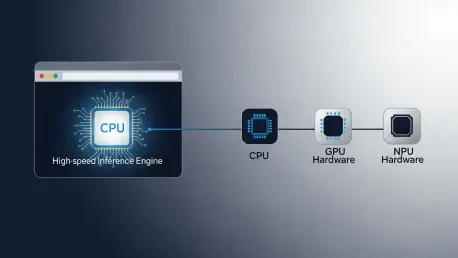
The library distinguishes itself through its versatile support for multiple backends, allowing developers to target various hardware components depending on the specific performance requirements. For standard deployments, the CPU remains the most compatible option, utilizing the XNNPACK library to facilitate high-speed, multi-threaded processing. This ensures that even devices without specialized graphics chips can handle complex neural network computations with reasonable efficiency. However, for more demanding visual tasks or large-scale data processing, the library utilizes the GPU through ML Drift via the WebGPU API. This provides a robust hardware-accelerated path that offloads the heavy mathematical lifting from the main processor, resulting in smoother frame rates and lower latency for interactive applications. By tapping into the local graphics hardware, the browser transforms into a powerful inference engine capable of running sophisticated models without external dependencies.
As silicon manufacturers continue to integrate dedicated AI hardware into consumer devices, the library has also introduced support for NPUs via the experimental WebNN API. This dedicated hardware path is designed specifically for the matrix multiplications central to deep learning, offering superior energy efficiency and throughput compared to traditional processors. To effectively utilize these advanced capabilities, developers must enable the JavaScript Promise Integration flag during the environment initialization phase. This specific configuration acts as a bridge between the synchronous nature of the execution environment and the asynchronous requirements of specialized hardware tasks. By prioritizing the NPU acceleration path within the model compilation settings, applications can achieve peak performance on the latest hardware. This strategic alignment with modern chip architecture ensures that web-based AI remains competitive with native implementations, allowing for more complex features to be deployed directly within a browser.
2. Implementation Workflow: Model Integration and Optimization
Integrating a pre-trained model into a web application requires a structured sequence of steps to ensure the runtime environment is properly configured. The process begins with the initialization of the LiteRT environment, where the developer must specify the correct paths to the necessary WebAssembly files to bootstrap the core runtime engine. Once the environment is active, the next phase involves preparing and building the model by uploading the .tflite file and selecting the desired hardware accelerator, such as Wasm, WebGPU, or the newer WebNN interface. After the model is loaded, the developer must define the input data by creating a new tensor that matches the specific dimensions and data types required by the architecture. This preparation is critical because the runtime expects precisely formatted data to avoid execution errors. This deliberate setup phase provides a high degree of control over how the browser interacts with the underlying system resources.
Executing the actual inference involves running the model processing and waiting for the hardware to generate the results. Because high-performance backends like the GPU and NPU operate in isolated memory spaces, the resulting data must be transferred back to the main processor. This movement of tensors from specialized hardware memory to CPU memory is essential for making the results readable and actionable within the standard JavaScript application logic. A unique aspect of this library is the requirement for manual resource management, which stands in contrast to the automatic garbage collection typically found in web development. To prevent severe memory leaks that could degrade system performance over time, every tensor used during the process must be explicitly deleted once its purpose is fulfilled. This manual control allows for highly optimized memory usage, which is especially important in resource-constrained mobile browser environments where efficiency is paramount for stability.
3. Model Management: Performance Validation and Comparison
Before committing to complex production code, developers must prioritize the validation of their models to ensure compatibility with the various hardware backends. This is achieved through a dedicated model-tester package that can be installed via standard package managers to automate the verification process. The automated test suite allows developers to run their models with random inputs across all available execution paths, ensuring that the results remain consistent whether the model is running on the CPU, GPU, or NPU. Furthermore, the tester provides insights into the model requirements by displaying expected input names and shapes. This diagnostic information is invaluable for troubleshooting data mismatches that often occur when porting models from different development environments. Having a robust testing phase reduces the likelihood of runtime failures and ensures that the AI features perform reliably across the wide diversity of user hardware.
While LiteRT.js is built for high-performance inference, developers coming from the PyTorch ecosystem have a clear path for migration using specialized conversion tools. The transition begins by using the torch.export.export method to generate a compatible version of the model, which is then processed by the LiteRT Torch tool to create a final .tflite file. To further enhance the efficiency of these models, the AI Edge Quantizer can be applied to shrink the file size and improve execution speed across different hardware layers. It is also important to distinguish this library from TensorFlow.js, as both serve different roles within the ecosystem. LiteRT.js is optimized for pure inference speed and cross-platform model consistency, whereas TensorFlow.js remains the preferred choice for in-browser training and complex pre-processing tasks. Developers can even utilize an interop package to share data between both libraries, allowing them to leverage the unique strengths of each system without incurring performance penalties.
4. Strategic Implementation: Future Hardware Compatibility
The technical community successfully adopted these high-performance standards to push the boundaries of what was possible within a standard browser window. Developers who prioritized local inference found that their applications were more resilient to network fluctuations and significantly cheaper to maintain at scale. The move toward explicit memory management and hardware-specific backends marked a shift in how web engineers approached resource allocation. This transition required a deeper understanding of hardware abstraction, but the results were evident in the deployment of more complex, real-time features that previously required native application wrappers. By leveraging the specific strengths of NPUs and the efficiency of WebAssembly, the industry established a new benchmark for browser-based intelligence. These advancements ensured that the web remained a first-class citizen in the world of machine learning, providing a robust platform for future innovation and highly interactive user experiences.
Looking ahead, organizations should prioritize the conversion of their existing model libraries into the .tflite format to take full advantage of these cross-platform optimizations. The integration of the model-tester utility into continuous deployment pipelines proved to be a vital step for maintaining performance across diverse hardware tiers. Teams that utilized the interop packages between LiteRT.js and TensorFlow.js effectively managed the balance between complex data manipulation and rapid execution. As hardware manufacturers continue to refine dedicated AI silicon, staying aligned with the WebNN and WebGPU specifications will be the primary method for maintaining a competitive edge. This proactive approach to hardware utilization allowed for the creation of sophisticated tools that functioned seamlessly regardless of the user’s device. The focus shifted from merely running models to optimizing the entire lifecycle of inference, ensuring that the next generation of web software remained both powerful and efficient for all users.