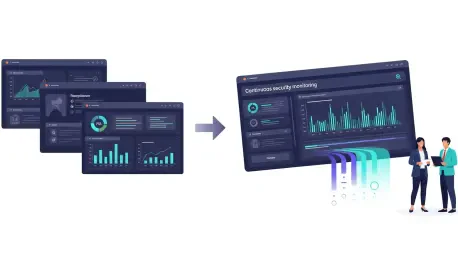

The persistent gap between theoretical security controls and actual system behavior often results in a dangerous illusion of safety that shatters during a modern audit or a sophisticated breach. Organizations frequently find themselves trapped in a cycle of reactive compliance, where teams scramble to collect screenshots and logs only when an auditor knocks on the door, leaving the business exposed during the long intervals between reviews. This fragmentation is not merely an administrative nuisance; it is a fundamental security risk that stems from managing SOC 2, ISO 27001, and NIST as isolated silos rather than as a single, cohesive infrastructure requirement. By the time a vulnerability is discovered in such a disconnected environment, it may have already been exploited, with the average time to identify and contain a breach stretching into several months. Moving toward a unified system allows an enterprise to bridge these visibility gaps, turning compliance from a periodic checklist into a continuous, data-driven security posture that scales alongside the infrastructure.
Effective unification requires a shift in perspective, moving away from document-heavy frameworks and toward a centralized control logic that satisfies multiple regulatory demands simultaneously. The structural overlap between the most common security standards is significant, yet many organizations continue to duplicate efforts by treating each requirement as a separate project. For instance, access control, incident response, and data encryption are core components of almost every framework, yet they are often audited and documented three different times by three different teams. This redundancy consumes hundreds of manual hours and introduces the risk of conflicting configurations across different parts of the network. A scalable system addresses this by establishing a single source of truth for every security control, ensuring that a verified implementation of MFA or an automated log review satisfies the requirements for SOC 2, ISO 27001, and NIST at the same time.
The Challenges: Complexity in Multi-Framework Environments
Operating within a multi-framework environment creates a compounding burden on engineering and security teams as the business grows. In the current landscape of 2026, global expansion and government contracting often necessitate simultaneous adherence to SOC 2 for trust, ISO 27001 for management systems, and NIST for rigorous risk controls. When these frameworks are managed manually, the effort required to maintain compliance grows linearly with every new regulation added to the stack. This leads to a phenomenon known as compliance fatigue, where teams spend more time documenting what they have done than actually hardening the environment against threats. Without a way to consolidate these requirements, the organization risks creating a “paper tiger” security posture that looks perfect in a report but fails to stop a real-world lateral movement attack within the network.
Fragmentation in these environments often reveals itself through inconsistent remediation efforts and duplicated workflows. If a vulnerability scanner identifies an unpatched server, a manual system might require that failure to be logged and tracked across three different compliance dashboards, each with its own severity rating and owner. This lack of synchronization creates a high probability that something will slip through the cracks, leading to “compliance drift” where systems slowly move away from their intended secure state. Furthermore, because different frameworks use slightly different terminology for the same underlying security principles, teams often find themselves arguing over definitions rather than fixing the technical issue. Solving this requires moving toward a structural alignment where the core security fundamentals are enforced once and mapped to the various framework-specific languages automatically.
The Limitations: Why Traditional Compliance Management Fails
Conventional compliance tools were largely designed for the era of static on-premise servers and annual audits, making them ill-equipped for the dynamic, cloud-native environments of 2026. These legacy systems typically rely on checklist-driven workflows that require humans to manually upload evidence, such as screenshots of firewall rules or exported lists of active users. This approach is fundamentally flawed because it only captures a single moment in time, providing no guarantee that the control remained effective five minutes after the evidence was collected. In a world where infrastructure is defined by code and changes occur thousands of times per day, a manual evidence collection process is effectively obsolete by the time the auditor reviews it. The reliance on human intervention also introduces significant room for error, as forgotten logs or mislabeled screenshots become the primary cause of audit failures.
Another major limitation of traditional management is the lack of a unified source of truth across the organization. Security policies often live in static PDF documents that are disconnected from the actual configuration of the production environment, creating a gap between “what we say we do” and “what we are actually doing.” When an incident occurs, the time wasted searching through disparate spreadsheets, emails, and isolated security tools to reconstruct an audit trail can be catastrophic. Traditional tools act as a record of history rather than a monitor of the present, which means they fail to provide the real-time visibility needed to prevent a breach before it occurs. To overcome these hurdles, organizations must transition to a platform that treats compliance as a byproduct of system activity, where every action taken within the infrastructure is automatically recorded, validated, and mapped to the relevant regulatory requirements.
Step 1: Establish a Standardized Control Framework
The first phase of building a scalable compliance platform involves deconstructing complex regulatory frameworks into their most basic logic components. Instead of starting with the framework’s high-level requirements, developers should identify the specific technical actions that satisfy multiple standards. For example, a requirement for “Logical Access” in SOC 2 and “User Access Management” in ISO 27001 can both be reduced to a single internal logic: “All users must authenticate via a centralized identity provider with multi-factor authentication enabled.” By creating a master library of these atomic controls, the organization establishes a foundational security language that is independent of any specific audit. This canonical control set acts as the translation layer between engineering reality and regulatory expectations, ensuring that when a developer implements a security feature, they are aware of exactly which compliance boxes are being checked.
Building this master library requires a rigorous mapping exercise that connects one internal security control to various framework-specific clauses. This “write once, map many” approach eliminates the need for redundant documentation and ensures that any update to an internal security policy automatically reflects across all relevant frameworks. Building on this foundation, the system must also account for the different levels of granularity required by standards like NIST compared to the broader principles of SOC 2. By defining controls at the most granular level possible, the platform can aggregate them to satisfy high-level requirements or provide deep technical proof where necessary. This standardization is the only way to prevent the system from collapsing under its own weight as the organization adopts new certifications or faces evolving regulatory scrutiny in a changing global market.
Step 2: Construct the Data Collection Infrastructure
Once the control framework is defined, the next critical step is establishing a robust data pipeline that connects directly with the source systems. In a modern enterprise, this involves creating secure, authenticated links to cloud providers like AWS or Azure, identity management platforms such as Okta, and various DevOps tools in the CI/CD pipeline. The goal is to move entirely away from manual evidence gathering by pulling raw configuration data, access logs, and system events directly through APIs. This infrastructure must be built to handle the high velocity of data generated by cloud-native services, ensuring that every change in a security group or an IAM role is captured in real time. Without this direct connectivity, the compliance platform remains a passive observer rather than an active participant in the security lifecycle.
Normalization is the second pillar of a successful data collection infrastructure, as data from different providers often arrives in disparate and incompatible formats. A log entry from a cloud-native firewall looks very different from an audit log generated by a container orchestration platform, yet both may contain evidence essential for a SOC 2 audit. The compliance platform must include a normalization layer that ingests these various data streams and converts them into a consistent, structured format that can be easily analyzed by the validation engine. This process ensures that the system can compare actual system states against the standardized control framework regardless of where the data originated. By building a reliable, automated pipeline, the organization ensures that its evidence is always fresh, accurate, and ready for inspection without requiring a single manual upload from the security team.
Step 3: Develop the Logic for Assessing Controls
The heart of an automated compliance platform is the validation engine, which translates abstract policy requirements into executable code and logic. This engine acts as the judge, constantly comparing the normalized data from the infrastructure against the predefined rules in the master control library. For instance, if the policy dictates that no database should be publicly accessible, the engine periodically scans the current state of the cloud environment to verify this configuration. If it detects a database with an open port, it immediately flags the control as “failed” and triggers an alert. This automated pass/fail evaluation replaces the traditional “sample-based” audit, where an auditor might only check five out of five hundred servers, with a 100% coverage model that monitors every single asset in the environment.
Developing this logic requires a deep understanding of both security best practices and the specific technical constraints of the underlying systems. The rules must be sophisticated enough to handle complex scenarios, such as temporary access grants for troubleshooting or specific exceptions for legacy systems, without generating a flood of false positives. Moreover, the evaluation engine should support different types of triggers, including scheduled polls for persistent configurations and event-based triggers for real-time changes. By automating the assessment process, the organization shifts the burden of proof from human memory to machine-driven certainty. This approach naturally leads to a more resilient security posture, as gaps are identified and flagged within seconds of occurring rather than months later during an annual review cycle.
Step 4: Execute Multi-Framework Alignment
With a functioning evaluation engine, the platform must then execute the complex task of aligning verified actions with specific regulatory demands. This is where the “one-to-many” mapping logic becomes operational, allowing a single verified security event to satisfy multiple auditors. For example, when the system confirms that a session was terminated after thirty minutes of inactivity, it should automatically update the compliance status for SOC 2 CC6.1, ISO 27001 A.9.4, and the relevant NIST AC family controls. This alignment must be dynamic; if a framework is updated or a new version is released, the platform should allow administrators to adjust the mappings without needing to re-engineer the underlying technical checks. This decoupling of technical validation from regulatory reporting is what gives the system its scalability.
The alignment process must also be transparent and verifiable to satisfy the scrutiny of external auditors who may be skeptical of automated systems. The platform should provide a clear “traceability matrix” that shows exactly how a specific piece of evidence from a specific server satisfies a specific framework requirement. This transparency bridges the gap between the high-level language of compliance and the low-level reality of engineering, allowing an auditor to drill down from a summary report into the raw system logs if necessary. By ensuring that one verified action satisfies several regulatory demands, the organization significantly reduces the time spent on “audit defense” and allows the security team to focus on proactive risk management. This streamlined alignment is the final piece of the puzzle that turns a collection of security tools into a unified compliance ecosystem.
Step 5: Create Live Tracking and Anomaly Identification
The transition from periodic reviews to continuous monitoring requires a sophisticated alerting and anomaly identification layer. In a unified system, compliance is not a static destination but a constant state of flux that must be tracked as it happens. Live tracking involves setting up real-time dashboards that reflect the current health of every security control across the entire organization. If an engineer accidentally disables encryption on a storage bucket or a new administrative user is created without MFA, the system must detect this “drift” immediately. By utilizing event streaming technologies like Kafka or native cloud event buses, the platform can catch these deviations within seconds, providing the security team with a window of opportunity to intervene before a vulnerability can be exploited by a malicious actor.
Beyond simple rule-based alerts, advanced anomaly identification can help uncover subtle risks that might not trigger a standard compliance check. For example, a sudden spike in access requests from an unusual geographic location or a series of failed login attempts followed by a successful one might not technically violate a specific SOC 2 control, but it indicates a significant security risk. The platform should be designed to correlate these events across different systems, providing a holistic view of the organization’s risk posture. This proactive identification of anomalies ensures that the system is not just checking boxes to satisfy an auditor but is actually identifying real-world threats to the business. Maintaining this high level of visibility is essential for ensuring that the unified compliance system remains effective in the face of an ever-changing threat landscape.
Step 6: Architect Resolution and Task Management Processes
Detection of a compliance failure is only half the battle; the platform must also provide a clear, automated path toward remediation. A scalable system should not exist in a vacuum but should be deeply integrated with the tools that the engineering and security teams already use, such as Jira, ServiceNow, or Slack. When a control failure is detected, the platform should automatically generate a ticket, assign it to the appropriate owner based on the asset involved, and attach the relevant evidence and remediation steps. This integration ensures that compliance issues are treated as high-priority bugs rather than administrative tasks that can be deferred until the next audit. By embedding compliance into the existing development workflow, the organization fosters a culture of shared responsibility for security across all departments.
The resolution architecture must also maintain a complete, immutable lifecycle for every issue identified by the system. This means tracking the issue from the moment of detection through the assignment, fix, validation, and ultimate closure. If a fix is implemented but fails to resolve the underlying problem, the system must be capable of re-opening the ticket and notifying the relevant stakeholders. This closed-loop process provides auditors with a permanent and verifiable trail of how the organization identifies and handles risks, which is a core requirement for both ISO 27001 and SOC 2. Building on this process, the system can also provide metrics on “mean time to remediate,” helping leadership identify bottlenecks in the security process and allocate resources where they are most needed to maintain the integrity of the environment.
Step 7: Formulate the Documentation and Review Module
The final layer of a unified compliance platform is the reporting module, which translates the technical data and remediation logs into the formal documentation required for an audit. Unlike traditional methods where reports are compiled manually over weeks of stressful work, an automated module should be able to generate framework-specific reports at the push of a button. These reports draw directly from the live data and the immutable audit trail, ensuring that they are always accurate and reflect the true state of the environment. For an auditor, this module acts as a self-service portal where they can view high-level compliance dashboards or dive into the technical details of a specific control, significantly reducing the amount of time the security team spends answering repetitive questions.
Effective documentation goes beyond just listing pass/fail statuses; it must provide the context and history necessary for a thorough review. The module should maintain historical snapshots of the environment, allowing an auditor to verify compliance for any given day during the audit period. It should also include a repository for non-automated evidence, such as signed policy documents or minutes from security committee meetings, so that all compliance-related materials are stored in one place. By providing a verifiable trail of all system activities and remediation efforts, the documentation module turns the audit process from a combative interrogation into a straightforward validation of the automated system. This move toward automated reporting is the ultimate realization of a scalable compliance strategy, allowing the business to grow and enter new markets without being held back by the weight of regulatory paperwork.
Essential Capabilities: Features of Modern Platforms
To remain effective in 2026, a compliance platform must possess specific capabilities that align with the high-speed nature of modern software delivery. Instant status tracking is the most visible of these, providing leadership with real-time dashboards that offer a “red-green” view of the global security posture across SOC 2, ISO, and NIST. This visibility allows executives to make informed decisions about risk and resource allocation without waiting for a quarterly report. Furthermore, the platform must utilize an interface-focused, API-first design to prevent information silos. By exposing its data through APIs, the compliance system can become a source of truth for other business units, such as procurement or legal, ensuring that everyone is working from the same set of security facts.
Integration with the development pipeline is another non-negotiable feature for a modern system, as it allows for the enforcement of standards before code even reaches production. By embedding compliance checks into the CI/CD process, organizations can block the deployment of non-compliant configurations, effectively “shifting left” on security and compliance. This capability is complemented by code-based policy management, where the security standards themselves are written in versioned code rather than static documents. Building on this, smart risk assessment logic can analyze the impact of different control failures, helping teams prioritize remediation efforts based on the actual threat to the business. These features ensure that the platform is not just an administrative tool but a fundamental component of the organization’s engineering excellence.
Security Essentials: Protecting the Compliance Platform
Since the compliance platform itself holds the keys to the organization’s security kingdom, it must be architected with the highest level of protection. Information classification is the starting point, ensuring that the sensitive logs and configurations stored within the platform are encrypted and handled according to their risk level. Access to the platform must be governed by strict, role-based permissions that follow the principle of least privilege. For instance, while an auditor may need read-only access to reports, only a handful of senior engineers should have the ability to modify the underlying control logic. By enforcing these boundaries, the organization protects the integrity of its compliance data and prevents the platform from becoming a target for internal or external actors.
Integrity is further maintained through the use of tamper-proof, immutable logs that record every action taken within the platform. If a user attempts to manually override a control failure or delete evidence of a breach, the system must create a permanent, chronological record of that action that cannot be altered. This ensures that the audit trail remains a reliable witness to the truth, which is essential for maintaining certifications like ISO 27001. Additionally, for organizations operating in multi-user or multi-tenant environments, logical isolation between different departments or clients is critical to prevent data leakage. By treating the compliance platform as a critical piece of infrastructure and applying the same rigorous NIST or SOC 2 standards to its own design, the organization ensures that its foundation for trust remains unshakable.
Frequent Errors: Common Pitfalls in Platform Development
One of the most frequent mistakes in developing a compliance platform is fragmenting the regulatory tracks and treating each framework as a completely separate project. This approach inevitably leads to a massive duplication of code and effort, making the system difficult to maintain as standards evolve. Instead of building a “SOC 2 tool” and an “ISO tool,” developers must focus on building a “control enforcement tool” that maps outward to the frameworks. Another common error is prioritizing the user interface over the core logic and data pipelines. While a beautiful dashboard is impressive to stakeholders, it is useless if the underlying data is inaccurate or relies on manual inputs. A successful build starts with the plumbing—the APIs and normalization layers—before moving to the visual presentation.
Underestimating the complexity of system connectivity also derails many development efforts, as the variety of data formats and API limitations across different cloud services can be overwhelming. Failing to account for these nuances often leads to brittle automation that breaks whenever a cloud provider updates their service. Furthermore, a platform that identifies issues without a clear workflow for remediation is effectively a “noise generator” that will eventually be ignored by the engineering team. Developers must ensure that every alert is actionable and tied to a specific owner and resolution process. Finally, building dashboards that still require manual data entry defeats the purpose of automation and creates a false sense of security. Avoiding these pitfalls requires a disciplined approach that prioritizes system-level integration and normalized control logic over superficial features.
Investment Decisions: Budgeting and Build vs. Buy
Determining the cost of a compliance platform depends heavily on the depth of integration and the number of frameworks the organization needs to cover. In 2026, a basic automation setup might start around $40,000, while a comprehensive enterprise-grade system that unifies SOC 2, ISO, and NIST across a global infrastructure can exceed $400,000. These costs are driven by the engineering hours required to build reliable data pipelines, the complexity of the “one-to-many” mapping logic, and the ongoing maintenance of the system as frameworks change. While the upfront investment may seem high, the long-term ROI is found in the hundreds of hours saved during audit preparation and the reduction in potential fines or lost revenue resulting from a failed compliance review or a data breach.
The “build vs. buy” decision is a critical crossroads for most leadership teams. Buying an off-the-shelf tool is often the best choice for smaller organizations that need to achieve their first certification quickly and have standard security requirements. However, for large enterprises with unique workflows, highly customized infrastructures, or a need for deep system-level integration, building a custom platform is often the more sustainable path. A custom build allows the organization to own the logic and the data, ensuring that the platform evolves perfectly in sync with the business’s specific needs. Regardless of the chosen path, the focus must remain on moving away from manual, checklist-driven compliance toward a scalable, automated system that treats security as a continuous and verifiable process.
Actionable Next Steps: Moving Toward Continuous Compliance
Building a unified compliance system is a strategic shift that requires moving from manual documentation to automated, system-driven enforcement. Organizations should begin by identifying the core technical controls that overlap across their current frameworks and establishing a single internal standard for each. Building on this foundation, the next step is to select a high-impact area, such as cloud configuration or identity management, and automate the data collection and validation for those specific controls. This incremental approach allows the team to prove the value of automation without the risk of a massive, all-or-nothing implementation. Over time, these automated “islands” can be connected into a unified platform that provides a holistic view of the organization’s entire compliance and security posture.
As the platform matures, leadership should focus on integrating compliance checks directly into the DevOps lifecycle to ensure that security is built-in rather than bolted-on. This transformation not only reduces the friction associated with annual audits but also fundamentally improves the organization’s ability to defend against evolving cyber threats. Future considerations should include the exploration of advanced logic to identify emerging risks and the expansion of the platform to cover new privacy regulations or industry-specific standards as they arise. By treating compliance as a scalable system rather than a series of one-off projects, an organization can transform a traditional cost center into a competitive advantage, proving to clients and partners that its commitment to security is verifiable, continuous, and built to last.