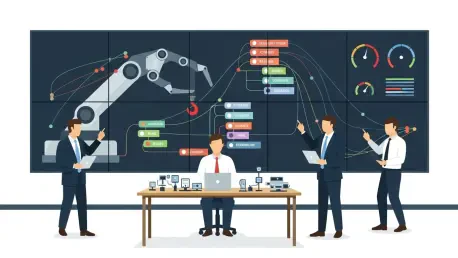

A chatbot can draft a 40‑page contract before the coffee cools, yet the same system still misreads a bumped mug wobbling toward the table’s edge and predicts the wrong fate once gravity, friction, and a surprised elbow come into play. The gap is not about literacy; it is about physics, causality, and what follows from an action when the world pushes back. That gap now defines the frontier.
The conversation around artificial intelligence has shifted from eloquence to embodiment. Language models still dominate headlines, but their blind spot becomes obvious the moment a task requires predicting how things move, collide, occlude, and persist over time. The new bet is that “world models”—systems that learn the dynamics of environments and use those dynamics to plan—can supply the missing common sense.
Why This Story Matters
The stakes are practical and immediate. Scaling large language models further brings soaring costs, thinner returns, and brittleness under distribution shift. In contrast, agents that can perceive, simulate, and act promise sturdier behavior in robotics, research, logistics, and policy—domains where a wrong assumption can spill chemicals, stall supply chains, or misprice risk.
Momentum inside labs and startups points in the same direction. Teams now fuse self-supervised perception with learned dynamics and decision-making, producing models that not only describe a scene but also anticipate what happens next and choose an action accordingly. If general intelligence requires understanding how cause leads to effect, then the shift from next-token prediction to world simulation looks less like a tweak and more like a paradigm change.
The Shift From Tokens to Worlds
LLMs excel at pattern completion. With retrieval and fine-tuning, they recall facts, summarize reports, translate jargon, and even sketch code that compiles. They can outline a long plan and critique it when asked, giving an impression of deep understanding. Yet their strengths rest on statistics over text, not on an internal grasp of objects, forces, or time.
This difference shows up under pressure. Ask for a plan that hinges on spatial constraints, partial observability, or long strings of contingent actions, and language systems often drift, contradict themselves, or hallucinate missing steps. These failures are not moral flaws; they are architectural. A mechanism optimized for token prediction does not natively encode three-dimensional geometry, causal interventions, or uncertainty evolving over time.
World models tackle these gaps head-on. Rather than guessing the next word, they learn compact states that summarize what matters in a scene, predict how those states change under actions and over time, and roll forward many possible futures before acting. The result is a system that treats planning as internal simulation, not as prose arrangement.
Inside a World Model
A modern world model follows a three-part recipe. First comes perception: encoders digest sensor streams—images, video, audio, proprioception—and distill them into latent states. These representations aim to strip away irrelevant details while preserving structure that supports prediction and control, such as object boundaries, poses, and contact cues.
Next comes prediction, or dynamics. A transition model evolves those latent states through time and under hypothetical actions, modeling uncertainty along the way. Stochastic dynamics capture branching futures; temporal abstractions let the model “skip” trivial frames to focus compute on meaningful changes. This is where counterfactuals live: if the robot nudges left instead of right, how do contacts and occlusions shift three seconds later?
Finally, planning closes the loop. Using the learned dynamics as a simulator, control algorithms evaluate many trajectories against a goal—minimum energy, fastest path, safest outcome—and select actions to execute. Techniques range from model predictive control and cross-entropy trajectory sampling to value gradients that backpropagate through the dynamics. Because the agent can rehearse internally, it learns more from fewer real-world trials.
How It Stacks Up Against LLMs
Training methods diverge first. World models lean on self-supervised learning from continuous sensor data and model-based reinforcement learning to identify latent variables that explain observations. LLMs, by contrast, largely scale next-token prediction with more text, images, and compute. The former optimizes for state and causality; the latter optimizes for sequence likelihood.
Grounding diverges next. World models encode space, motion, and interaction as first-class citizens. They represent object permanence, contact dynamics, and constraints like gravity or friction, even from partial views. LLMs can mimic physical intuition in scripted puzzles, but when asked to reason through occlusion or multi-object dynamics, they often stumble because their representations remain symbolic rather than embodied.
Planning ability offers the starkest contrast. With an internal simulator, a world model can evaluate thousands of action sequences before taking one step, pruning risky branches and hedging against uncertainty. Prompted planning inside a language model can be clever, but it remains brittle when outcomes hinge on unobserved state, real-time feedback, or strict physics. The output space underscores the difference: beyond text and 2D images, world models generate trajectories, controls, and multi-step, physically consistent sequences that can be executed in robots, games, or simulations.
Signals From the Field
A chorus of researchers has argued that perception, dynamics, and planning form the recipe for robust behavior. Yann LeCun has forecast that learned world models will supplant many LLM-centric applications, asserting that agents need predictive representations rather than surface-level correlations. Founders building physical AI echo the point: success comes from closing the loop between seeing, imagining, and doing.
Early systems reveal the curve. JEPA introduced objectives for learning abstract predictive representations, shifting focus from pixels to semantics that support control. PlaNet and DreamerV3 learned latent dynamics that enabled agents to plan in imagination and act with striking sample efficiency, with reports of order-of-magnitude gains over model-free baselines in benchmark tasks. These results did not claim perfection, but they showed the power of internal rehearsal.
Media generation is converging with physics. Genie 3 offered interactive environment generation; Marble and Oasis assembled editable 3D worlds from text, images, video, or layouts. Runway’s GWM‑1 and Luma’s Modify Video emphasized dynamics-aware video generation, improving consistency across frames. NVIDIA’s Cosmos 2.5 focused on video prediction that respects object and motion continuity, producing synthetic data for autonomous systems. Across these projects, the lesson is consistent: the closer the model gets to a coherent world, the more useful its outputs become for both storytelling and control.
Where the Payoff Shows Up
Interactive entertainment illustrates the leap from scenes to systems. Prompt-shaped worlds that remain playable—where characters keep balance, objects collide plausibly, and environments respond—demand dynamics, not just textures. Studios now prototype levels and mechanics by steering generators that obey constraints, then refine the results with human judgment.
Science and engineering use the same tools for different stakes. In materials discovery and biomedicine, researchers explore candidate designs by rolling forward simulated reactions or conformations in learned latent space, discarding dead ends before expensive lab work. Structural engineers test failure modes under varying loads, guiding sensor placement and inspection schedules. The aim is not pretty frames but fast feedback on hypotheses.
Decision support gains from scenario branching. Economic planning, climate risk, and infrastructure policy all involve interdependent variables over long horizons. World-model-style simulation makes it possible to test interventions under uncertainty, flag failure points, and quantify trade-offs. The output is not a prediction to believe blindly, but a map of plausible futures to stress-test choices.
The Hard Parts Still Ahead
None of this removes real challenges. Long-horizon rollouts can drift as small model errors accumulate; robust uncertainty calibration remains difficult; and integrating symbolic reasoning with continuous dynamics at scale is unsolved. Safety also demands guardrails: planners must respect constraints, defer under ambiguity, and recover gracefully from surprises.
Data strategy matters as much as architecture. Robots do not enjoy web-scale corpora; they need continuous, high-quality sensory streams. Synthetic, physics-grounded data helps, but the sim-to-real gap can bite when textures, contacts, or human behavior differ from training. Iterative loops—pretrain in simulation, fine-tune on hardware, refresh the model, repeat—have proven effective, yet they require disciplined evaluation under shift.
Finally, energy and cost count. Merely scaling models is not a plan. The appeal of world models is efficiency: learn more from each experience by reusing a learned simulator for many tasks. That promise holds only if teams invest in compact representations, selective computation, and planning algorithms that spend cycles where it changes outcomes.
What Can Be Done Now
Product leaders can triage portfolios by physics, causality, and horizon length. Wherever outcomes hinge on space, time, or counterfactuals—robotics workflows, operations planning, immersive creation—world-model pilots deserve priority. Language models still shine for interfaces and documentation, but the core loop should center on perception, dynamics, and control.
Researchers and engineers can build stacks that compound. Train self-supervised encoders on multi-view, multi-sensor data to form robust latents; learn stochastic transition models with calibrated uncertainty; and layer planners—MPC, trajectory sampling, or value gradients—that exploit those dynamics. Evaluate under occlusions, shifts, and long objectives, and track counterfactual accuracy alongside rewards.
Robotics teams can start with video-to-dynamics pretraining, then fine-tune with limited real interactions. Distill imagined rollouts into compact policies, deploy on hardware, and feed new traces back to the model. Creators can treat video and 3D generators as editable worlds, enforcing collisions and gravity during generation while prompts specify goals, not frame-by-frame outcomes. Governance should include physical-consistency audits, fail-safe thresholds, and energy tracking to ensure that smarter planning beats brute force.
Conclusion
The story ultimately drawn a line between eloquence and understanding, then followed the thread to systems that learned to perceive, predict, and plan. Evidence from labs, studios, and shop floors showed that internal simulation reduced trial-and-error, improved transfer, and made decisions sturdier under uncertainty. The next steps had been clear: pilot world-model cores where dynamics rule, pair them with language for human I/O, and hold them to standards that reward physical consistency and prudent control. With that playbook in hand, the shift from tokens to worlds no longer read like a slogan; it looked like a workable path to machines that behave with common sense.